

Pakistan Crypto Capital Gains Tax Calculator
Calculate your tax liability based on Pakistan's 15% capital gains tax rate. The tax applies to profits from selling cryptocurrency for Pakistani rupees (PKR) with an exemption threshold of ₨50,000.
Exemption applies: Your profit is below the ₨50,000 exemption threshold.
There’s a rumor going around that Pakistan is cutting its crypto capital gains tax from 15% to 0%. If you’ve seen that headline, you’re not alone. But here’s the truth: Pakistan has not and will not eliminate its 15% capital gains tax on cryptocurrency profits. That claim is false. What’s real is a clear, flat 15% tax on crypto gains - and it’s already in effect as of January 2025.
What the Law Actually Says
Under the Virtual Assets Ordinance passed in July 2025, Pakistan implemented a flat 15% Capital Gains Tax (CGT) on profits made from selling cryptocurrency for fiat currency - like Pakistani rupees. This applies whether you held Bitcoin for a week or two years. There’s no difference between short-term and long-term holdings. That’s different from countries like the U.S. or Germany, where holding crypto longer can lower or even eliminate your tax bill.The tax only kicks in when you cash out. If you buy Bitcoin at ₨2 million and sell it later for ₨3 million, you owe 15% on the ₨1 million profit. That’s ₨150,000. If you just hold it, trade between coins, or use crypto to buy goods, you don’t owe CGT yet - but other taxes might apply.
What Else Gets Taxed
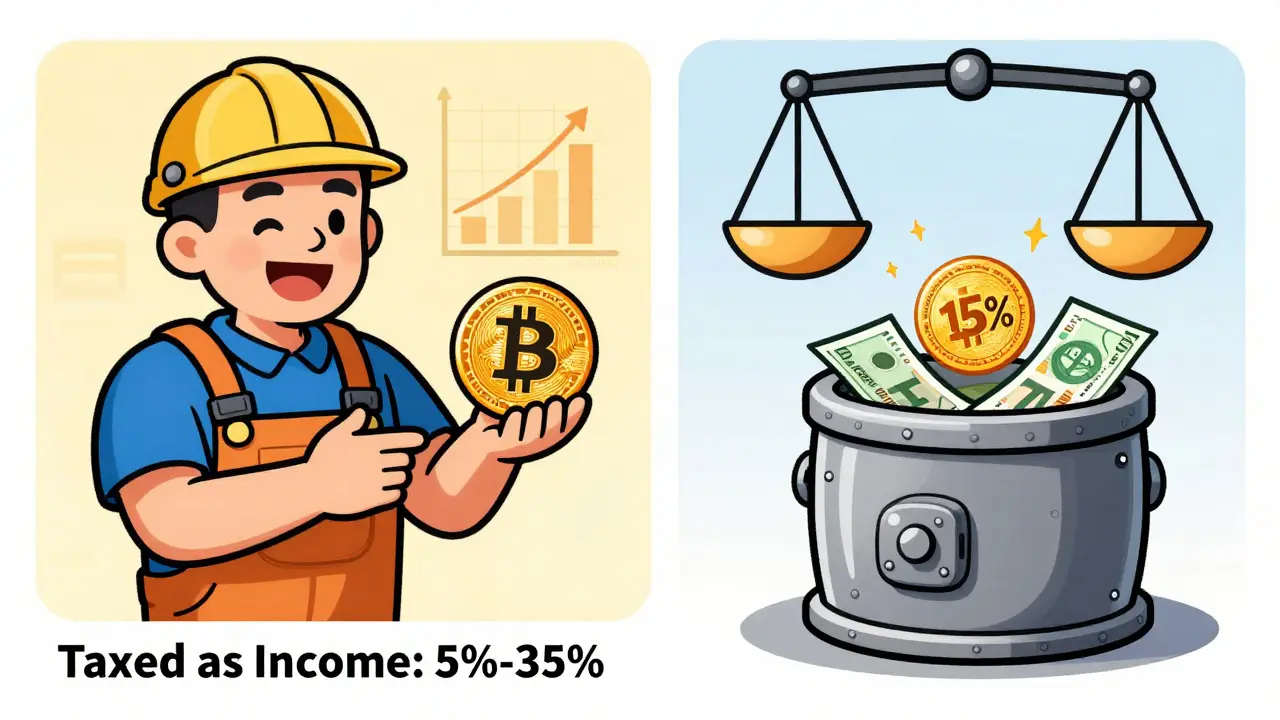
The 15% rate is just one piece of the puzzle. Other crypto income is taxed differently:- Mining and staking rewards: Treated as regular income. That means they’re taxed at Pakistan’s progressive rates - from 5% for income under ₨600,000 per year up to 35% for income over ₨12 million.
- Getting paid in crypto: If your employer pays you in Bitcoin or Ethereum, that’s taxable income at your regular salary tax rate.
- Businesses: Companies trading or mining crypto pay 29% corporate tax.
- Foreign conversions: If you send crypto profits to a foreign bank account, you might pay an extra 5% to 10% depending on the account type.
Importantly, there’s no GST or VAT on crypto transactions - yet. But regulators warn that could change. The only exemption is for small gains under ₨50,000. That sounds generous, but it’s one of the lowest thresholds in the region. In India, the exemption is ₹100,000. In Bangladesh, it’s BDT 50,000 - roughly the same, but with a much smaller economy.
Why the 0% Myth Keeps Spreading
You’ll find posts on Reddit, Telegram groups, and YouTube saying Pakistan is going 0% - and they’re usually quoting a misread article or a joke that got out of hand. Some people mix up Pakistan’s rules with places like Portugal (which eliminated crypto taxes in 2024) or the UAE (which has never taxed crypto). Others confuse the 15% CGT with the 0% tax on crypto in El Salvador, where Bitcoin is legal tender.There’s also confusion around the Pakistan Digital Assets Authority (PDAA), which was formed in May 2025 to oversee the market. The PDAA has been working on draft rules for long-term holding incentives - meaning they might lower taxes for people who hold crypto for over a year. But as of December 2025, those rules haven’t been approved. No official document says 0% is coming. Not from the Finance Ministry. Not from the Federal Board of Revenue (FBR). Not from the IMF, which actually helped design the 15% rate to prevent revenue loss.
How Tax Reporting Works
You’re required to file Form IT-1 by September 30 each year. All crypto exchanges operating in Pakistan - like Rain and Binance Pakistan - must now share your transaction data with the FBR starting mid-2025. That means the government knows what you bought, sold, and when.But here’s the catch: the FBR website still doesn’t have a dedicated crypto tax form. That forces users to manually track every trade, convert every purchase and sale into Pakistani rupees using exchange rates from the day of the transaction, and calculate gains manually. No official guidance exists on how to value crypto you bought before 2025. That’s a nightmare for people who’ve held Bitcoin since 2020.
Many traders are turning to tools like Koinly and CoinTracker - both now available in Pakistan since July 2025. These platforms connect to your wallets and exchanges, auto-calculate gains, and generate reports in the format the FBR expects. Over 28,000 Pakistani users have signed up as of October 2025, according to those platforms’ public reports.
What Traders Are Saying
On r/PakistanCrypto, users are split. One trader, 'KarachiTrader88', wrote: “The flat 15% is better than the 30% rumors we heard last year, but I wish they’d follow UAE’s model with 0% for long-term holdings.” That post got 142 upvotes.Another user, 'BlockchainLahore', said: “As a miner, I’m relieved they’re taxing mining income as regular income rather than applying the higher 35% bracket some feared.” That one got 89 upvotes.
But complaints are loud too. Over 63% of negative Trustpilot reviews on Pakistani exchanges mention confusion around DeFi yields - like earning interest on crypto loans or liquidity pools. How do you calculate the gain there? No one knows. And 78% of users say reconciliation between local exchanges and international ones like Binance is nearly impossible because they don’t use the same reporting formats.

How Pakistan Compares
Pakistan’s 15% flat rate sits in the middle globally:| Country | Capital Gains Tax Rate | Long-Term Discount? | Exemption Threshold |
|---|---|---|---|
| Pakistan | 15% flat | No | ₨50,000 |
| India | 30% + 1% TDS | No | ₹100,000 |
| United States | 0%-20% (based on income and holding period) | Yes (1+ year) | No |
| Germany | 0% after 1 year | Yes | No |
| Portugal | 0% | Yes (for individuals) | No |
| UAE | 0% | Yes | No |
| Bangladesh | 10% (proposed) | Not confirmed | BDT 50,000 |
Pakistan’s rate is lower than India’s punishing 30% and more predictable than the U.S.’s complex brackets. But it’s far from competitive with places like the UAE or Portugal that offer 0% for everyone. The lack of long-term incentives could push serious investors - the kind who bring capital, not just speculation - to other markets.
What’s Next?
The PDAA is working on draft rules for long-term holding discounts. Industry analysts at Deloitte Pakistan predict a tiered system could arrive in 2026 - maybe 10% for holdings over one year, 5% for over two. But nothing is guaranteed. The IMF, which helped design the current system, has warned that without clear rules on valuation and reporting, compliance will remain a mess.Meanwhile, the FBR is training 5,000 chartered accountants across 12 cities between November 2025 and January 2026. That’s a sign they’re serious about enforcement. If you’ve been ignoring your crypto taxes, now’s the time to get organized.
What You Should Do Right Now
If you trade crypto in Pakistan:- Track every transaction - buy, sell, swap, stake, earn. Use Koinly or CoinTracker if you can.
- Save your records - screenshots, transaction IDs, exchange statements. You’ll need them.
- Don’t assume 0% is coming - plan for 15% on profits. That’s the law today.
- Calculate your cost basis - if you bought crypto before 2025, estimate its value in PKR on January 1, 2025, and document how you got it.
- File Form IT-1 by September 30 - even if you think you owe nothing. Better safe than audited.
There’s no magic loophole. No hidden exemption. No surprise tax cut. The 15% rate is real. The 0% rumor is just noise. If you want to stay compliant - and avoid penalties - focus on what’s documented, not what’s whispered.
Is the 0% crypto tax in Pakistan real?
No, it’s not real. Pakistan has a flat 15% capital gains tax on cryptocurrency profits as of January 2025. There is no official plan, law, or announcement to reduce this rate to 0%. Claims of a 0% tax are based on misinformation or confusion with countries like the UAE or Portugal.
When did Pakistan start taxing crypto gains?
Pakistan officially started taxing cryptocurrency capital gains on January 1, 2025, under the Virtual Assets Ordinance passed in July 2024. The tax was formalized after recommendations from the IMF and the establishment of the Pakistan Digital Assets Authority (PDAA) in May 2025.
Do I pay tax if I just hold crypto?
No, you don’t owe capital gains tax just by holding crypto. The tax applies only when you sell crypto for fiat currency (like PKR) and make a profit. Trading between cryptocurrencies or using crypto to buy goods doesn’t trigger CGT - but other income taxes might apply.
What’s the exemption threshold for crypto gains in Pakistan?
Pakistan exempts capital gains under ₨50,000 per year. Any profit above that - even ₨50,001 - is fully taxable at 15%. This is one of the lowest thresholds in South Asia, and many experts say it captures casual traders who shouldn’t be in the tax net.
Do I need to report crypto mining income?
Yes. Mining, staking rewards, and crypto payments received as income are taxed as regular income under Pakistan’s progressive tax brackets - from 5% to 35%, depending on your total annual income. This is separate from the 15% capital gains tax.
Can I use Koinly or CoinTracker in Pakistan?
Yes. Both Koinly and CoinTracker are available and actively used by Pakistani crypto traders. They help track transactions, calculate gains, and generate reports compatible with Pakistan’s tax filing requirements. Over 28,000 Pakistani users have used these tools since July 2025.
Will Pakistan lower the crypto tax rate in 2026?
It’s possible, but not confirmed. The Pakistan Digital Assets Authority is drafting rules that could introduce lower rates for long-term holdings - for example, 10% after one year or 5% after two. However, these are still proposals. No law has been passed, and there’s no official timeline.
What happens if I don’t report my crypto gains?
Exchanges in Pakistan are now required to share your transaction data with the Federal Board of Revenue (FBR). If you don’t report gains and the FBR finds them, you’ll face penalties, interest, and possible legal action. The FBR is training 5,000 accountants to enforce compliance starting late 2025.
15% flat on crypto gains is actually pretty reasonable compared to India’s 30% plus TDS. At least it’s predictable. No need to track holding periods or jump through IRS-style hoops.
The real tragedy here isn’t the tax-it’s the lack of a clear cost-basis method for pre-2025 holdings. Imagine trying to reconstruct Bitcoin purchases from 2017 with no receipts, no screenshots, and no official exchange records. This isn’t taxation-it’s historical archaeology with penalties.
Hey everyone, I just want to say that even if you’re new to crypto or just dabbled a little, you’re not alone in feeling overwhelmed. The system is confusing, and the government hasn’t made it easy-but you’re doing better than you think. Start with one transaction, just one. Use Koinly. Save a screenshot. That’s enough for now. You’ve got this.
India’s 30% tax is brutal, but at least they have TDS built into exchanges. Here in Pakistan, you’re on your own. I’ve spent 40 hours this month just reconciling trades between Binance and Rain. No automated reporting. No API access. Just spreadsheets and prayer.
Of course it’s 15%. The IMF wrote this. They’ve been pushing this exact model on every developing economy since 2020. This isn’t about revenue-it’s about control. They want to track every crypto movement so they can freeze accounts later. Don’t be fooled by the ‘flat rate’ lie.
15% on gains is fine. The real issue is the ₨50,000 exemption. That’s below the poverty line in Karachi. You’re taxing people who made ₨60,000 profit over two years because they bought Bitcoin during the 2021 dip. That’s not tax policy. That’s punishment for being lucky.
THIS IS A TRAP. THEY’RE LURING YOU IN WITH A ‘LOW’ RATE SO YOU’LL TRADE MORE-THEN THEY’LL SLAP YOU WITH VAT NEXT YEAR. THEY’RE DOING THE SAME THING THEY DID WITH GASOLINE IN 2018. DON’T BE A FOOL.
Anyone else find it hilarious that the same people who scream ‘crypto is freedom’ are now begging for tax exemptions? You don’t get to have your decentralized cake and eat it with a government subsidy. Pay your 15% and stop whining.
I’ve been in crypto since 2015. I’ve seen countries go from zero to draconian. Pakistan’s approach? It’s not perfect, but it’s honest. They’re not pretending it’s not happening. They’re not banning it. They’re taxing it. That’s maturity. And yes, the exemption threshold is low-but it’s a start. Let’s build on it, not burn it down.
Just keep trading. Keep holding. Keep using Koinly. The tax is real, but so is the opportunity. Don’t let bureaucracy scare you off. This isn’t the end-it’s the beginning of something real.
Why are people even talking about this? The tax is 15%. Big deal. I made 200k last year and paid 30k. So what? I’m still way ahead. Stop complaining and do the math.
the 15% thing? yeah it’s real… but honestly? i think they’re gonna roll out long-term discounts soon. i’ve heard whispers from devs at the pdaa. they know this 50k threshold is killing small traders. it’s not about punishing people-it’s about growing the market. patience, friends. 🤍
Let’s be real. Pakistan’s tax system is a joke. You’re expected to calculate gains from 2020 using exchange rates from a website that doesn’t exist anymore. This isn’t regulation-it’s performance art for the IMF. The 15% is a distraction. The real tax is your sanity.
If you’re struggling with cost basis for pre-2025 holdings, try using the average price from January 1, 2025, across the top three Pakistani exchanges. It’s not perfect, but it’s defensible. Document everything-even your reasoning. The FBR may not be kind, but they’re not irrational. Show them you tried.
As someone who mines from Lahore, I’m glad mining income is treated as regular income. At least now I know where I stand. I used to worry they’d tax it as capital gains-now I just file under salary. Simple. Clean. No guesswork.
For anyone using Koinly: make sure you enable the ‘Pakistan FBR’ export template. It formats the report to match Form IT-1’s required fields. Also, use PKR as your base currency. Don’t default to USD-it will throw off your gain calculations by up to 18% due to exchange rate drift.
15%? More like 150%. They’re gonna audit you next year, then charge you for the audit, then charge you for the interest on the audit, then charge you for the lawyer you had to hire. Welcome to Pakistan 2.0.
They’re not taxing crypto. They’re taxing hope. You think you’re investing? You’re just handing your money to a bureaucracy that doesn’t even have a form for it. 😎
28k users on Koinly? That’s 0.1% of Pakistan’s population. The rest are either in cash or on Telegram groups pretending the tax doesn’t exist. This system is built to fail. The FBR knows it. They just want the paperwork to look good.
You don’t have to do this alone. If you’re stuck on how to calculate your gains, DM me. I’ve helped 37 people this month. No charge. Just send me your transaction history-I’ll walk you through it step by step.
they said the same thing about the internet in 1999… ‘it’s just a fad’… now look at us. crypto is the new oil. and they’re taxing it like it’s gasoline from 1973. we’re the future. they’re the past. and the past is always mad. 💔🔥
As someone who grew up in Karachi and now lives in LA, I can say this: Pakistan’s approach is actually more advanced than most African nations. They’re not banning it. They’re not ignoring it. They’re trying. That’s more than I can say for 12 other countries I’ve lived in.
Anyone who says ‘just use Koinly’ hasn’t tried to connect it to Binance Pakistan’s API. It doesn’t work. The platform exports CSVs with missing fields. You’re better off using Excel and crying.
That’s why the FBR needs to mandate API standards. No more CSV chaos. If exchanges can’t provide clean data, they shouldn’t be allowed to operate. This isn’t a tax issue-it’s a technical infrastructure failure.