
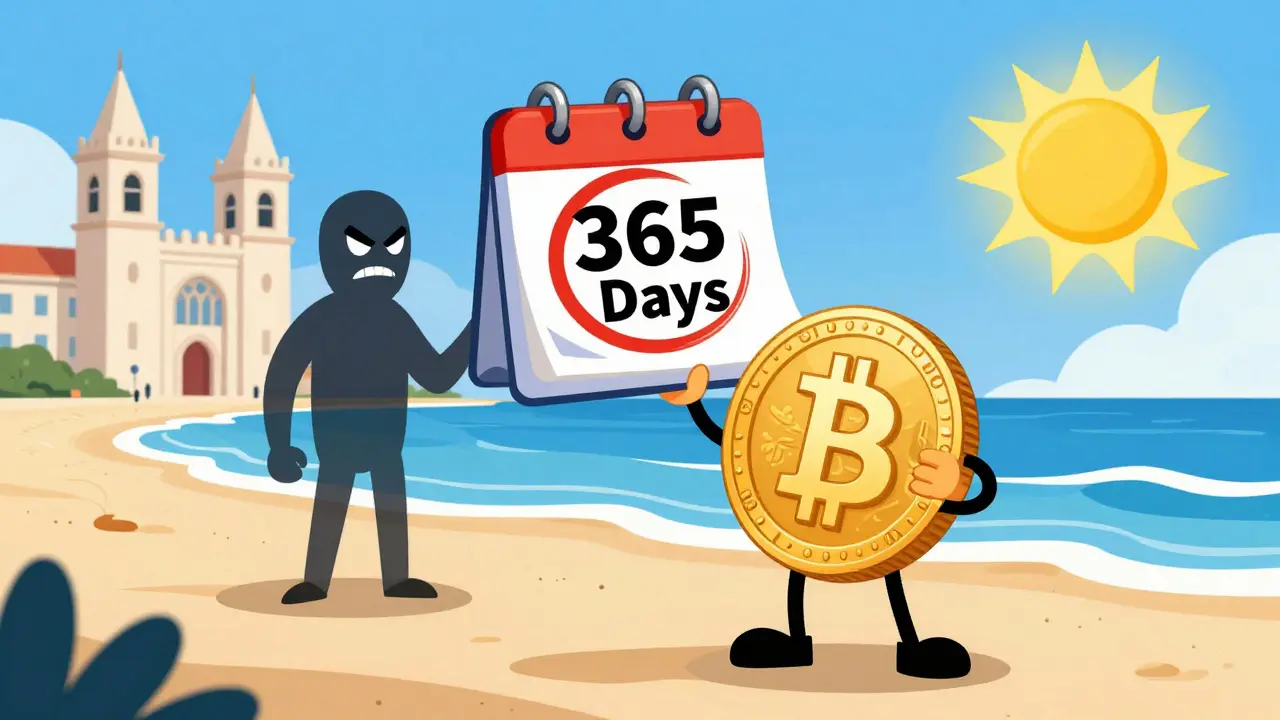
For years, Portugal was the golden ticket for crypto investors. You could buy Bitcoin, sell it a week later for a profit, and pay zero taxes on that gain. It felt like a loophole in paradise. But if you are looking at your portfolio today in 2026, those days are gone. The landscape shifted dramatically starting in 2023, introducing a flat 28% tax on short-term cryptocurrency gains.
This change didn't just tweak the rules; it fundamentally altered how you need to think about holding digital assets in Europe’s most popular sun-soaked destination. If you hold your crypto for less than a year, you pay up. If you wait longer, you might pay nothing at all. Understanding this split is the difference between keeping your profits and handing them over to the Portuguese tax authority, Autoridade Tributária e Aduaneira (AT).
The Core Rule: The 365-Day Threshold
The entire system hinges on one specific number: 365 days. This is the dividing line between being treated as a speculative trader and a long-term investor. When you dispose of any cryptocurrency-whether you swap it for Euros, trade it for another coin, or use it to buy goods-the clock starts ticking from the moment you acquired it.
If you sell a token three months after buying it, that profit is taxable. The rate is a flat 28%. There are no deductions for inflation, and there are no progressive brackets for this specific category unless you choose to aggregate it with other income (more on that strategy later). The calculation is straightforward:
- Acquisition Date: The day the transaction confirmed on the blockchain or settled on the exchange.
- Disposal Date: The day you sold, swapped, or spent the asset.
- Holding Period: If Disposal Date minus Acquisition Date is less than 365 days, the 28% tax applies.
Conversely, if you hold that same token for 366 days or more, the gain is completely exempt from tax. This exemption preserves Portugal’s appeal for "HODLers" and strategic investors who believe in the long-term value of blockchain technology rather than daily price fluctuations.
Choosing Your Tax Path: Flat Rate vs. Progressive Income
Here is where many investors make costly mistakes. You have a choice when filing your annual tax return. You can either accept the default 28% flat rate on your short-term crypto gains, or you can opt to include those gains in your total annual income. Why would you do that? Because if your marginal income tax rate is lower than 28%, aggregating your crypto gains with your salary or other business income could save you money.
Let’s look at the numbers. In 2024 and continuing into 2026, Portugal’s progressive income tax brackets start at 13.25% for income up to €7,703. If you are a student, a part-time worker, or someone with low overall income, adding your crypto gains to your taxable income might push you into the 18% or 23% bracket. Both are significantly cheaper than the 28% flat rate.
| Tax Option | Rate | Best For | Risk Factor |
|---|---|---|---|
| Flat Rate (Default) | 28% | High-income earners whose marginal rate exceeds 28% | None. Predictable cost. |
| Aggregated Income | 13.25% - 48% | Low-to-medium income earners | Pushing yourself into a higher bracket (e.g., 32.75% or 45%) |
However, be careful. If you already earn a high salary, say €60,000 a year, your marginal tax rate is likely around 43.5% or higher. Adding crypto gains to that income means those gains get taxed at that higher rate, not the lower base rates. In that scenario, sticking to the 28% flat rate is mathematically superior. Always run both calculations before submitting your Modelo 3 declaration.
Passive Income: Staking, Lending, and DeFi Rewards
Buying and holding isn't the only way people interact with crypto. Many users earn rewards through staking, lending protocols, or providing liquidity in decentralized finance (DeFi) pools. Under Portuguese law, these rewards are not considered capital gains. They are classified as passive income.
Surprisingly, this passive income also falls under the 28% flat tax regime, similar to short-term capital gains. Whether you earned interest from a centralized lending platform like Celsius (before its collapse) or native staking rewards from Cardano or Solana, the tax treatment remains consistent. You report these earnings in the year they are received, valued at their Euro equivalent on the date of receipt.
There is a nuance here for professional traders. If your crypto activities are deemed "professional"-meaning you trade frequently, use sophisticated strategies, and rely on this income as your primary livelihood-your profits are taxed as business income. Business income follows the progressive scale, ranging from 14.5% to 53% depending on your total revenue. Determining whether you are a private investor or a professional trader can be subjective, so maintaining detailed records of your trading volume and frequency is crucial.

Filing Requirements: The Paperwork Trail
You cannot ignore crypto gains in Portugal. The tax authorities require transparency. All reporting happens through the Portal das Finanças, the online portal for the Portuguese Tax Authority. You will primarily deal with three specific annexes attached to your main income tax return, Modelo 3.
- Anexo G: This is for capital gains. Here, you list every disposal of cryptocurrency. You must separate assets held for less than 365 days (taxable at 28%) from those held longer (exempt). You need to provide the acquisition date, disposal date, purchase price, and sale price in Euros.
- Anexo E: This covers passive income. Use this form to declare staking rewards, mining income, and lending interest. These are taxed at the flat 28% rate.
- Anexo B: Reserved for professional traders. If you classify yourself as a business, you report your net profit here, subject to progressive income tax and social security contributions.
The biggest challenge for most taxpayers is record-keeping. Exchanges often provide reports in USD or BTC, but Portugal requires values in Euros. You will need to calculate the Euro value of your holdings on the exact day of each transaction. Using specialized crypto tax software can automate this process, pulling API data from exchanges like Binance, Coinbase, or Kraken to generate the necessary reports.
The End of an Era: NHR Program Changes
If you moved to Portugal recently, you might have heard about the Non-Habitual Residence (NHR) program. For years, this was a massive draw for expats and digital nomads. NHR beneficiaries enjoyed a flat 20% tax rate on certain professions and exemptions on foreign-sourced income. For some, this meant crypto gains were taxed at 20% instead of 28%, or even exempt entirely if sourced outside Portugal.
However, the NHR program closed to new applicants in January 2024. If you established residency before that cutoff, you still enjoy those benefits for ten years. But for anyone arriving in 2025 or 2026, the standard tax rules apply. There is no special discount for new residents. This shift has made Portugal slightly less attractive for ultra-high-net-worth individuals seeking tax optimization, though it remains competitive compared to neighbors like France or Germany.

How Portugal Compares to Europe
Is 28% bad? Context matters. Let’s compare Portugal’s current regime with other major European jurisdictions.
- Germany: Taxes crypto gains as income if held for less than one year, at rates up to 45%. After one year, it’s tax-free. Similar structure to Portugal, but potentially higher peak rates.
- France: Applies a flat 30% tax (Prélèvement Forfaitaire Unique) on all crypto gains, regardless of holding period. No long-term exemption. Portugal’s 365-day rule makes it far more favorable for patient investors.
- United Kingdom: Treats crypto as property. Gains are subject to Capital Gains Tax (up to 20% for higher-rate taxpayers) or Income Tax (up to 45%) if deemed trading. No specific holding period exemption like Portugal’s.
- Spain: Taxes crypto gains as savings income at rates between 19% and 28%. While the lower end is cheaper, Spain lacks the complete long-term exemption that Portugal offers.
Portugal sits in a sweet spot. It penalizes short-term speculation moderately while rewarding long-term commitment with full tax freedom. This balance supports the local blockchain ecosystem without alienating serious investors.
Practical Tips for Optimizing Your Crypto Tax in Portugal
Navigating this system requires strategy. Here are actionable steps to minimize your liability legally.
1. Calendar Your Sales: Before selling any asset, check your acquisition date. If it’s within 360 days, ask yourself if you can wait five more days. That small delay moves your gain from taxable to tax-free.
2. Track Every Wallet: Don’t just track your exchange accounts. If you move funds to a hardware wallet like Ledger or Trezor, you must still record that transfer. Selling from a self-custody wallet is still a taxable event if the holding period is short.
3. Use FIFO or Specific Identification: When you sell multiple units of the same coin bought at different times, specify which units you are selling. Selling older units first (First-In, First-Out) can help maximize the portion of your sale that qualifies for the long-term exemption.
4. Consult a Local Expert: Tax laws evolve. The definition of "professional trader" is vague. Hiring a certified accountant in Portugal who specializes in crypto can prevent costly errors during audits. The cost of professional advice is usually deductible against your business income if you qualify as a professional trader.
Is crypto tax-free in Portugal in 2026?
Only if you hold the cryptocurrency for more than 365 days. Short-term gains (held less than a year) are taxed at a flat rate of 28%. Passive income like staking is also taxed at 28%.
Do I have to pay tax on crypto-to-crypto trades?
Yes. Swapping one cryptocurrency for another is considered a disposal event. If the original asset was held for less than 365 days, the gain from the swap is taxable at 28%.
Can I deduct losses from my crypto gains?
Yes. You can offset capital gains with capital losses incurred in the same tax year. If your losses exceed your gains, you may carry forward the unused loss deduction for up to five years.
What forms do I need to file for crypto taxes?
You must file Modelo 3 (annual income tax return) along with Anexo G for capital gains and Anexo E for passive income like staking rewards. Professional traders use Anexo B.
Does the NHR program still help with crypto taxes?
The NHR program closed to new applicants in January 2024. Existing beneficiaries retain their benefits for 10 years, but new residents face the standard 28% short-term tax rate.