

Imagine sending a postcard where everyone in the neighborhood can read your message. That is essentially how Bitcoin works. Sure, your name isn't on it, but your address and every transaction you've ever made are visible to anyone with an internet connection. For years, we thought this was enough anonymity. We were wrong. As cryptocurrency adoption has grown, so has the battle between those who want financial freedom and those who want to watch every move. This isn't just a tech debate; it's an arms race that determines whether your digital money belongs to you or the state.
The Myth of Bitcoin Anonymity
Let's be clear: Bitcoin is pseudonymous, not anonymous. There is a huge difference. If I know your Bitcoin address, I can see your entire financial history. Researchers have spent over a decade proving that these addresses aren't as private as they seem. They use techniques like clustering, where multiple addresses used by one person are grouped together because they interacted in a single transaction. It’s like noticing that three different people always buy groceries at the same time from the same store-eventually, you realize they live in the same house.
This lack of true privacy creates real-world problems. If you pay for coffee with Bitcoin, the merchant knows your balance. If you donate to a political cause, your wallet reveals your support. In countries with unstable governments, showing off wealth on a public ledger can make you a target. This vulnerability sparked the first wave of privacy technologies, designed to break the link between sender, receiver, and amount.
How Privacy Coins Fight Back
To fix Bitcoin's transparency issues, developers created privacy coins. These are cryptocurrencies specifically engineered to obscure transaction details. Unlike Bitcoin, where the ledger is open book, privacy coins use advanced cryptography to hide who sent what to whom and how much was sent. The most famous example is Monero. It uses three main tools: ring signatures, stealth addresses, and RingCT.
- Ring Signatures: These mix your transaction with others, making it impossible to tell which signature actually authorized the payment. It’s like shouting in a crowd; no one knows exactly who spoke.
- Stealth Addresses: Every time you receive funds, a new, unique address is generated. Your public identity stays hidden behind thousands of temporary aliases.
- Ring Confidential Transactions (RingCT): This hides the amount being transferred. Without it, observers could deduce identities based on exact amounts.
Then there is Zcash, which takes a different approach using zero-knowledge proofs. Specifically, it uses zk-SNARKs. This technology allows one party to prove to another that a statement is true without revealing any information beyond the validity of the statement itself. You can prove you have enough money to send a transaction without revealing your total balance or even the specific inputs you used. While Monero makes all transactions private by default, Zcash offers "shielded" transactions that users must opt into, creating a hybrid model that regulators often prefer.

The Rise of Blockchain Surveillance
If privacy tech is the shield, surveillance tech is the sword. Companies like Chainalysis, Elliptic, and CipherTrace have built billion-dollar businesses analyzing blockchain data. They don't just look at individual transactions; they map the entire economy of crypto. Their software uses machine learning to identify patterns that humans would miss.
These firms work closely with law enforcement agencies, including the FBI and IRS. When the US government seized billions in Bitcoin from the Silk Road marketplace, it wasn't luck. Analysts traced the flow of funds through hundreds of hops, using heuristics to guess which wallets belonged to exchanges, merchants, or individuals. They correlate timing-if two transactions happen milliseconds apart, they likely came from the same source. They also monitor off-ramps, tracking when crypto is converted back into fiat currency via banks.
The sophistication is staggering. Modern surveillance tools can now de-anonymize many "private" transactions if the user makes a mistake. For instance, if you use a privacy coin but then deposit it into a KYC-compliant exchange (Know Your Customer), the chain breaks. The exchange knows your identity, and the analyst links your private wallet to your bank account. The privacy ends where the regulation begins.
Regulatory Pressure and the Compliance Wall
The arms race isn't just technical; it's legal. Governments view complete anonymity with suspicion. The primary concern is money laundering and terrorism financing. If authorities can't trace funds, they argue they can't stop criminals. This led to strict regulations like the Travel Rule, which requires exchanges to share sender and receiver information for transactions above certain thresholds.
This pressure has forced major exchanges to delist privacy coins. In 2021, Binance and OKX removed Monero and Zcash from their European platforms due to regulatory uncertainty. The logic is simple: it's cheaper to ban a difficult-to-regulate asset than to build complex compliance systems for it. This creates a chilling effect. Even if you value privacy, you might not use it because you can't easily cash out.
| Feature | Bitcoin | Monero | Zcash |
|---|---|---|---|
| Transparency Level | High (Public Ledger) | Low (Default Private) | Variable (Opt-in Shielding) |
| Main Tech | ECDSA Signatures | Ring Signatures, Stealth Addresses | zk-SNARKs |
| Surveillance Difficulty | Easy (Clustering works well) | Hard (Requires statistical analysis) | Medium (Depends on usage) |
| Exchange Availability | Universal | Limited (Delisted in EU/US) | Moderate |
| Fungibility | Low (Coins can be blacklisted) | High (All coins equal) | Medium (Shielded coins preferred) |
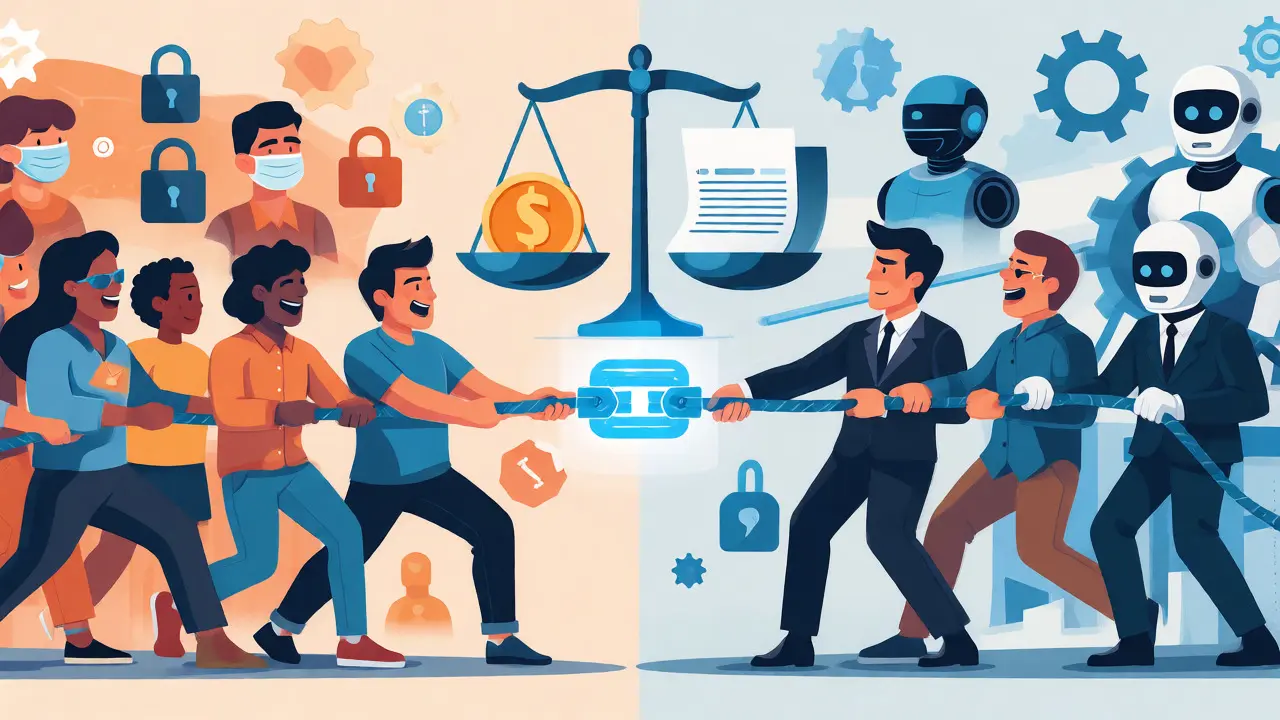
The Role of AI in the Tug-of-War
Artificial Intelligence has become the ultimate force multiplier in this conflict. On the surveillance side, AI models analyze vast datasets to detect anomalies. They can spot mixing services-tools that pool and redistribute coins to break trails-even if the underlying tech is strong. Machine learning algorithms learn the behavior of legitimate users versus bots or launderers, flagging suspicious clusters automatically.
On the privacy side, AI helps optimize transaction structures to resist analysis. Some newer protocols use AI to dynamically adjust parameters, making it harder for external observers to find statistical biases. However, this is a double-edged sword. As surveillance AI gets better at pattern recognition, privacy tech must evolve faster. It’s a feedback loop: better detection forces better obfuscation, which forces better detection.
What Does This Mean for Users?
For the average user, this arms race creates a dilemma. Do you prioritize convenience and accessibility, sticking with Bitcoin or Ethereum? Or do you prioritize sovereignty, accepting the hassle of lower liquidity and potential regulatory scrutiny by using Monero or Zcash?
There is no perfect answer. If you live in a stable democracy with strong property rights, the surveillance risk might be low. But if you live in a region with capital controls or political instability, privacy becomes a survival tool. Edward Snowden famously argued that privacy should be the default, not the exception. Making privacy hard to access effectively criminalizes it for those who need it most.
Looking ahead, the battle will shift to Layer 2 solutions and smart contracts. As DeFi grows, keeping business logic private while maintaining auditability is the next frontier. Zero-knowledge rollups are promising here, allowing transactions to be verified on-chain without revealing the underlying data. This could bridge the gap, offering both compliance-friendly proofs and user privacy.
Ultimately, technology alone won't resolve this. It requires societal consensus on what financial privacy means. Is it a right? A luxury? A threat? Until we answer that, the code will keep evolving, and the watchers will keep watching.
Is Bitcoin completely anonymous?
No, Bitcoin is pseudonymous. All transactions are recorded on a public ledger. If your identity is linked to your Bitcoin address (e.g., through an exchange KYC process), your entire transaction history becomes visible to anyone who analyzes the blockchain.
Why are exchanges delisting privacy coins like Monero?
Exchanges delist privacy coins primarily due to regulatory pressure. Governments worry that untraceable transactions facilitate money laundering and tax evasion. To comply with anti-money laundering (AML) laws, many exchanges choose to remove assets that are difficult to monitor rather than invest in specialized compliance infrastructure.
Can Chainalysis track Monero transactions?
Tracking Monero is significantly harder than Bitcoin but not impossible. Chainalysis and other firms use statistical methods and heuristic analysis to estimate probabilities. They can often identify flows between known entities (like exchanges) even if the exact path is obscured, especially if users accidentally leak metadata or use non-private features.
What is a zero-knowledge proof?
A zero-knowledge proof is a cryptographic method that allows one party to prove to another that a statement is true without revealing any information beyond the validity of the statement itself. In crypto, it lets you prove you have sufficient funds for a transaction without revealing your balance or the specific coins you spent.
Does using a mixer guarantee privacy?
Not necessarily. Mixers (or tumblers) pool coins from multiple users to break the direct link between input and output. However, sophisticated surveillance firms can sometimes deanonymize mixed coins by analyzing timing, amount patterns, and fee structures. Additionally, some jurisdictions consider mixer usage itself a red flag for compliance purposes.