

You’ve probably seen the flashy claims about SecretSky.finance or SSF. Promises of anonymous messaging on the blockchain paired with astronomical staking yields are hard to ignore. But before you connect your wallet or spend hours farming points for an alleged airdrop, we need to look at what is actually happening under the hood. The reality is starkly different from the hype.
The project markets itself as a decentralized communication platform that allows users to send stealth messages using only BEP-20 addresses, without needing email or phone verification. It sounds like a privacy utopia. However, when you dig into the tokenomics, the trading data, and the lack of official documentation, several major red flags appear. This guide breaks down everything you need to know about the potential SecretSky.finance campaign, why the numbers don’t add up, and how to protect yourself from potential rug pulls.
What Is SecretSky.finance?
SecretSky.finance is a proposed decentralized communication protocol operating on the BNB Smart Chain. Its core feature, known as SSF:Chat, claims to enable anonymous messaging between users via their wallet addresses. The platform promises advanced privacy features, including anti-screenshot modes and automatic message destruction after reading.
The project positions itself in the privacy-focused sector of the crypto market, similar to earlier attempts at decentralized messaging apps. Unlike Telegram or Signal, which rely on centralized servers, SecretSky.finance aims to use the blockchain for peer-to-peer communication. This theoretically removes single points of failure and enhances user anonymity.
However, "proposed" is the key word here. As of mid-2026, the actual applications referenced by the project are listed as "not yet available." Users are directed to a product timeline for launch information, but there is no functional mainnet application currently live for public use. You cannot test the chat features, verify the privacy claims, or experience the user interface. You are being asked to trust promises based on a website and a token contract.
The Token Distribution and Supply
To understand any potential airdrop, you must first understand the token economics. SecretSky.finance has established a total supply of 1 billion SSF tokens. The distribution model outlined by the project is as follows:
- 30% Presale: Allocated for presale availability through platforms like Unicrypt.
- 20% Liquidity Pool: Designated for the initial liquidity pool to enable trading.
- Remaining Allocation: The remaining 50% is typically reserved for development, team incentives, marketing, and potentially community rewards or airdrops, though specific percentages for these categories are not clearly detailed in public documents.
Here is where things get suspicious. Data from CoinMarketCap shows the current circulating supply of SSF as 0. This indicates one of two scenarios: either the token has not been distributed yet, or it is so illiquid and untracked that it registers as zero. Combined with a trading volume of $0 USD, this suggests the token lacks meaningful market adoption or active trading pairs.
If an airdrop were imminent, you would expect to see some pre-market activity, snapshot announcements, or clear eligibility criteria. Instead, the silence around concrete distribution timelines raises questions about whether an airdrop will ever materialize.
The Danger of Unsustainable Yields
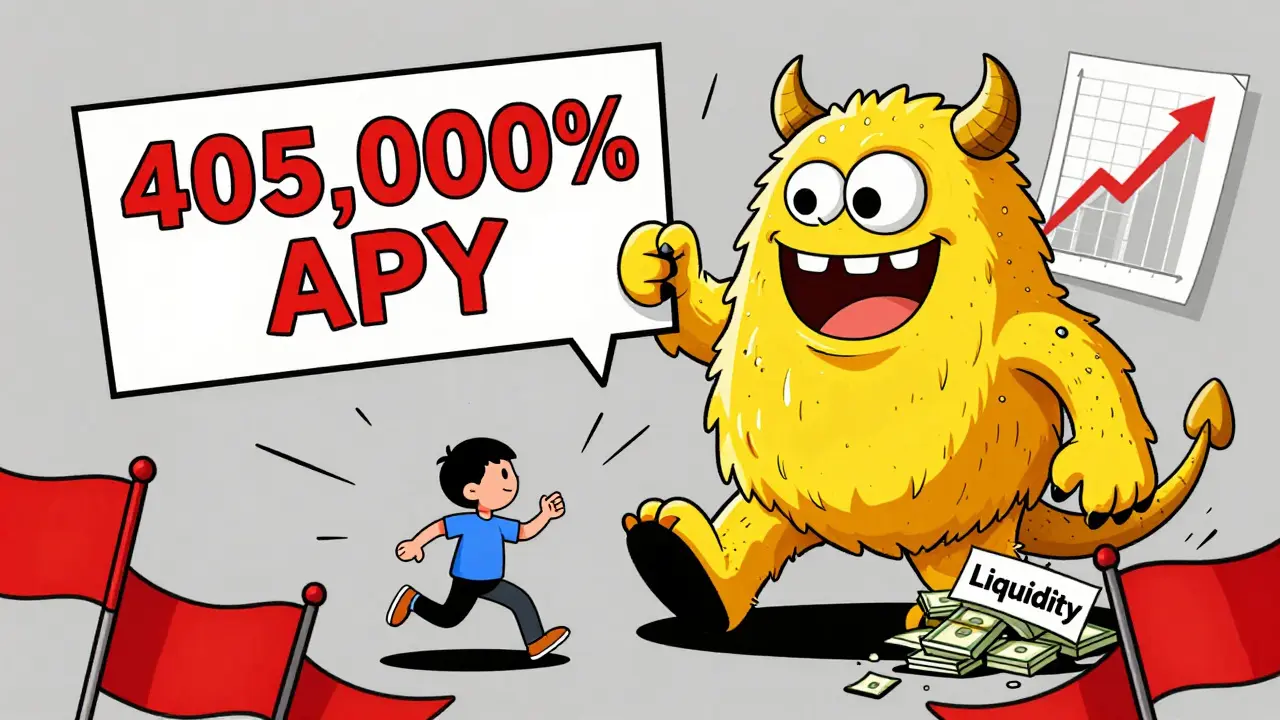
This is the most critical section for anyone considering interacting with SecretSky.finance. The project advertises staking rewards with an Annual Percentage Yield (APY) of 405,555.56% and a Daily Percentage Yield (DPY) of 1,111.11%.
Let’s put those numbers in perspective. If you staked $100 at this rate, you would theoretically earn over $400,000 in a year. In daily terms, you’d turn $100 into $1,111 every single day. No legitimate financial instrument-bank savings, bonds, stocks, or even mature cryptocurrencies like Bitcoin or Ethereum-offers returns anywhere near this magnitude.
| Asset / Platform | Typical APY Range | Risk Level |
|---|---|---|
| Ethereum (ETH) | 3% - 5% | Low |
| Solana (SOL) | 5% - 8% | Medium |
| High-Risk DeFi Protocols | 50% - 200% | High |
| SecretSky.finance (SSF) | 405,555.56% | Extreme / Scam Likely |
Such extreme yields are mathematically unsustainable. They usually indicate one of three things:
- Inflationary Tokenomics: The project is printing new tokens out of thin air to pay early stakers, diluting the value of existing holdings rapidly.
- Ponzi-like Structure: New investor funds are used to pay rewards to earlier participants. Once new money stops flowing in, the system collapses.
- Rug Pull Setup: Developers lure users in with fake high yields, then drain the liquidity pool once enough capital is locked.
In the context of an "airdrop," these high yields might be a bait mechanism. Projects sometimes offer massive rewards for early interaction to generate buzz and attract liquidity, only to abandon the project later. If you are connecting your wallet to stake SSF tokens, you are exposing your assets to significant smart contract risk.
Missing Documentation and Transparency
A legitimate cryptocurrency project provides comprehensive documentation. For SecretSky.finance, this information is severely lacking:
- No Whitepaper: There is no detailed technical whitepaper explaining the consensus mechanism, encryption standards, or node architecture for the messaging platform.
- No Audited Smart Contracts: Reputable projects undergo security audits by firms like CertiK, Hacken, or OpenZeppelin. No such audit reports are publicly linked or verified for SSF.
- Anonymous Team: The identities of the developers are not disclosed. While anonymity isn't always bad in crypto, it becomes a major red flag when combined with high-yield promises and zero transparency.
- Vague Roadmap: The product timeline is mentioned but lacks specific dates, milestones, or deliverables. "Refer to product timeline" is not a roadmap; it's a placeholder.
Without these elements, you have no way to verify if the technology works or if the team has the expertise to build it. You are essentially trusting strangers with your digital assets based on a website design.
How to Spot Fake Airdrop Campaigns
If you encounter social media posts claiming a "SecretSky.finance airdrop" is live, proceed with extreme caution. Here is how to distinguish between legitimate opportunities and scams:
- Check Official Channels: Only trust announcements from the official website or verified Twitter/Discord accounts. Look for blue checks or consistent history. Scammers often create fake websites with URLs slightly different from the original (e.g., secretsky-finance.com vs. secretsky.finance).
- Never Share Private Keys: Legitimate airdrops never ask for your private key or seed phrase. If a site asks for this to "claim" tokens, it is a scam designed to drain your wallet.
- Beware of Gas Fee Scams: Some fake airdrop sites ask you to pay a small gas fee to claim tokens. Once you pay, nothing happens. Real airdrops are free to claim.
- Verify Contract Addresses: Always copy the contract address directly from the official website and compare it with what is listed on trusted aggregators like CoinGecko or CoinMarketCap. For SSF, the contract address is cited as
0x6836...ab7ffaon BNB Smart Chain. Verify this matches exactly. - Analyze Community Sentiment: Search Reddit, Twitter, and crypto forums for discussions about the project. If everyone is only posting "to the moon" graphics and no one is asking technical questions, it’s likely a pump-and-dump scheme.

Current Market Status and Trading Activity
As of May 2026, the market status of SSF is concerning. CoinMarketCap lists the price at $0 USD with $0 24-hour trading volume. This indicates that there is no active secondary market for the token. Without liquidity, you cannot sell your tokens even if you receive them via an airdrop.
This lack of trading activity, combined with the limited documentation and questionable tokenomics, suggests that the project has not achieved meaningful market adoption. It may still be in its infancy, or it may have failed to gain traction due to the reasons outlined above.
If you decide to interact with the project, use a burner wallet-a separate wallet with minimal funds that you are willing to lose completely. Never use your primary wallet holding long-term investments.
Conclusion: Proceed With Extreme Caution
The SecretSky.finance campaign presents a classic case of high-risk crypto speculation. While the concept of anonymous blockchain messaging is appealing, the execution details raise serious doubts. The combination of zero circulating supply, $0 trading volume, missing audits, and astronomically high staking yields creates a profile typical of speculative or fraudulent projects.
There is no verified evidence of a legitimate, large-scale airdrop campaign currently underway. Any claims to the contrary should be treated as potential scams until proven otherwise by official, transparent documentation. Protect your capital by sticking to well-established protocols and avoiding promises that sound too good to be true.
Is there an official SecretSky.finance airdrop?
As of mid-2026, there is no verified official announcement of a widespread airdrop campaign for SSF tokens. The project lacks clear eligibility criteria, snapshot dates, or distribution timelines. Be wary of third-party sites claiming to offer free SSF tokens, as they are likely phishing scams.
Why is the SSF staking APY so high?
The advertised APY of over 400,000% is mathematically unsustainable for a legitimate investment. It likely indicates an inflationary token model where new tokens are printed to pay rewards, or it serves as a lure to attract liquidity for a potential rug pull. Such yields are common in high-risk or fraudulent crypto projects.
What is the total supply of SSF tokens?
The total supply of SecretSky.finance (SSF) tokens is 1 billion. According to the project's distribution plan, 30% was allocated for presale and 20% for the initial liquidity pool. However, CoinMarketCap currently lists the circulating supply as 0, indicating low or non-existent market activity.
Is SecretSky.finance safe to use?
Safety cannot be guaranteed. The project lacks audited smart contracts, a transparent team, and a functional mainnet application. The extremely high staking yields and lack of trading volume are significant red flags. If you choose to interact with SSF, use a burner wallet with funds you can afford to lose entirely.
How can I verify if an SSF airdrop is real?
Only trust information from the official SecretSky.finance website and verified social media channels. Never share your private keys or seed phrases. Check the contract address against reputable aggregators like CoinGecko. If a site asks for payment to claim an airdrop, it is a scam.