
Imagine updating your phone’s operating system. Usually, you hit a button, wait for the download, and restart. But in the world of blockchain a decentralized digital ledger that records transactions across many computers so that any involved transaction cannot be altered retroactively, an update isn’t just a software patch. It’s a vote by thousands of independent servers worldwide. If they don’t agree on the new rules, the network can split into two separate chains. This is why understanding how networks evolve without breaking is critical.
This is where soft fork backward compatibility a protocol upgrade mechanism where new rules are stricter than old ones, allowing older nodes to still validate blocks created by newer nodes comes into play. It allows a blockchain to add features or fix bugs while keeping everyone connected. You don’t need to force every user to upgrade immediately. Instead, the network evolves gradually. Let’s break down exactly how this works, why it matters, and what happens when things go right-or wrong.
The Core Concept: Stricter Rules, Same Chain
To understand soft forks, you first need to grasp the idea of rule sets. A blockchain is essentially a list of rules that define what makes a block valid. Does it have the right hash? Is the signature correct? Are the inputs unspent?
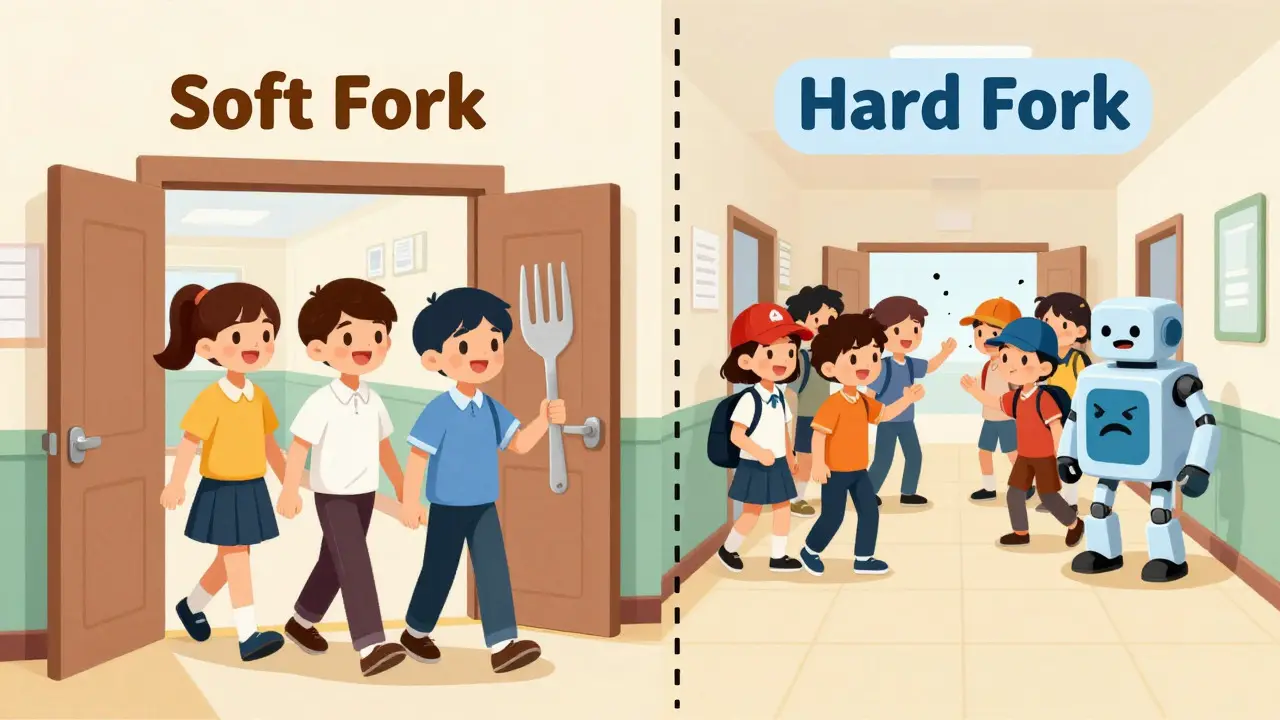
A soft fork introduces new rules that are a subset of the old rules. Think of it like a school changing its dress code. The old rule was "wear clothes." The new rule is "wear clothes with collars." Anyone wearing a shirt with a collar satisfies both the old and new rules. However, someone wearing a t-shirt (valid under the old rule) would now be invalid under the new rule.
In technical terms, this means:
- New Nodes: Run the updated software. They enforce the stricter rules. They accept only blocks that meet the new criteria.
- Old Nodes: Run the legacy software. They see the new blocks as valid because the new blocks also satisfy the original, looser rules.
This creates backward compatibility the ability of a system to work with data or programs created for an older version of that system. The old nodes don’t know the rules have tightened; they just see valid transactions passing through. The network stays unified because the "truth" defined by the miners (who create the blocks) is accepted by everyone, even those who haven’t upgraded.
Soft Fork vs. Hard Fork: Why One Splits and the Other Doesn’t
The biggest risk in blockchain upgrades is fragmentation. This is where comparing soft forks to hard forks a non-backward-compatible upgrade that splits the blockchain into two separate chains if not all nodes adopt the change becomes essential.
A hard fork relaxes rules or changes them fundamentally. Going back to the school analogy, a hard fork would be changing the rule from "wear clothes" to "wear hats." People wearing clothes but no hats were fine before, but now they’re out. Old nodes reject the new blocks. The chain splits. You get Bitcoin and Bitcoin Cash. You get Ethereum and Ethereum Classic. Two communities, two coins, often fighting over which one is the "real" one.
Soft forks avoid this by design. Because the new rules are stricter, the old nodes never reject the new blocks. They might not understand the new features inside the blocks, but they won’t flag them as errors. This preserves the network effect the phenomenon where a product or service gains additional value as more people use it. Everyone stays on the same ledger. The value remains concentrated in one asset rather than diluting across multiple competing chains.
| Feature | Soft Fork | Hard Fork |
|---|---|---|
| Rule Change Type | Stricter (Subset) | Looser or Fundamental Change |
| Backward Compatibility | Yes (Old nodes accept new blocks) | No (Old nodes reject new blocks) |
| Consensus Required | Majority of Miners/Validators | Near-Universal Node Adoption |
| Risk of Split | Low | High |
| Example | SegWit (Bitcoin) | Ethereum Classic (Ethereum) |
Real-World Examples: SegWit and BIP66
Theory is great, but let’s look at how this played out in the largest cryptocurrency ecosystem: Bitcoin the first decentralized cryptocurrency, launched in 2009 by Satoshi Nakamoto.
The most famous example is Segregated Witness (SegWit) a soft fork upgrade implemented in 2017 that separated signature data from transaction data to increase block capacity. Before SegWit, Bitcoin blocks had a strict size limit of 1 megabyte. Transactions were getting expensive and slow because signatures took up a lot of space. Developers wanted to increase capacity without breaking the consensus model.
SegWit moved the signature data (the "witness") outside the main block calculation. This didn’t change the fundamental validity of a transaction in the eyes of an old node. An old node saw a standard transaction. A new node saw the extra data and processed it more efficiently. The result? Effective block sizes increased, fees dropped, and the network became more secure against certain attacks-all without splitting the community.
Another key example is BIP66 Bitcoin Improvement Proposal 66, a soft fork that enforced strict DER encoding for ECDSA signatures. Before BIP66, Bitcoin allowed some variations in how digital signatures were formatted. This ambiguity could lead to malleability attacks, where someone could alter a transaction ID without changing the actual payment. BIP66 made the rules stricter. Only perfectly formatted signatures were accepted. Old nodes didn’t care about the format details; they just saw a valid signature. New nodes enforced the strict format. This closed a security hole seamlessly.
How Activation Works: The Miner Signal
Since old nodes don’t need to upgrade, who drives the change? The answer is usually the miners or validators. In Proof-of-Work systems like Bitcoin, miners control which blocks enter the chain. For a soft fork to activate, a majority of mining power must signal their support.
This process typically involves several steps:
- Proposal: Developers propose a change via a Bitcoin Improvement Proposal (BIP).
- Signaling: Miners set a specific bit in their block headers to indicate they are ready to enforce the new rules.
- Threshold: Once a high percentage (often 95%) of blocks in a recent window show this signal, the upgrade activates automatically.
- Enforcement: After activation, miners enforce the new rules. If a miner tries to include an invalid block (under new rules), other upgraded miners will ignore it, causing that miner to lose revenue.
This economic incentive ensures compliance. No one wants to mine blocks that no one else accepts. However, this reliance on miners has sparked debates about decentralization. Should miners, who profit from block rewards, have the final say on protocol changes? Critics argue this centralizes power. Proponents argue that miners bear the cost of computation, so they should have a voice. Regardless of the debate, the mechanism works: the network evolves without a hard split.
Limitations and Risks of Soft Forks
Soft forks aren’t a magic bullet. They come with constraints. The primary limitation is scope. Because soft forks must be backward compatible, they can only introduce rules that are stricter subsets of the current rules. You can’t easily expand functionality in ways that old nodes wouldn’t recognize as valid.
For instance, increasing the base block size limit directly would require a hard fork. Old nodes would see these larger blocks as invalid. That’s why SegWit used a clever workaround (moving data out of the weight calculation) rather than just saying "let’s make blocks bigger."
There’s also the risk of contentious forks upgrades that divide the community due to disagreement over the necessity or direction of the change. Even though soft forks technically prevent chain splits, social splits can occur. If a significant portion of the community disagrees with the upgrade, they may choose to run old nodes indefinitely. While they remain on the same chain, they become spectators. They can send and receive funds, but they can’t fully verify the new features. This creates a trust gap. Users relying on old nodes must trust that the upgraded miners are honest. This erosion of self-sovereignty is a subtle but real downside.
Why Backward Compatibility Matters for Users
If you’re a regular user, not a miner or developer, why should you care about soft forks? Because stability equals value. Every time a blockchain splits, liquidity fragments. Exchanges have to list new tokens. Wallets have to update. Confusion spreads. Prices become volatile.
Soft forks keep the ecosystem intact. Your wallet continues to work. Your exchange account doesn’t suddenly hold two different coins. The network gets faster, cheaper, or more secure, and you benefit from it without lifting a finger. It’s the difference between a road repaving project that keeps traffic flowing versus one that shuts down the highway for months.
Furthermore, security improvements like BIP66 protect your funds. By tightening validation rules, soft forks close loopholes that hackers might exploit. You get better protection without needing to manually configure your node settings.
Future Outlook: Smarter Upgrades
As blockchain technology matures, the focus is shifting toward making upgrades even smoother. Developers are exploring client diversity the practice of running different implementations of the same protocol to reduce systemic risk. Relying on a single client software increases the risk that a bug in that code affects the whole network. Encouraging multiple independent implementations helps catch errors early.
We’re also seeing experiments with governance mechanisms processes by which stakeholders decide on protocol changes that involve more than just miners. Some networks are testing voting systems where token holders or node operators have a direct say. This aims to balance the power dynamics and ensure that upgrades reflect the broader community’s will, not just the interests of large mining pools.
Ultimately, soft fork backward compatibility remains the gold standard for conservative, stable growth. It prioritizes continuity over radical change. In a space known for volatility and disruption, that restraint is a feature, not a bug. As long as blockchains aim to be global, reliable ledgers, the ability to upgrade without breaking the chain will remain essential.
What is the difference between a soft fork and a hard fork?
A soft fork is backward-compatible, meaning older nodes can still validate blocks created by newer nodes because the new rules are stricter. A hard fork is not backward-compatible; older nodes reject new blocks, often leading to a permanent split in the blockchain and the creation of a new cryptocurrency.
Do I need to upgrade my wallet for a soft fork?
Not necessarily. Since soft forks are backward-compatible, your existing wallet will likely continue to function normally. However, upgrading to a newer version of your wallet software may allow you to access new features introduced by the soft fork, such as lower fees or improved privacy.
Can a soft fork fail?
Yes. If insufficient mining power signals support for the soft fork, it may not activate. Additionally, if a bug is discovered in the new code after partial adoption, it can cause confusion or temporary instability. However, because old nodes still accept the blocks, the network rarely suffers a complete split like in a hard fork failure.
What is SegWit and why was it important?
Segregated Witness (SegWit) was a major soft fork upgrade to Bitcoin in 2017. It separated signature data from transaction data, effectively increasing block capacity without changing the base block size limit. This reduced transaction fees, prevented transaction malleability attacks, and laid the groundwork for the Lightning Network.
Why do some people dislike soft forks?
Critics argue that soft forks give too much power to miners, who must signal support for activation. They also note that users running old nodes lose the ability to fully validate the network's state, forcing them to trust upgraded miners. This reduces the decentralization and self-sovereignty principles that many blockchain enthusiasts value.