
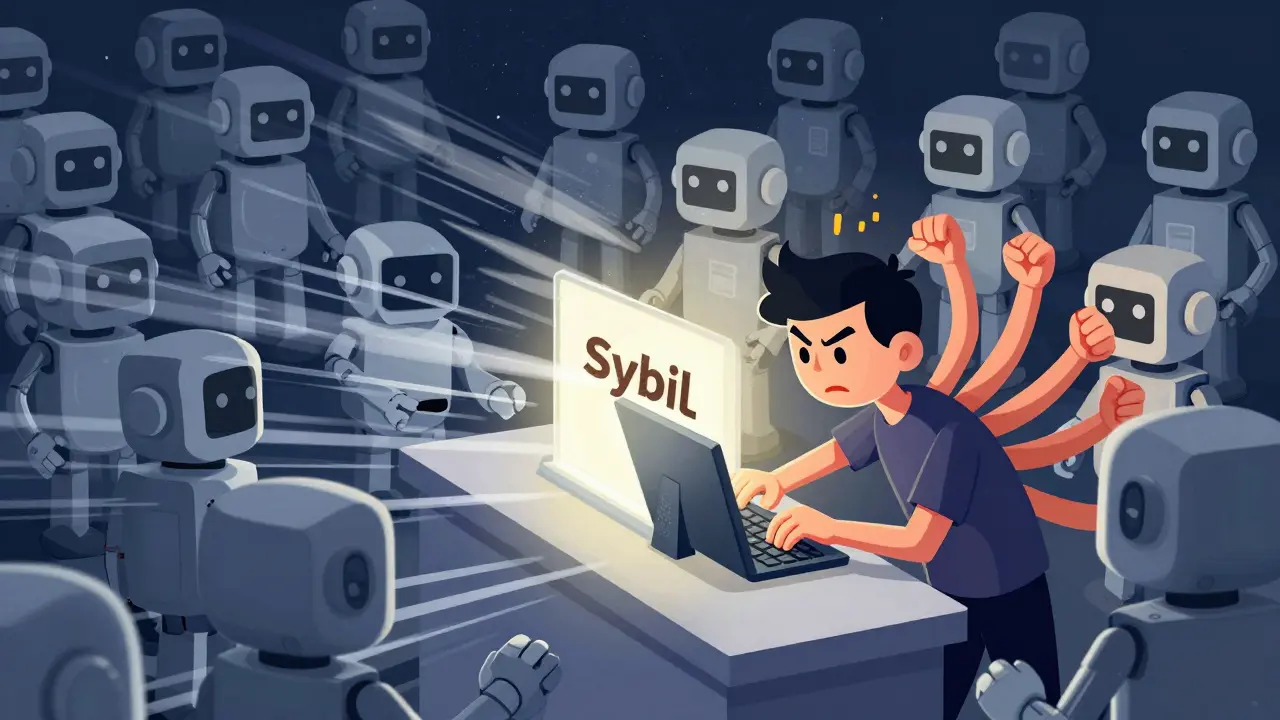
Imagine you are running a decentralized voting system. One person decides to create ten thousand fake accounts. They vote for their preferred candidate with every single one of them. The result? A rigged election where the majority has no say. This isn't science fiction; it is the nightmare scenario for any distributed network. It is called a Sybil attack, and it remains one of the most persistent threats to trust in digital ecosystems.
The term comes from a 1973 book about a woman with multiple personality disorder. In cybersecurity, it describes a single entity pretending to be many. If your system treats every identity as equal and free to create, an attacker can flood the network with bots, diluting the influence of real users. To fix this, we need Sybil resistance mechanisms that distinguish between real people and fake identities without compromising privacy or decentralization.
What Is a Sybil Attack?
A Sybil attack occurs when an adversary creates multiple false identities to gain disproportionate control over a network. The core principle is simple: one body pretending to be many. In peer-to-peer networks, entities present identities as abstractions. More than one identity can correspond to a single physical user. Attackers exploit this many-to-one mapping to manipulate consensus, spam content, or drain resources.
Three factors determine how vulnerable a system is to these attacks:
- Cost of identity creation: If creating an account costs nothing, attackers will generate millions.
- Trust chains: Does the system require new users to be vouched for by existing trusted users?
- Identity treatment: Does the system treat all entities identically, regardless of history or behavior?
Research from 2012 showed that large-scale Sybil attacks could be carried out cheaply and efficiently in realistic systems like BitTorrent Mainline DHT. Even today, traditional platforms struggle. Facebook has armies of moderators, Twitter bans waves of bots daily, and Google deploys endless AI filters. Yet billions of fakes slip through because the underlying assumption hasn't changed: creating an account is free, easy, and unlimited.
Why Reputation Systems Fail Without Sybil Resistance
Reputation systems aim to build trust by tracking user behavior over time. But if an attacker can spawn infinite identities, they can reset their reputation instantly. A bad actor gets banned? No problem. They just create a new wallet or account and start fresh. This breaks the fundamental link between accountability and identity.
Academic research defines a reputation function as "sybilproof" if no user can benefit from creating fake identities. Formal proofs show that true sybilproofness requires either economic friction or social verification. Without these, reputation becomes meaningless. As security experts note, without Sybil resistance, nothing online can be trusted for long-not reviews, not votes, not metrics, and not even community size.
The challenge lies in balancing security with usability. You cannot simply require government IDs for every blockchain user. That defeats the purpose of decentralization and excludes billions of unbanked individuals. Instead, systems must make identity scarce again by proving humanity without exposing personal data.
Economic Friction: Making Attacks Expensive
One of the oldest defenses against Sybil attacks is economic cost. If creating an identity requires staking tokens or performing computational work, attackers face a financial barrier. Proof-of-Work (PoW) and Proof-of-Stake (PoS) consensus mechanisms use this principle at the protocol level.
In PoW, miners compete to solve complex puzzles. The energy and hardware costs prevent any single entity from easily dominating the network. In PoS, validators must lock up cryptocurrency as collateral. Misbehavior leads to slashing-losing part or all of their stake. Both methods raise the cost of launching a Sybil attack significantly.
However, economic friction alone isn't enough. Wealthy adversaries can still afford to buy thousands of nodes. That's why modern systems layer additional protections on top of staking requirements.
| Method | Mechanism | Pros | Cons |
|---|---|---|---|
| Economic Friction | Staking tokens or computing power | Simple to implement, proven effective | Wealthy attackers can bypass, centralizes wealth |
| Social Graph Analysis | Mapping relationships between wallets | Detects coordinated botnets, low cost | Privacy concerns, hard to scale |
| Zero-Knowledge Proofs | Cryptographic proof of uniqueness | Preserves privacy, highly secure | Complex implementation, steep learning curve |
| Machine Learning Detection | Analyzing transaction patterns | Adapts to new threats, automated | False positives, requires training data |

Social Graph Analysis: Mapping Real Connections
Real humans have messy, organic connections. Bots often act alone or in tightly coordinated groups. Social graph analysis examines wallet relationships to detect anomalies. If fifty wallets always transact at the same second with identical amounts, they likely belong to one operator.
This method leverages the principle that real users have diverse interaction histories. They interact with different services, spend varying amounts, and operate across different time zones. Fake users, however, often follow predictable scripts. Machine learning models monitor on-chain behavior, analyzing transaction times, wallet activity, and interaction types to flag suspicious patterns before damage spreads.
Projects like Arcium Network combine social graph insights with cluster-based architecture. Their intra-cluster Sybil resistance prevents collusion among nodes within small groups, while network-wide resistance protects the entire ecosystem. By ensuring at least one randomly selected node exists in every non-permissioned cluster, they create an independent counterbalance against coordinated attacks.
Zero-Knowledge Proofs: Privacy-Preserving Identity
Zero-knowledge proofs (ZKPs) represent a breakthrough in Sybil resistance. They allow users to prove they are unique humans without revealing who they are. Think of it like showing your ID to a bouncer but keeping the details hidden. The bouncer knows you're eligible to enter, but doesn't know your name, address, or birthdate.
In Web3, ZKP-based identity systems verify "the truth, not the identity of the user." Biometric checks, wallet-bound credentials, and cryptographic signatures combine to ensure each participant is one person. Since the proof reveals no personal data, privacy remains intact. Since the proof is mathematically verifiable, duplication becomes nearly impossible.
Implementing ZKPs is technically demanding. Developers must understand advanced cryptography, circuit design, and gas optimization. But the payoff is significant. Projects adopting ZK identity solutions report fewer fraudulent interactions and higher user confidence. As more tools become available, this approach may become the standard for decentralized applications.
Machine Learning: Detecting Patterns Before Damage Spreads
Traditional rule-based systems fail against evolving threats. Hardcoded rules catch known bot behaviors but miss novel tactics. Machine learning models adapt continuously. They learn from historical data, identifying subtle correlations invisible to human analysts.
For example, a model might notice that certain wallets always interact with specific smart contracts within milliseconds of each other. Or that new accounts consistently receive funds from known mixer services. These patterns suggest automation rather than organic usage.
ML detection works best when combined with other layers. Alone, it risks false positives-blocking legitimate users who happen to behave unusually. Paired with economic friction and social graph analysis, it forms a robust defense-in-depth strategy. Continuous monitoring ensures the system evolves alongside attacker techniques.

Building Resilient Reputation Systems
Effective reputation systems earn credibility over time through consistent participation. Bots struggle to maintain long-term engagement in decentralized apps. They lack genuine interest, so their activity feels artificial. Human users, by contrast, contribute meaningfully, vote thoughtfully, and respond to community feedback.
To build resilient systems, developers should focus on three pillars:
- Scarcity: Make identity creation costly enough to deter mass fraud but accessible enough to include everyone.
- Verification: Use cryptographic or behavioral signals to confirm uniqueness without doxxing users.
- Accountability: Tie reputation to persistent identifiers that cannot be easily reset.
Arcium’s node operator reputation system encourages community engagement to monitor and report suspicious activities. Heavier slashing punishments for concurrent node downtimes further disincentivize malicious coordination. Community-driven oversight adds another layer of resilience, turning passive users into active defenders.
Challenges and Trade-offs
No solution is perfect. Economic barriers exclude poor users. Social graphs invade privacy. Zero-knowledge proofs demand expertise. Machine learning generates noise. Designers must weigh these trade-offs carefully based on their application’s needs.
A public governance token might prioritize accessibility over absolute security, accepting some risk to remain inclusive. A high-value DeFi protocol, however, would lean heavily toward rigorous verification, sacrificing convenience for safety. Context dictates choice.
Another challenge is scalability. As networks grow, maintaining accurate reputation scores becomes computationally expensive. Off-chain computation with on-chain verification offers a partial fix, but introduces trust assumptions about the off-chain operators.
Finally, there’s the human factor. Users resist invasive checks. Convincing them that privacy-preserving verification benefits everyone requires education and transparency. Clear communication about how data is used-and what isn’t collected-builds trust faster than technical specs ever could.
Future Directions
The future of Sybil resistance lies in hybrid approaches. Combining economic friction, machine learning, social graphs, and zero-knowledge proofs creates overlapping layers of defense. Attackers must overcome multiple hurdles simultaneously, raising the cost beyond feasibility.
Web3-native identity proofs will mature as tooling improves. Standards like ERC-4361 (Sign-In with Ethereum) lay groundwork for portable, verifiable credentials. Interoperable identity frameworks enable seamless cross-platform reputation transfer, reducing fragmentation.
Academic research continues refining mathematical models. K-sybilproof functions limit users to creating no more than K fake identities, acknowledging that total elimination is impractical. Cost-aware algorithms adjust thresholds dynamically based on network conditions, optimizing security versus performance.
Ultimately, solving Sybil resistance means redefining digital identity. Not as usernames or email addresses, but as provable, unique, private assertions of humanity. When achieved, decentralized systems can finally match the trustworthiness of centralized ones-without surrendering control to corporations or governments.
What is a Sybil attack in blockchain?
A Sybil attack happens when one person creates many fake identities to take unfair control of a network. In blockchain, this could mean manipulating votes, spamming transactions, or distorting reputation scores. The goal is to make the system believe there are many distinct users when really it’s just one attacker.
How does Sybil resistance work?
Sybil resistance uses various methods to stop fake identities. Common approaches include requiring users to stake money (economic friction), analyzing connection patterns between accounts (social graph analysis), using cryptographic proofs to verify uniqueness without revealing identity (zero-knowledge proofs), and employing AI to spot unusual behavior (machine learning).
Can zero-knowledge proofs prevent Sybil attacks?
Yes, zero-knowledge proofs can help prevent Sybil attacks by allowing users to prove they are unique humans without sharing personal information. This maintains privacy while making it extremely difficult for attackers to create duplicate identities since each proof is cryptographically tied to a single source.
Why is reputation important in Web3?
In decentralized networks where no central authority exists, reputation helps establish trust. It allows users to identify reliable partners, quality content, and honest participants. Without strong Sybil resistance, reputation systems break down because attackers can reset their standing endlessly by creating new fake profiles.
What are the limitations of current Sybil resistance methods?
Current methods face several challenges. Economic barriers can exclude poorer users. Social graph analysis raises privacy concerns. Zero-knowledge proofs require significant technical expertise to implement correctly. Machine learning systems may produce false positives. Balancing security, usability, and inclusivity remains an ongoing challenge for developers.