

You know the feeling. A customer wants to pay you for your service or product, but they don't want to use a credit card. Maybe they are overseas, maybe they hate the fees, or maybe they just prefer digital assets. They ask if you accept stablecoins, which are cryptocurrencies pegged to stable assets like the US dollar, such as USDT or USDC. In 2026, this is no longer a niche request. Stablecoins offer near-instant settlement and global reach without the wild price swings of Bitcoin. But setting up a system to handle these payments securely and compliantly can feel like navigating a minefield. Do you build it yourself? Do you trust a big tech giant? Or do you find a specialized tool? Here is the reality: building a custom wallet from scratch is a security nightmare and a compliance headache. The best way to accept stablecoin payments today depends entirely on where you are based, what technology stack you run, and how much control you want over your funds.
Why Stablecoins Are Changing Online Commerce
Before picking a provider, it helps to understand why merchants are making the switch. Traditional credit card processing comes with hidden costs. Chargebacks happen when customers dispute transactions, often costing the merchant the full amount plus a fee. International transfers take days and eat into margins via foreign exchange spreads. Stablecoins solve this by moving money on blockchain networks. When a customer pays with USDC (USD Coin) or USDT (Tether), the transaction settles on-chain in minutes. It is final. There is no chargeback mechanism built into the protocol. For a solo founder or a small business, that finality is a massive relief. However, stability is only half the equation. You still need a way to convert those tokens into usable cash if you have rent to pay, or a secure way to hold them if you want to keep your treasury on-chain. This is where payment gateways come in.
The Four Ways to Accept Crypto Payments
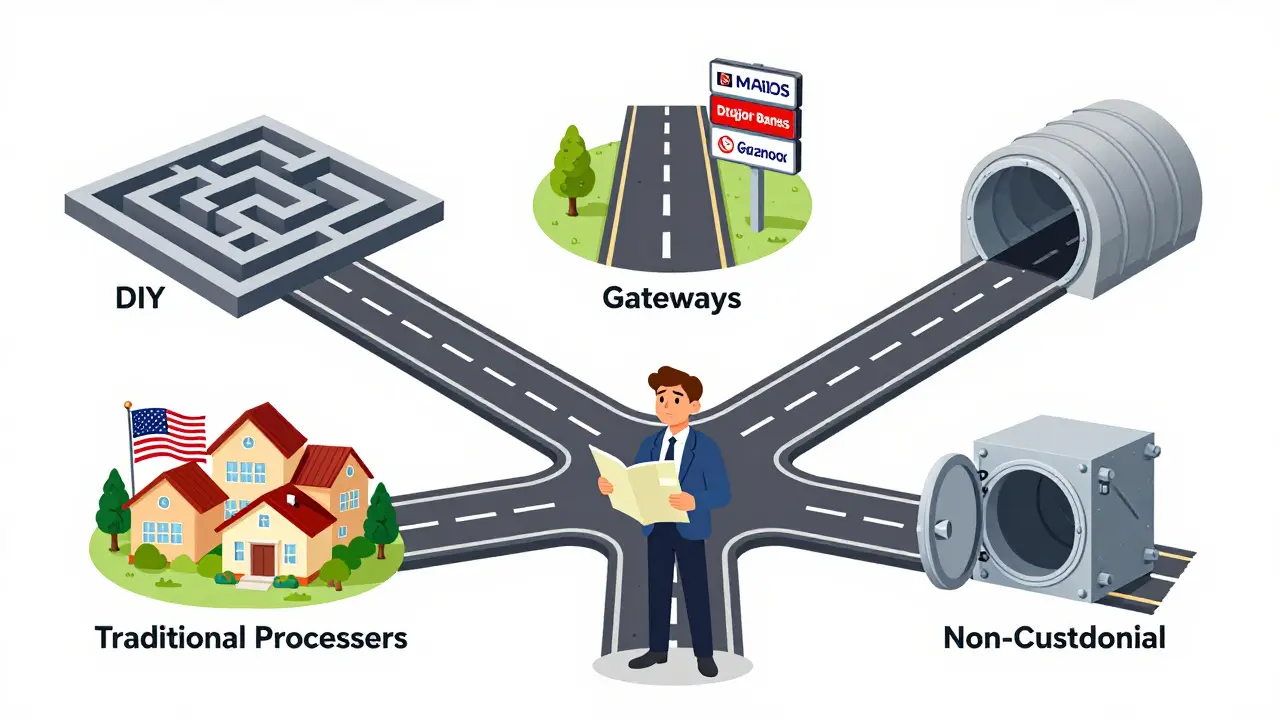
Not all integrations are created equal. Depending on your technical skills and risk tolerance, there are four main models you can choose from.
- The DIY Wallet Approach: You publish your public address on your website. Customers send funds directly. You monitor the blockchain manually or with a script to confirm receipt. This offers total self-custody but requires significant engineering effort to handle reconciliation, refunds, and security. It is generally not recommended for mainstream e-commerce unless you are highly technical.
- Crypto-Native Gateways: Services like NOWPayments, BitPay, or Triple-A generate unique addresses for every invoice. They monitor the chain and notify you via webhooks when payment arrives. These platforms usually support multiple chains (Ethereum, Solana, TRON) and offer plugins for Shopify or WooCommerce.
- Traditional Processors with Crypto Add-ons: Giants like Stripe now allow businesses to accept stablecoins. However, these features often come with strict geographic restrictions. For instance, Stripe’s stablecoin feature currently limits eligibility to US-based businesses and caps transactions at $10,000 USD.
- Non-Custodial Developer Tools: Newer platforms focus on giving developers API access while keeping funds in the merchant's own hardware wallet. This model eliminates counterparty risk because the platform never holds your money.
Comparing Top Payment Providers
Choosing the right partner means looking beyond marketing slogans. You need to evaluate custody, fees, supported networks, and ease of integration. Here is how the major players stack up against each other in 2026.
| Provider | Custody Model | Settlement Options | Key Constraints | Best For |
|---|---|---|---|---|
| Stripe | Custodial | Fiat (USD) | US Businesses only; $10k limit per tx | Established US companies already using Stripe |
| BitPay | Custodial | Fiat or Crypto | KYC required; variable withdrawal fees | Retailers wanting fiat conversion |
| NOWPayments | Semi-Custodial | Crypto or Fiat partners | Requires manual payout configuration | E-commerce stores needing multi-coin support |
| TxNod | Non-Custodial | Direct to Merchant Wallet | Invite-only; Hardware wallet required | Developers, Solo Founders, Indie Hackers |
| Yellow Card | Custodial | Local Fiat / Crypto | Regional focus (Africa/Emerging markets) | Platforms serving specific regional markets |
Why Custody Matters More Than You Think
When you use a custodial provider like BitPay or Stripe, they act as the middleman. The customer sends money to their wallet, they verify it, and then they release funds to you-either in crypto or converted to dollars. This sounds convenient, but it introduces counterparty risk. If the provider freezes your account, delays payouts, or goes bankrupt, your capital is trapped. This is why non-custodial architecture has gained traction among sophisticated operators. With a non-custodial gateway, the platform generates an invoice and monitors the blockchain, but the funds go directly to an address derived from your own private keys. The platform never touches the money. For example, tools like TxNod connect to your hardware wallet (like a Ledger or Trezor) via extended public keys. They derive a unique address for each customer invoice, but your signing keys stay offline on your device. If the service disappears tomorrow, your funds are safe in your wallet. You also avoid KYC hurdles and account freezes because you aren't relying on their permission to access your own assets.
Integration: Plugins vs. APIs
How you integrate depends on your site. If you run Shopify or WooCommerce, look for ready-made plugins. Providers like NOWPayments and Triple-A offer these, allowing you to toggle stablecoin acceptance on in minutes. This is the fastest path to revenue if you lack coding resources. However, if you are building a custom SaaS platform or a membership site, an API-first approach gives you more flexibility. You can create invoices programmatically, listen for webhook events like `PAYMENT.SETTLEMENT_PROCESSING`, and update your database automatically. Modern developer tools are evolving to meet this demand. Some newer SDKs, written in TypeScript, allow AI coding agents to scaffold the entire integration. By connecting to a local MCP (Model Context Protocol) server, a developer can ask their AI assistant to "create a stablecoin invoice endpoint" and get production-ready code in seconds. This reduces integration time from weeks to hours.

Security and Compliance Checklist
Before going live, ensure your setup covers these critical bases:
- Multi-Chain Support: Don't force customers to use Ethereum if gas fees are high. Offer options like TRC-20 USDT or Solana USDC to reduce transaction costs for your users.
- Address Verification: If using a third-party gateway, ensure the address presented to the customer matches the one generated by your backend. Trust, but verify.
- Refund Policies: Blockchain transactions are irreversible. You must have a clear process for issuing refunds, which typically involves sending new funds back to the customer's wallet rather than reversing the original payment.
- Regulatory Alignment: Check local laws regarding crypto acceptance. While many regions are silent, others require specific licensing. Using a regulated processor can offload some of this burden, though non-custodial tools place the compliance responsibility squarely on you.
Next Steps for Merchants
If you are a US-based business already deep in the Stripe ecosystem, enabling their stablecoin feature might be the path of least resistance. Just remember the $10,000 cap and the fact that you will hold no crypto yourself. For global merchants who want to retain ownership of their funds and avoid account freezes, exploring non-custodial gateways is worth the extra setup time. Connecting a hardware wallet ensures that even if the software provider fails, your treasury remains intact. Start by auditing your current checkout flow. Identify where friction exists for international customers. Then, test a sandbox environment with two different providers-one custodial and one non-custodial-to see which fits your operational workflow better. The goal isn't just to accept crypto; it's to do so in a way that scales with your business without introducing new risks.
What is the cheapest way to accept stablecoins?
Generally, non-custodial gateways or direct wallet integrations have the lowest fees because there is no middleman taking a cut for currency conversion or custody. However, you must factor in the blockchain network fees (gas), which vary by chain. Networks like Solana or Tron often have lower transaction costs than Ethereum.
Do I need a registered company to accept crypto payments?
It depends on the provider. Major custodial processors like Stripe and BitPay usually require strict KYC (Know Your Customer) verification, including business registration documents. However, some non-custodial developer tools allow individuals and solo founders to operate without formal corporate structures, provided they manage their own tax obligations.
Can customers pay with Bitcoin?
While this article focuses on stablecoins, most payment gateways support Bitcoin alongside stablecoins. The advantage of stablecoins is price predictability. With Bitcoin, you risk value fluctuation between the time of purchase and settlement unless the provider offers instant fiat conversion.
Is it safe to use a non-custodial gateway?
Yes, arguably safer than custodial options regarding fund security. Since the gateway never holds your private keys or funds, they cannot freeze your assets or suffer a hack that drains your balance. Your security relies on protecting your own hardware wallet and seed phrase.
How long does integration take?
Using a plugin for platforms like Shopify can take less than an hour. Custom API integrations typically take a few days to a couple of weeks, depending on complexity. Modern SDKs designed for AI-assisted coding can significantly reduce this timeline for developers.