

Remember when buying Bitcoin felt like gambling on a tech startup that might vanish overnight? Those days are gone. As we move through mid-2026, the conversation around Institutional Crypto Investment is the strategic allocation of capital by large financial entities, pension funds, and corporations into digital assets for diversification and yield has shifted from "if" to "how." The speculative wild west is being paved over with regulatory clarity, institutional-grade infrastructure, and products that fit neatly into existing financial workflows.
For traditional finance professionals, this isn't just about chasing hype. It’s about risk management, inflation hedging, and accessing new asset classes that offer low correlation to stocks and bonds. If you’re an investor, a fund manager, or simply curious about where big money is going, here is what is actually happening behind the scenes.
The Shift from Speculation to Asset Class
Five years ago, mentioning cryptocurrency in a boardroom meeting often ended the discussion. Today, it’s a standard line item in alternative asset strategies. This change didn’t happen by accident. It was driven by three key factors: reduced volatility, regulatory approval, and better infrastructure.
Let’s look at the numbers. During the turbulent 2020-2022 period, Bitcoin’s average volatility hovered around 70%. That is terrifying for a pension fund managing billions. But since 2023, that metric has dropped below 50%. While still higher than gold or equities, it is now manageable within strict risk frameworks. More importantly, survey data from 2025-2026 shows that 60% of institutional respondents now allocate more than 1% of their portfolios to digital assets. For firms managing over $500 billion, nearly half (45%) have crossed that 1% threshold. In the world of institutional investing, 1% is not a rounding error; it represents billions of dollars in committed capital.
This shift signals that crypto is no longer viewed as a speculative toy but as a legitimate component of a diversified portfolio. Institutions are treating it like real estate or private equity: a long-term hold with specific risk parameters, not a day-trading vehicle.
Regulatory Clarity: The Green Light for Big Money
You cannot ask institutions to invest billions without clear rules. The lack of regulatory certainty was the biggest barrier for years. That changed dramatically in 2024 with the U.S. Securities and Exchange Commission (SEC) approving spot Bitcoin and Ether exchange-traded funds (ETFs). This was a watershed moment. It allowed traditional brokers like Fidelity, Schwab, and Vanguard to offer crypto exposure to their clients without them needing to manage private keys or worry about hacked exchanges.
Further momentum came from executive actions supporting the responsible growth of blockchain technology across all economic sectors. These moves signaled that governments view digital assets as part of the future economy, not a threat to be banned. States began exploring legislation to permit digital asset investments, creating a structured legal framework. For compliance officers, this clarity removed the fear of fiduciary breach, unlocking doors that had been locked for decades.
| Access Method | Risk Profile | Liquidity | Best For |
|---|---|---|---|
| Spot Bitcoin ETFs | Low-Medium | High (T+0/T+1) | Core portfolio allocation, ease of use |
| Direct Custody | Medium-High | High | Tax efficiency, direct ownership control |
| Venture Capital/Private Equity | High | Low (Illiquid) | Growth upside, ecosystem bets |
| Tokenized Assets | Variable | Medium-High | Yield generation, fractional ownership |
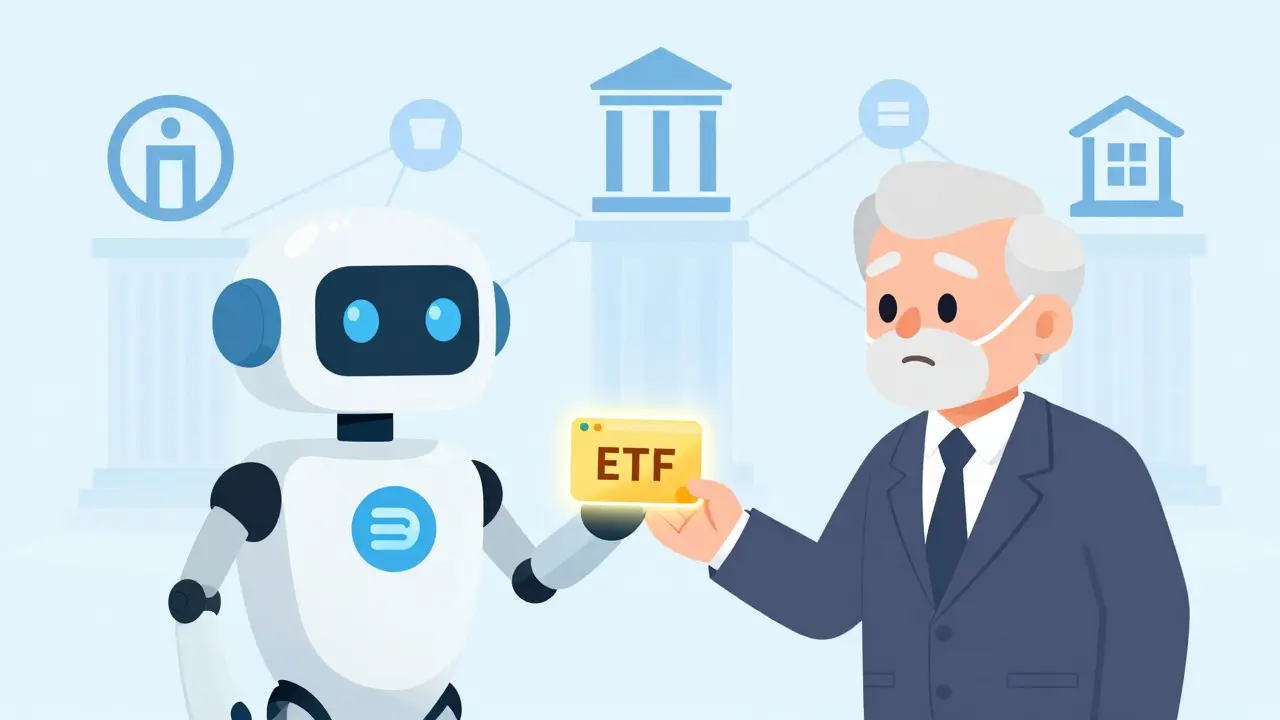
How Institutions Are Actually Buying In
Institutions rarely buy crypto directly on public exchanges anymore. They prefer familiar interfaces and trusted partners. The most popular route right now is through Spot ETFs. BlackRock’s IBIT Fund, for example, became the globe’s largest Bitcoin fund, attracting hundreds of millions in inflows in single days. Why? Because it fits into existing brokerage accounts. A portfolio manager can buy IBIT just like they buy Apple stock. No learning curve, no custody headaches.
However, ETFs aren’t the only path. Many institutions use multi-strategy hedge funds where crypto is one slice of a diversified pie. Others go deeper via private equity and venture capital, investing in blockchain infrastructure companies, mining operations, or payment processors. This provides exposure to the industry’s growth without taking on the price volatility of the underlying coins. Public equity indices like the Russell 3000 also offer indirect exposure through chipmakers and energy companies tied to crypto mining, though this link is often weak and diluted.
The preference for integrated platforms is telling. Institutions want crypto to work within their current operational workflows, not force them to adopt entirely new, risky systems. This is why professional service providers-law firms, tax advisors, and custodians-have launched specialized digital asset teams. They bridge the gap between old-world compliance and new-world technology.
Tokenization: The Next Frontier
If ETFs are the entry point, tokenization is the destination. Institutional investors are increasingly excited about Tokenization is the process of converting rights to an asset into a digital token on a blockchain. This isn’t just about issuing new cryptocurrencies. It’s about putting real-world assets (RWAs) on-chain.
Imagine a pension fund wanting to invest in commercial real estate in Hobart or New York. Traditionally, this requires massive capital, slow paperwork, and illiquidity. With tokenization, that property can be divided into digital shares. Investors can buy fractions, trade them instantly, and receive automated rental income distributions. Central banks and major financial institutions are already testing blockchain rails for this exact purpose.
Hedge funds are leading the charge here, expecting to deploy capital into tokenized assets within the next two years. Stablecoins play a crucial role in this ecosystem, acting as the bridge between fiat banking and crypto settlements. They allow for near-instant, low-cost transfers globally, solving a major pain point in international finance. As these technologies mature, expect to see more government bonds, treasury bills, and private credit issued as tokens.

Risks, Taxes, and Realistic Timelines
It’s not all smooth sailing. Taxation remains a complex hurdle. The difference between commercial treatment (trading) and passive treatment (investment) can drastically alter net returns. Institutions need specialized tax experts to navigate these waters, ensuring they optimize after-tax yields while staying compliant across different jurisdictions.
Security is another constant concern. While regulated custodians have improved significantly, the threat of cyberattacks never disappears. Institutions are cautious, typically planning to scale their crypto investments over two to three years rather than dumping billions in at once. This measured approach allows them to build internal safeguards, test partnerships, and refine risk models.
Correlation risks also exist. In periods of market stress, crypto sometimes moves in tandem with tech stocks rather than acting as a true hedge. Investors must monitor these dynamics closely. However, in low-interest-rate environments, the asymmetric return potential of digital assets continues to outweigh these concerns for many allocators.
What Comes Next?
The trajectory is clear. Institutional adoption is accelerating, not slowing down. With volatility dropping, regulations solidifying, and infrastructure reaching enterprise-grade standards, crypto is becoming a permanent fixture in global finance. We are moving from a phase of speculation to a phase of integration.
For the average observer, this means more stability but potentially less explosive short-term gains. For professionals, it means new opportunities in tokenization, decentralized finance (DeFi) integration, and cross-border payments. The future of institutional crypto investment isn’t about replacing traditional finance; it’s about upgrading it.
Why are institutions interested in crypto now?
Institutions are drawn to crypto for portfolio diversification. Digital assets like Bitcoin have shown low correlation to traditional stocks and bonds, offering a hedge against inflation and currency debasement. Additionally, reduced volatility and the availability of regulated products like ETFs have made crypto safer and easier to integrate into existing investment strategies.
What is the role of ETFs in institutional crypto adoption?
ETFs provide a regulated, familiar way for institutions to gain exposure to crypto without handling private keys or dealing with unregulated exchanges. Spot Bitcoin and Ether ETFs allow investors to buy and sell crypto assets through standard brokerage accounts, simplifying compliance and custody issues.
How does tokenization benefit institutional investors?
Tokenization converts real-world assets like real estate, bonds, or art into digital tokens on a blockchain. This increases liquidity, allows for fractional ownership, reduces transaction costs, and enables faster settlement times. It opens up previously illiquid markets to a broader range of institutional capital.
Is crypto investment safe for large funds?
While crypto carries inherent risks, including price volatility and cybersecurity threats, institutional-grade infrastructure has significantly mitigated these dangers. Regulated custodians, insurance products, and clear regulatory frameworks make it safer than in previous years. However, institutions typically limit allocations to 1-5% of their total portfolio to manage risk.
What is the typical timeline for institutional crypto adoption?
Most institutions plan to scale their crypto investments over two to three years. This cautious approach allows them to develop internal risk management protocols, partner with trusted custodians, and ensure compliance with evolving tax and regulatory requirements before making large-scale deployments.
Oh please, spare me the corporate cheerleading. You call this "regulatory clarity"? It's just a nicer cage for your money. The SEC approving ETFs didn't make Bitcoin safe; it made it easier for banks to skim fees off the top while you hold the bag when the inevitable crash happens. They want you to think it's an asset class because they're tired of losing control. But let's be real, this is still digital gambling with a suit on. I'm sticking to gold and cash under my mattress where no algorithm can hack it.
I honestly feel like we are witnessing history in real time! It is so exciting to see these barriers breaking down. For years, people told us crypto was a scam or a bubble, but look at how many institutions are now quietly buying in. It gives me so much hope that financial systems can evolve to be more inclusive and efficient. We should celebrate this progress rather than fear it. Imagine if this level of innovation had been applied to banking decades ago! 🌟
The article ignores the elephant in the room: foreign influence. Why are Indian and Chinese entities pushing so hard for tokenization? It is a clear attempt to bypass US sanctions and undermine the dollar. The "global economy" they speak of is a Trojan horse for authoritarian regimes to launder money through blockchain rails. We need to protect our national sovereignty, not invite these digital threats into our pension funds. This is economic warfare disguised as innovation.
i mean its kinda cool that big banks are finally getting it but i dont trust them yet lol. they always say one thing and do another. maybe ill dip my toes in later when its less risky. feels like everyone is rushing though which makes me nervous. chill guys.
Your analysis is superficial at best. You fail to recognize the nuanced interplay between liquidity premiums and institutional risk aversion. The volatility drop you cite is merely a statistical anomaly driven by market manipulation by whale accounts. True alpha lies in private equity structures, not these diluted retail-facing ETFs. Most of you reading this lack the intellectual capacity to understand why BlackRock's IBIT is a trap for the masses while smart money moves into tokenized T-bills. Educate yourselves before deploying capital.
One must consider the philosophical implications of digitizing value. Is a token truly an asset, or merely a symbol of trust in a system that may not deserve it? The shift from physical to digital mirrors the broader societal move towards virtual existence. We are trading tangible security for convenient abstraction. :/
Hey there, nice post. I think tokenization is really interesting especially for real estate. It could help people like me who cant afford whole buildings to invest in small parts. Hope it works out well for everyone. Let's keep learning together!
You are all missing the point entirely. This isn't about innovation; it's about consolidation of power. The elites have decided they want a piece of the action, so they regulate it until it's boring enough for their portfolios. If you think this makes it safer, you are naive. The tax implications alone will crush the average participant. Read the fine print on passive vs commercial treatment. It is a minefield designed to penalize those without expensive legal teams.
I've been trying to figure out how to buy some of these ETFs but the process seems so complicated. Do I need a special account or can I just use my regular brokerage? I don't want to make a mistake and lose money. Any tips would be great since I'm pretty new to this stuff.
why do you care what institutions think anyway theyre just suits trying to justify their bonuses. the real revolution is decentralized finance where no one needs permission. but sure keep talking about blackrock and fidelity like theyre heroes. its pathetic really. wake up sheeple.
Actually, Caralee, you can buy spot Bitcoin ETFs like IBIT or FBTC directly through most major brokerages such as Fidelity, Schwab, or Vanguard. You don't need a separate crypto exchange account. Just search the ticker symbol in your app and buy shares like you would stock. It's super easy and keeps your assets insured within the brokerage framework. No private keys to worry about! 👍📈
This is a significant development for portfolio diversification. While the hype often overshadows the practicalities, the reduction in volatility metrics is a crucial factor for fiduciaries. However, investors must remain vigilant regarding correlation risks during market stress periods. The integration of tokenized real-world assets offers promising liquidity solutions, but regulatory frameworks must continue to mature to ensure consumer protection. It is essential to approach this with a balanced perspective, recognizing both the technological advancements and the inherent risks involved.
Absolutely ridiculous that we are allowing foreign-backed algorithms to dictate our financial future. This is a direct threat to American economic independence. The SEC should have banned this garbage instead of legitimizing it. We need to bring jobs back here, not facilitate global capital flight through blockchain loopholes. Patriotism means protecting our currency, not diluting it with digital scrip.
Sylvia, your cynicism is noted, but perhaps a bit excessive. Every major financial shift faces resistance from those comfortable with the status quo. Remember when online banking was called "unsafe"? Now it's standard. Crypto might have its flaws, but dismissing it entirely ignores the potential for greater financial inclusion globally. Let's engage constructively rather than tearing down progress. After all, change is uncomfortable but necessary.
The author fails to address the catastrophic environmental impact of proof-of-work mining despite Ethereum's switch. Tokenization is just greenwashing for speculative bubbles. You are ignoring the carbon footprint required to secure these networks. Until sustainable consensus mechanisms are universally adopted, this entire industry is built on ecological debt. Stop pretending this is a noble pursuit of efficiency. It is resource extraction dressed up as tech. 📉🗑️