
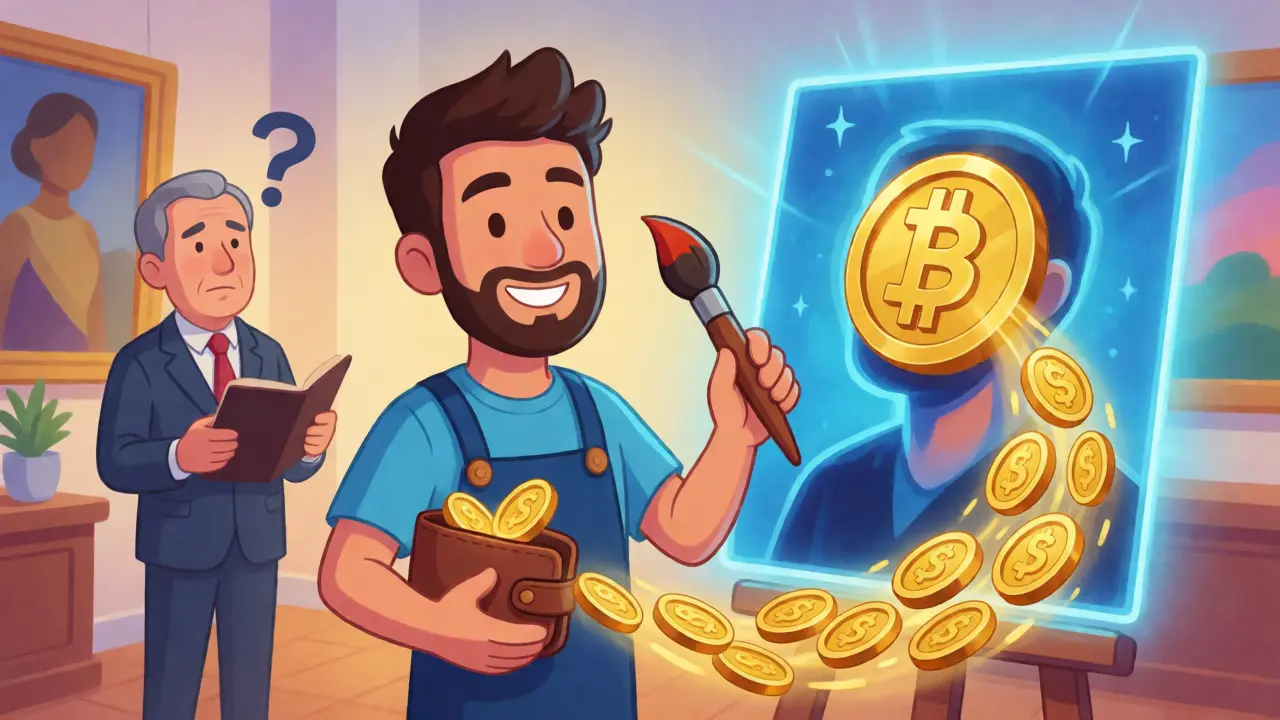
Imagine you sell a painting for $100. Five years later, it resells for $1 million. Do you get a cut? In the traditional art world, usually no. The gallery or the new owner keeps that profit. But in the world of NFT royalties, this changes entirely. These are automated payments sent to the original creator every time their digital asset is resold on a secondary market.
This isn't just a nice-to-have feature; it's the economic engine that makes Web3 creative ownership viable. If you're an artist, a collector, or just curious about how digital assets actually make money over time, understanding royalties is non-negotiable. Let’s break down exactly what they are, how they work technically, and why the industry is currently fighting over whether they should be mandatory or optional.
The Core Concept: Perpetual Income for Digital Work
NFT royalties are programmatically encoded fees, typically between 5% and 10%, that are automatically deducted from secondary sale prices and sent directly to the original creator's wallet. Unlike traditional copyright, which often ends after the first sale, these royalties create a perpetual revenue stream. This solves a massive pain point for creators who historically saw little benefit when their work appreciated in value.
Think of it like a song playing on the radio. Every time it plays, the artist gets paid. With NFTs, every time your digital collectible flips hands on a marketplace, you get paid. It turns one-time sales into long-term investments for the creator. For collectors, it means part of their purchase price supports the ecosystem that made the asset valuable in the first place.
How Smart Contracts Automate the Payment
You might wonder, "Who ensures the buyer actually pays me?" You don't need to chase people with invoices. The magic lies in smart contracts. These are self-executing codes stored on the blockchain that handle transactions without needing a bank or lawyer.
When an NFT is minted (created), the developer writes specific rules into the contract. These rules include:
- Creator Wallet Address: Where the money goes.
- Royalty Percentage: Usually set at 5-10%, though some platforms allow higher.
- Trigger Event: A change in ownership via a supported marketplace.
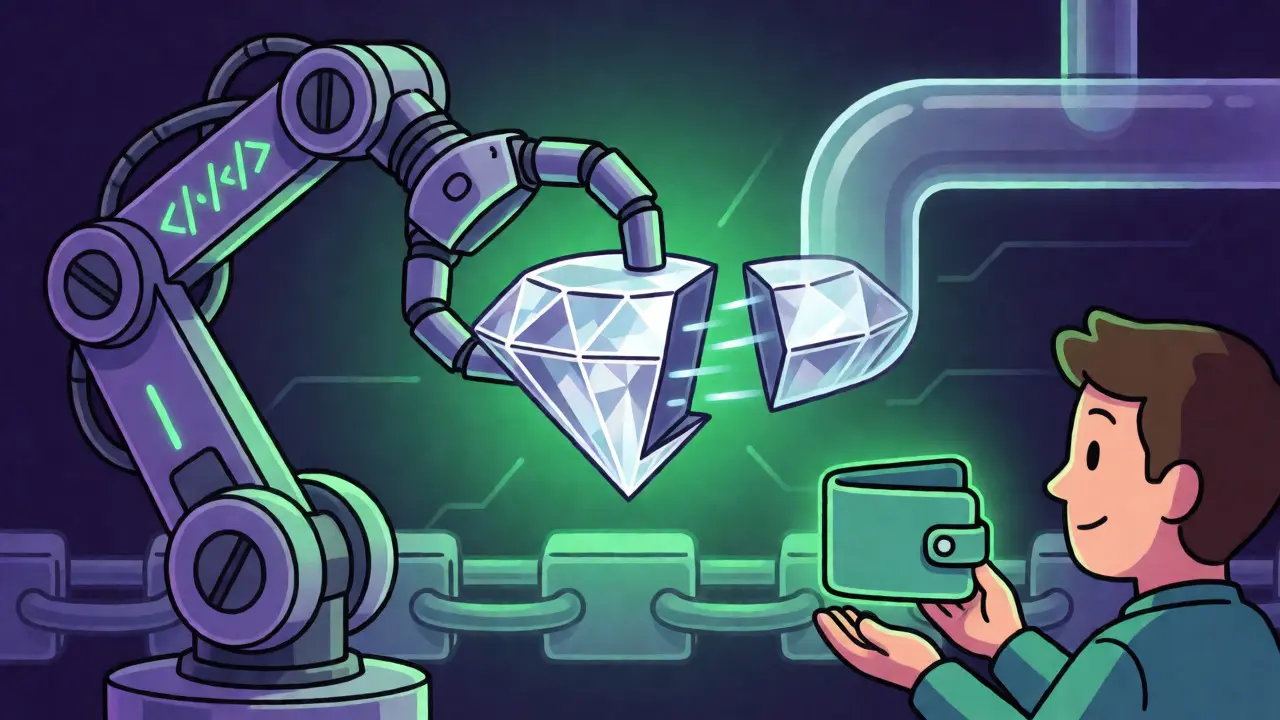
When a sale happens, the smart contract calculates the fee instantly. If you sell an NFT for 1 ETH with a 5% royalty, the contract sends 0.05 ETH to you and 0.95 ETH to the seller. This happens on-chain, meaning it’s transparent, immutable, and visible to anyone with a block explorer. No trust issues, no delayed checks.
Real-World Impact: The Beeple Example
Numbers speak louder than code. Consider Beeple, the digital artist whose work "Everydays: The First 5000 Days" made headlines. While his initial sale was huge, the real story for royalties is in secondary markets. If an artwork sells for $6.6 million on a resale, and the royalty is set at 10%, the creator pockets $660,000 from that single transaction.
This scalability is unique. In traditional publishing, if your book becomes a bestseller ten years after release, you might get a small bonus, but not a percentage of every used copy sold. With NFTs, the upside is uncapped. As long as the asset has value and trades, the creator earns. This shifts power dynamics away from galleries and publishers toward the artists themselves.
The Enforcement Crisis: Mandatory vs. Optional
Here is where things get messy. Just because the code *can* enforce royalties doesn't mean everyone *will*. Major marketplaces like OpenSea, LooksRare, and Magic Eden have faced intense pressure regarding royalty enforcement.
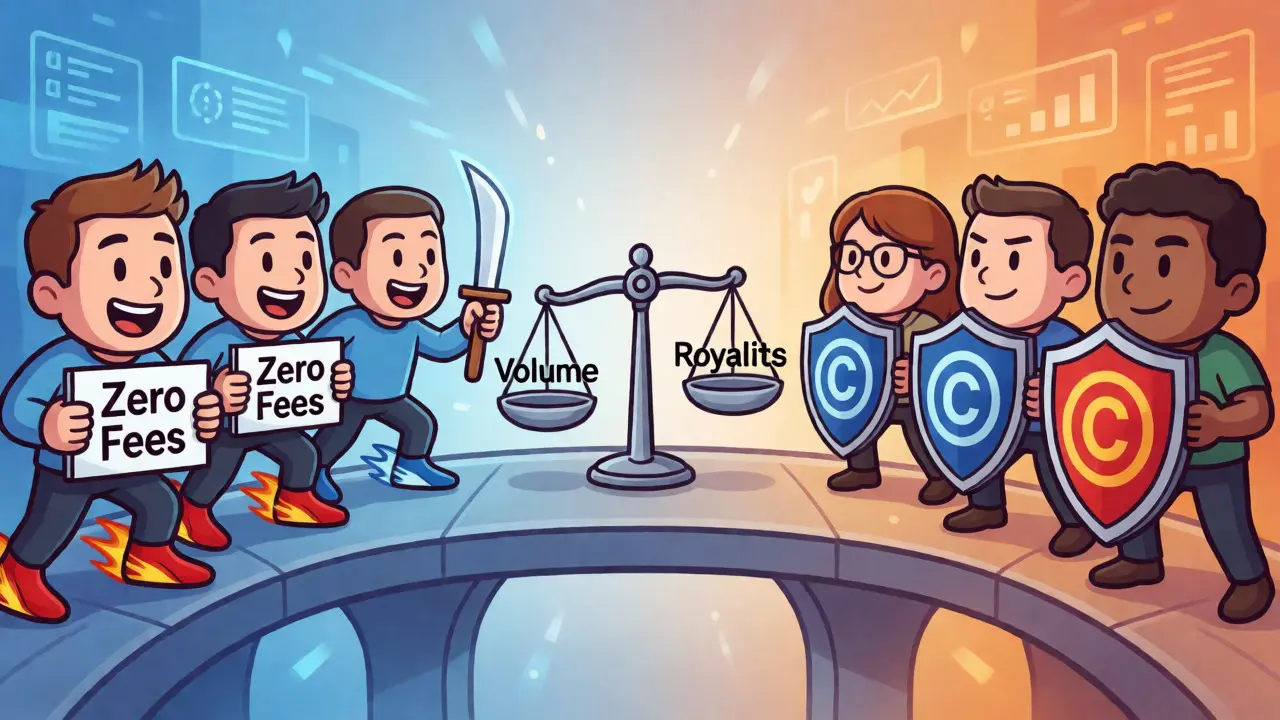
Some platforms decided to make royalties optional. Why? Because traders hate losing margin. If I buy an NFT for 1 ETH and want to flip it for 1.1 ETH, paying a 5% royalty cuts my profit significantly. Platforms offering "zero-fee" or "optional royalty" trading attract high-volume traders who prioritize speed and cost over supporting creators.
This created a fragmentation problem:
| Platform Type | Royalty Status | Trader Appeal | Creator Safety |
|---|---|---|---|
| Traditional (e.g., OpenSea) | Mandatory (mostly) | Lower margins | High |
| Aggregators (e.g., X2Y2) | Optional/Negotiable | Higher margins | Low |
| Community-Driven (e.g., LooksRare) | Variable/Policy-based | Mixed | Medium |
Creators argue that optional royalties gut the incentive model. Traders argue that mandatory royalties stifle liquidity. It’s a classic battle between short-term volume and long-term sustainability.
Legal and Technical Limitations
It’s crucial to understand that a smart contract cannot force a human to use a specific marketplace. If I sell my NFT directly to a friend via an OTC (Over-The-Counter) deal, bypassing all marketplaces, I can choose not to pay the royalty. The blockchain records the transfer, but unless the payment mechanism is tied strictly to the transfer logic (which is rare due to gas costs and complexity), the royalty is essentially a "gentleman's agreement" enforced by social pressure rather than hard code.
Legal experts, including those at firms like White & Case, note that while smart contracts facilitate terms, they lack inherent legal enforcement mechanisms outside the blockchain environment. If a buyer refuses to pay, suing them across jurisdictions for a few hundred dollars in crypto is rarely worth the effort. Thus, the system relies heavily on marketplace compliance and community reputation.
Future Outlook: Standardization and New Tech
The industry is reacting. Projects like ImmutableX launched blacklists against platforms ignoring royalties, showing that communities can exert pressure. We are also seeing technical solutions emerge, such as ERC-2981, a standard that embeds royalty info directly into the token metadata, making it easier for wallets and marketplaces to respect creator settings universally.
For now, if you are buying an NFT, check the platform’s royalty policy. If you are selling, understand that your expected passive income depends entirely on where the trade occurs. The technology works, but the economics are still being negotiated.
Are NFT royalties legally binding?
Not always. While the smart contract dictates the rule within supported marketplaces, there is no universal law forcing private peer-to-peer transfers to include royalty payments. Enforcement relies on marketplace compliance and community norms rather than strict legal penalties.
Can I change the royalty percentage after minting?
Usually, no. The royalty percentage is hardcoded into the smart contract during the minting process. To change it, you would typically need to upgrade the contract or migrate the collection to a new contract, which can be complex and costly.
Do royalties apply to primary sales?
No. Royalties are specifically designed for secondary market sales. The creator receives the full sale price (minus platform fees) during the initial mint or primary sale. Royalties kick in only when the asset changes hands again.
Which blockchains support NFT royalties?
Most major chains support them, including Ethereum, Polygon, Solana, and Flow. However, implementation varies. Ethereum uses standards like ERC-2981, while other chains may rely on marketplace-specific logic to calculate and distribute fees.
Why do some marketplaces make royalties optional?
To attract more traders. High-frequency traders prefer lower costs and higher profit margins. By allowing users to skip or reduce royalty payments, marketplaces increase trading volume, even if it comes at the expense of creator revenue.