

When you see a coin named AI ROCKET is a speculative cryptocurrency token built on the Virtuals Protocol that claims to function as an AI-agent terminal for trading, your first instinct might be excitement. The name suggests speed, artificial intelligence, and dominance. But if you dig into the data available in May 2026, the picture looks very different from the marketing hype. This isn’t a polished, institutional-grade asset. It’s a micro-cap token with wild price discrepancies, near-zero liquidity, and serious questions about its actual utility.
If you are holding ROCKET or thinking about buying it, you need to understand what you are actually dealing with. You aren’t just buying a piece of technology; you are navigating a high-risk environment where data itself seems unreliable. Let’s break down the reality behind the buzzwords.
The Core Concept: What Is AI ROCKET Supposed to Do?
To understand the token, you have to look at its parent project, Virtuals Protocol. Virtuals Protocol describes itself as a society of productive AI agents designed to generate services and engage in autonomous onchain commerce. In theory, this sounds like the future of decentralized finance. Imagine AI bots that trade, create content, or manage portfolios without human intervention.
AI ROCKET is positioned as the specific agent or terminal within this ecosystem tasked with dominating other AIs in the crypto space. According to listings on CoinGecko and CoinMarketCap, it promises "daily alpha detection"-essentially finding profitable trades automatically-and multi-lingual support. The marketing calls it the "ultimate degen toolkit," targeting experienced speculators who want an edge.
However, there is a massive gap between the claim and the evidence. As of late April and early May 2026, there is no public GitHub repository, no technical whitepaper detailing the AI algorithms, and no verified user guides. Without transparent code or documentation, the "AI" part remains a black box. You are trusting a narrative, not a verified product.
The Data Disaster: Why Prices Don't Match
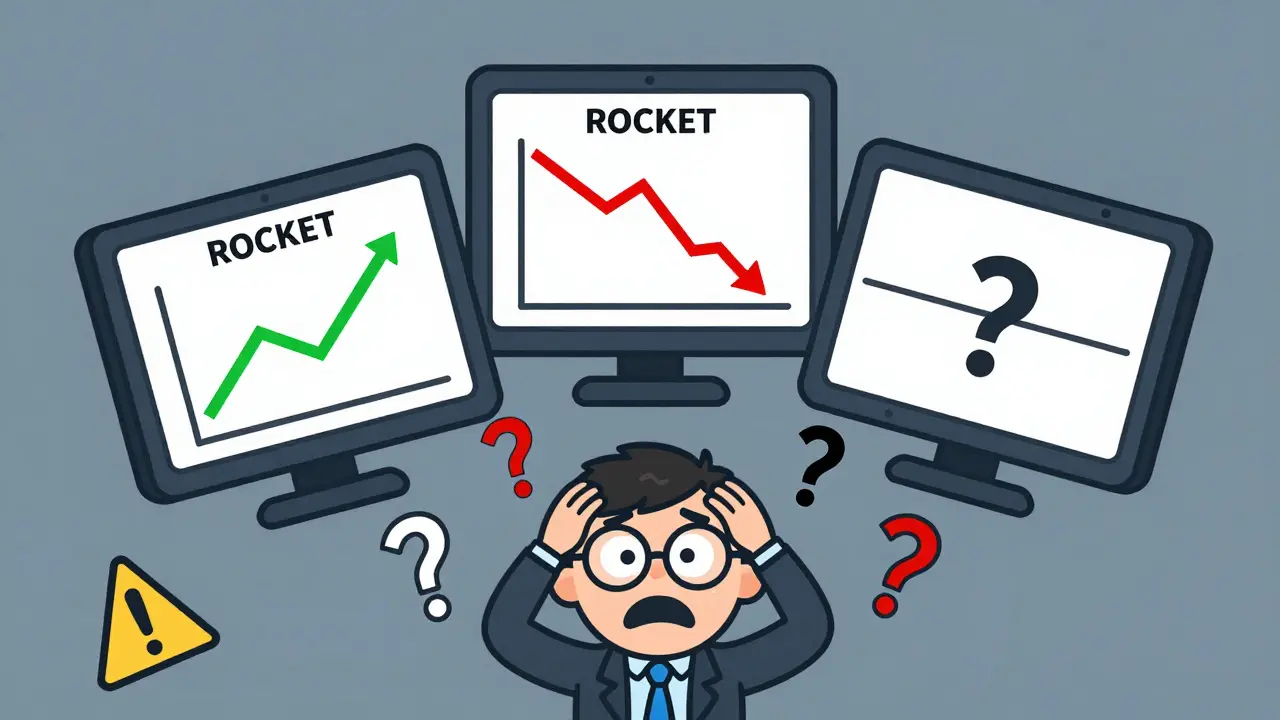
If you check the price of ROCKET today, you might get three completely different answers depending on which site you visit. This isn’t just normal market fluctuation; it’s a sign of broken data infrastructure or extreme manipulation.
| Platform | Reported Price | Circulating Supply | Market Cap | 24h Volume |
|---|---|---|---|---|
| CoinGecko | $0.00082 - $0.00085 | 790 Million | ~$660,000 | $313 |
| CoinMarketCap | $0.000051 | 498.76 Million | ~$25,000 | $0 |
| Bybit | $0.000060 | 950.82 Million | ~$57,000 | $2,400 |
| Crypto.com | $0.000054 / $0.00080 | N/A | $1.5 Million (claimed) | N/A |
Look closely at those numbers. CoinGecko shows a price roughly sixteen times higher than CoinMarketCap. That is not a rounding error. It suggests that either exchanges are reporting fake volume, or the token is being traded on fragmented, illiquid pools with no price discovery mechanism.
Furthermore, Crypto.com lists a market cap of over $1.5 million but explicitly states that "ROCKET is not tradable yet." How can a token have a multi-million dollar valuation if you cannot buy or sell it? This contradiction makes any technical analysis meaningless. You cannot chart trends when the underlying data is fabricated or inconsistent.
Liquidity and Trading Reality
Liquidity is the lifeblood of any cryptocurrency. It determines whether you can exit your position when you want to. For ROCKET, liquidity is practically non-existent.
- Zero Volume Days: CoinMarketCap reports $0 in 24-hour trading volume. This means no trades occurred, or the feed is disconnected.
- Micro-Trading Only: Bybit shows $2,400 in daily volume. If you try to sell $1,000 worth of ROCKET, you could crash the price by 10% or more due to slippage.
- Exchange Absence: Major centralized exchanges like Binance, Coinbase, or Kraken do not list ROCKET. You are likely restricted to small decentralized exchanges or obscure platforms.
This creates a dangerous scenario. If bad news hits, or if the developers decide to dump their holdings, there is no buyer pool to absorb the sell pressure. Your assets could become worthless instantly, with no way to cash out.
Performance and Historical Context
Let’s look at the track record. The all-time high for ROCKET reportedly occurred on January 4, 2025. Since then, the token has collapsed.
CoinMarketCap indicates a decline of -99.79% from that peak. Even if you believe the higher prices reported by CoinGecko, the trend is negative. Over the last week, the token dropped 23.4%. Short-term movements show erratic swings, ranging from +8.79% to -4.65% in a single day, depending on the source.
Compare this to established AI blockchain projects. Fetch.ai has a market capitalization of approximately $1.2 billion. SingularityNET sits around $750 million. These projects have functional mainnets, active developer communities, and real-world partnerships. ROCKET, with a market cap under $100,000 on most reliable trackers, exists in a completely different league. It is not a competitor; it is a speculative footnote.
Risk Factors and Red Flags
Before you consider allocating even a small amount of capital to ROCKET, you must acknowledge the severe risks identified by industry analysts.
- Data Integrity Issues: Bernstein Crypto Research classified ROCKET as a "speculative micro-cap token exhibiting data inconsistencies." Chainalysis noted that such discrepancies often signal wash trading or unreliable exchange feeds.
- No Expert Validation: There are no reviews from reputable firms like Messari, Delphi Digital, or The Block. Institutional investors ignore this token because it lacks fundamental value.
- Regulatory Uncertainty: The claim of being an "AI-agent terminal" could trigger securities laws in various jurisdictions. If regulators deem it an unregistered security, trading could be banned abruptly.
- Pump and Dump Characteristics: The combination of low float, high volatility, and lack of utility fits the profile of short-term speculation schemes rather than long-term investments.
Coinbase’s prediction model offers a grim forecast, projecting a value of $0.00 through 2040 based on current growth metrics. While prediction models are not crystal balls, they reflect the mathematical reality of a token with no adoption curve.
Who Should Avoid ROCKET?
This token is not suitable for beginners. It is not suitable for conservative investors. It is not suitable for anyone looking for steady returns or exposure to legitimate AI technology.
If you are new to crypto, stick to blue-chip assets like Bitcoin or Ethereum, or established AI tokens with proven track records. If you are an experienced trader, you should treat ROCKET as a lottery ticket, not an investment. Never invest money you cannot afford to lose entirely. Given the liquidity constraints, assume that once you buy, you may never be able to sell.
Final Verdict
AI ROCKET by Virtuals presents an intriguing concept on paper: autonomous AI agents trading on-chain. However, the execution falls drastically short. With conflicting price data, negligible liquidity, and a 99.79% drop from its highs, the token currently serves as a warning label for speculative excesses in the crypto market.
Until Virtuals Protocol releases verifiable code, achieves major exchange listings, and demonstrates consistent, reliable trading volume, ROCKET remains a high-risk asset with unclear utility. Stay skeptical, verify data across multiple sources, and prioritize transparency over hype.
Is AI ROCKET (ROCKET) a safe investment?
No, it is extremely risky. The token suffers from severe liquidity issues, inconsistent price data across exchanges, and a lack of transparent development activity. Analysts classify it as a speculative micro-cap with potential pump-and-dump characteristics.
Why does the price of ROCKET differ so much between CoinGecko and CoinMarketCap?
The discrepancy likely stems from fragmented liquidity pools and unreliable data reporting by smaller exchanges. CoinGecko may be aggregating data from a pool with a higher recent trade, while CoinMarketCap reflects a lower baseline. This inconsistency indicates a lack of true price discovery.
Can I buy ROCKET on major exchanges like Binance or Coinbase?
As of May 2026, ROCKET is not listed on major centralized exchanges. Crypto.com explicitly states it is "not tradable yet," despite listing price data. Trading is likely limited to obscure decentralized platforms or small exchanges with high fees and slippage.
What is the Virtuals Protocol?
Virtuals Protocol is the parent project behind ROCKET. It describes itself as a network of productive AI agents that autonomously generate services and engage in on-chain commerce. However, public technical documentation and code repositories for the protocol remain minimal.
How does ROCKET compare to other AI crypto tokens?
ROCKET is significantly smaller and less established than competitors like Fetch.ai or SingularityNET. While those projects have market caps in the hundreds of millions and functional mainnets, ROCKET has a sub-$100K market cap, negligible volume, and no verified utility.
look at this mess it makes my head spin just thinking about the chaos of unregulated markets and how we trust these numbers like they are gospel truth when they are clearly lies told by bots or worse humans trying to scam each other out of their life savings which is tragic really
I find it fascinating how the community reacts to such discrepancies. It really highlights the need for better educational resources so everyone can understand what liquidity actually means before diving in. Let's keep the conversation respectful though.
one must consider the philosophical implications of a token that has no intrinsic value yet commands attention through sheer narrative force it is a testament to human folly that we continue to chase these digital phantoms despite the evidence being right in front of our faces suggesting total collapse
actually you are all missing the point here the price difference is just arbitrage opportunity if you had any skill you would see this as a chance to make money not a warning sign stop being so negative about potential gains
oh wow another ai rocket ship to the moon i guess while the rest of us watch from the ground with our boring stablecoins lol
i hear your concerns about the data integrity issues and it is quite unsettling to think about how much information could be fabricated without anyone noticing until it is too late for the average investor
We should certainly appreciate the effort put into analyzing these micro-caps. It is important to remember that every participant in the market deserves respect regardless of their investment choices, even if those choices seem risky to outsiders.
Stay focused on the facts.
this article is garbage written by someone who clearly does not understand the nuances of decentralized finance or the power of community driven valuation metrics which are far more important than any centralized exchange listing you idiots
The lack of institutional validation is precisely what separates the sophisticated investor from the common retail speculator. One must cultivate a refined palate for assets that demonstrate structural integrity rather than mere speculative fervor.
you people are pathetic for falling for this narrative i know exactly where the developers are hiding their wallets and i will expose them all soon enough so stay tuned for my next big reveal
maybe the silence is just peace maybe the zero volume is a meditation on emptiness and we are all projecting our fears onto a blank canvas instead of seeing the beauty in nothingness
You're doing great by sticking to the basics! Don't let the noise distract you from your goals; consistency is key!!!
i feel like the universe is testing us with these confusing charts and maybe we just need to trust our gut feelings more than the cold hard numbers which often lie anyway
Let me tell you something about market caps that nobody else wants to admit: they are completely irrelevant in the early stages of a project. What matters is the team's vision and their ability to execute, which ROCKET seems to have in spades despite what this article says.