

Most people think of stablecoins as simple digital dollars. You buy one, you hold it, and it stays worth $1. It’s supposed to be boring. But if you’ve been watching the crypto space closely since mid-2024, you might have noticed a new player trying to change that narrative: AUSD, a U.S. dollar-pegged stablecoin launched by Agora in July 2024. Unlike the giant stablecoins you see on every exchange, AUSD isn’t built for your everyday coffee purchase or casual trading pair. It’s engineered for institutions.
If you’re wondering what makes AUSD different from USDT or USDC, or whether this "Stablecoin 3.0" hype has any substance behind it, you’re not alone. With a market cap hovering around $183 million as of late 2025, AUSD is still small compared to the titans. But its backers argue that size doesn’t matter when you’re talking about security, compliance, and speed for enterprise clients. Let’s break down exactly what AUSD is, how it works, and who actually needs it.
The Origin Story: Why Another Stablecoin?
To understand AUSD, you have to look at who built it. Agora, the company behind the token, was led by Nick van Eck, the former CEO of VanEck Digital Assets. Van Eck spent over 15 years in traditional finance before diving into crypto. He didn’t launch AUSD because he wanted to compete with Tether for retail dominance. He launched it because he saw a gap in the market for regulated entities.
Institutional investors-think hedge funds, banks, and large fintech firms-have been hesitant to use crypto stablecoins due to regulatory uncertainty and counterparty risk. Remember the Terra/Luna collapse in 2022? That event shook confidence in algorithmic models and even raised eyebrows around fully backed coins like USDC during the Silicon Valley Bank crisis. Van Eck positioned AUSD as a solution to these fears. He called it "Stablecoin 3.0," aiming to offer better transparency, lower costs, and stricter compliance than previous generations.
AUSD is backed 1:1 by U.S. dollars held in Agora’s Reserves. These aren’t just sitting in a bank account under a mattress. According to Agora’s disclosures, the reserves consist of cash, overnight repurchase agreements, and short-term U.S. Treasury securities with maturities under 90 days. This structure is designed to meet the strict requirements of institutional auditors while maintaining liquidity.
How AUSD Works Technically
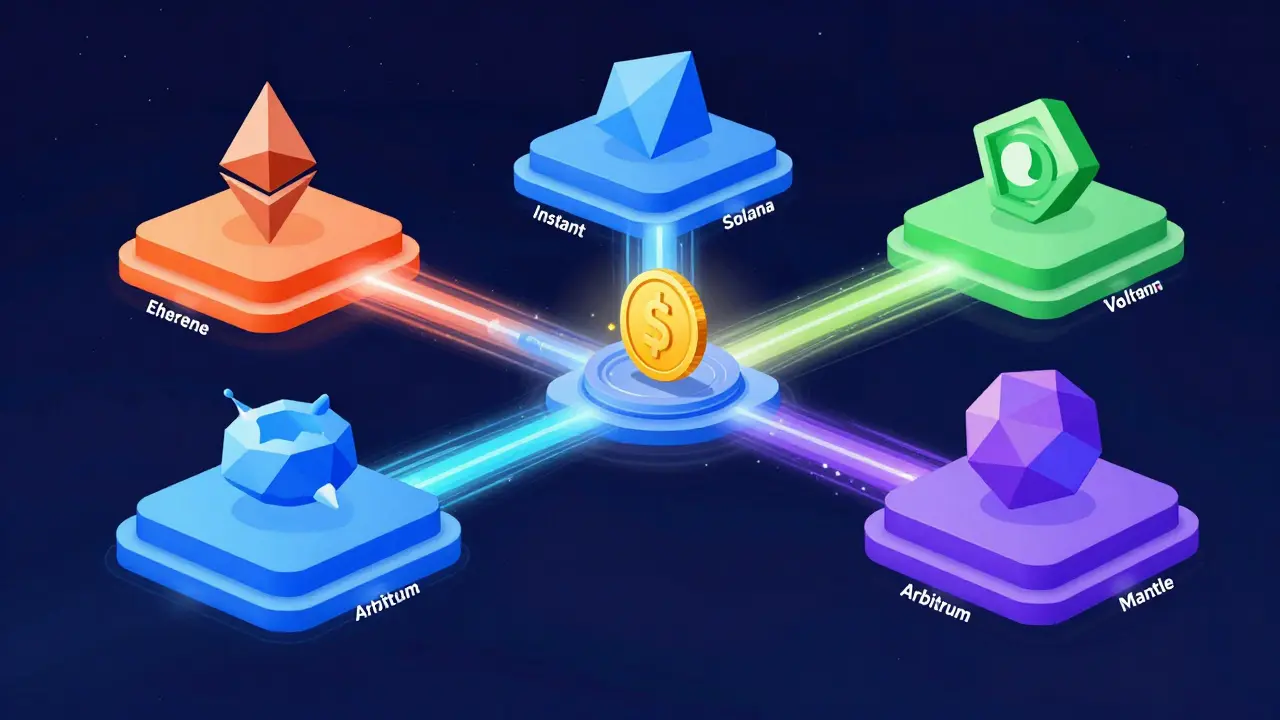
Technically, AUSD operates as a multi-chain asset. It’s not locked to one blockchain. Instead, it’s deployed across six major networks: Ethereum, Solana, Avalanche C-Chain, Polygon, Arbitrum, and Mantle. On Ethereum, it functions as an ERC-20 token with a specific contract address (0x00000000efe302beaa2b3e6e1b18d08d69a9012a) and uses 6 decimal places, similar to other major stablecoins.
The key technical advantage Agora claims is gas optimization. Their smart contracts are designed to reduce transaction fees by approximately 40-60% compared to standard ERC-20 tokens. In tests conducted between July and October 2024, AUSD transactions on Ethereum mainnet averaged $0.45, while USDC transactions averaged $0.94 during the same period. For high-volume institutional traders, those savings add up quickly.
Another feature worth noting is "Instant Liquidity." This proprietary tool allows users to mint AUSD against USDC or USDT with settlement times under 15 seconds across supported chains. Traditional bridging solutions often take 2-5 minutes or longer, exposing users to bridge risks and price slippage. AUSD aims to eliminate that friction entirely.
| Feature | AUSD | USDC | USDT |
|---|---|---|---|
| Market Cap (Dec 2025) | $183.5 Million | $48.3 Billion | $88.6 Billion |
| Primary Audience | Institutions / Enterprises | Retail & Institutions | Retail & Exchanges |
| Reserve Composition | Cash, Treasuries (<90 days), Repos | Treasuries, Cash Equivalents | Commercial Paper, Cash, Deposits |
| Exchange Listings | 23 | 187+ | 200+ |
| Transparency Rating (Artemis) | A+ | A | B |
| Cross-Chain Reliability | 98.7% | 92.4% | 88.1% |
Security and Transparency: The Institutional Edge
If you’re dealing with millions of dollars in treasury management, trust isn’t optional-it’s mandatory. AUSD addresses this through rigorous auditing and real-time monitoring. Agora partners with BPM LLP, an independent accounting firm, for quarterly attestations. Additionally, they use Artemis, a blockchain analytics platform, for real-time reserve monitoring.
This combination earned AUSD an "A+" rating from Artemis Analytics for reserve transparency, outperforming both USDC (rated "A") and USDT (rated "B"). While USDT has improved its transparency over the years, it still lags behind in providing real-time data access. AUSD’s approach is proactive rather than reactive, giving institutional clients peace of mind that their collateral is actually there.
However, no system is perfect. Critics point out that AUSD’s smaller market cap makes it vulnerable to liquidity issues during extreme market volatility. With only $36,372 in 24-hour trading volume compared to USDC’s $14.2 billion, large sell-offs could cause significant slippage. This is why AUSD is rarely used by retail traders who need instant exit ramps on major exchanges.
Who Should Use AUSD?
Let’s be clear: AUSD is not for everyone. If you’re a retail investor looking to swap tokens on Uniswap or pay for goods online, AUSD will likely frustrate you. It’s listed on only 23 exchanges, making on-ramps difficult for non-institutional users. One Reddit user noted experiencing 2.3% slippage when trying to swap to AUSD due to low liquidity pools-a common issue for niche assets.
On the flip side, if you work for a fintech company, a trading firm, or a traditional financial institution exploring blockchain integration, AUSD offers distinct advantages. Enterprise users report seamless integration with existing treasury management systems and 30% lower transaction costs than USDC on Ethereum mainnet. The API documentation provided by Agora is also highly rated, with developers praising the multi-chain deployment guides.
Implementation typically takes 3-5 business days for enterprise clients, supported by dedicated technical teams boasting a 98.7% first-contact resolution rate. Agora has even launched certification programs, training nearly 300 developers since launch. This level of support is something you won’t find with decentralized protocols like USDC, which operate more passively.

Market Position and Future Outlook
As of early 2026, the stablecoin market is projected to grow from $165 billion to $310 billion by 2027. Regulatory pressures are intensifying, with 78% of institutional investors prioritizing compliant stablecoins with transparent reserves. AUSD fits squarely into this trend.
Agora has secured partnerships with 14 institutional players, including Fidelity Digital Assets and Kraken Institutional. More importantly, they announced plans to integrate with the SWIFT network by Q3 2026, piloted with major banks like JPMorgan and Citibank. If successful, this move could bridge the gap between traditional banking infrastructure and decentralized finance, giving AUSD a unique competitive moat.
JPMorgan’s blockchain research team estimates a 68% probability of AUSD sustaining operations through 2030, based on its institutional partnerships and regulatory positioning. While this is lower than USDC’s 82%, it reflects AUSD’s specialized niche rather than failure. Bernstein analysts predict AUSD could capture 0.5-1.2% market share by 2027 if it executes its institutional strategy effectively.
Potential Risks and Challenges
No investment is without risk. AUSD faces several headwinds. First, regulatory changes such as the proposed 2026 Stablecoin Transparency Act could impose new burdens on issuers. Second, competition from Circle’s upcoming USDC 3.0 may erode AUSD’s technological edge. Third, the reliance on traditional finance relationships means AUSD’s success is tied to broader macroeconomic conditions affecting banks and treasuries.
Additionally, some DeFi researchers remain skeptical of the "Stablecoin 3.0" label, viewing it as marketing rather than substantive innovation. A University of Pennsylvania Blockchain Lab report suggested that while AUSD’s architecture is sound, its value proposition depends heavily on achieving scale-a chicken-and-egg problem common in network-effect-driven markets.
Is AUSD safe to hold?
For institutional users, yes. AUSD is backed 1:1 by cash and short-term U.S. Treasuries, with quarterly audits by BPM LLP and real-time monitoring via Artemis. However, its smaller market cap ($183M) poses liquidity risks for large trades compared to USDC or USDT.
Can I buy AUSD on Coinbase or Binance?
Not currently. AUSD is listed on only 23 exchanges, primarily catering to institutional platforms like Kraken Institutional. Retail users may face difficulties finding direct on-ramps or deep enough liquidity pools for easy swapping.
How does AUSD compare to USDC?
AUSD offers lower gas fees (~52% less on Ethereum) and higher cross-chain reliability (98.7% vs 92.4%). However, USDC has vastly greater liquidity, wider exchange support (187+ vs 23), and larger market cap. AUSD targets enterprises; USDC serves both retail and institutions.
What blockchains does AUSD support?
AUSD operates on six major networks: Ethereum, Solana, Avalanche C-Chain, Polygon, Arbitrum, and Mantle. It uses identical underlying reserves across all chains, enabling seamless cross-chain transfers via its Instant Liquidity feature.
Who created AUSD?
AUSD was launched by Agora, a fintech company led by Nick van Eck, former CEO of VanEck Digital Assets. It was released in July 2024 specifically to serve institutional clients requiring regulatory compliance and enhanced security.