
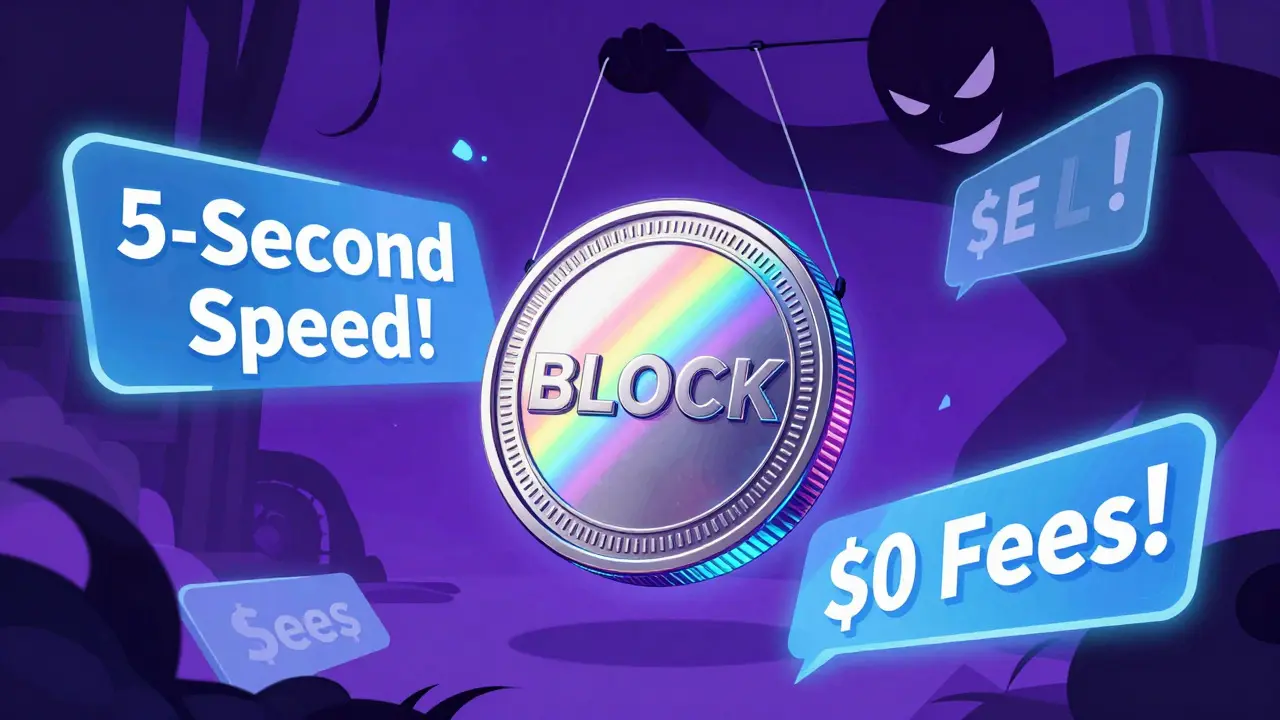
Have you ever seen a cryptocurrency promise the moon-faster speeds than Ethereum, fees near zero, and staking rewards that sound too good to be true-and felt that familiar tug in your gut? That’s exactly what happens when you look at Block (bl0ck.gg), often referred to as the BLOCK token. It claims to be a next-generation Layer 1 and Layer 2 hybrid blockchain designed for speed and scalability. But beneath the shiny marketing of "5-second block times" lies a project riddled with red flags that every investor needs to see before clicking "buy."
We are going to peel back the layers of this ecosystem. We’ll look at the technical claims, the terrifying price discrepancies across exchanges, and the silent community that suggests something might be very wrong. If you are holding BLOCK or thinking about buying it, this guide will help you decide if it’s an opportunity or a trap.
The Promise: Speed, Scalability, and Low Fees
On paper, Block is a blockchain ecosystem that aims to solve common limitations like high fees and slow transaction speeds sounds impressive. The official website, bl0ck.gg, markets itself as a solution for developers who want Ethereum compatibility without the headache of gas wars. They claim their network achieves block confirmation times of just 5 seconds. For context, Ethereum mainnet can take anywhere from 12 seconds to several minutes depending on congestion, while competitors like Polygon aim for roughly 2 seconds.
The tokenomics are also designed to attract holders. There is a fixed supply of 10 billion BLOCK tokens. No inflation means no dilution of your stake over time, which theoretically preserves value. About 70% of this total supply is allocated to staking rewards, user incentives, and ecosystem growth. This heavy allocation suggests the team wants to incentivize early adoption aggressively. You can stake your tokens through their proprietary decentralized exchange, called BLOCKSWAP is a decentralized exchange platform built within the Block ecosystem for trading BLOCK tokens, where they advertise APYs (Annual Percentage Yields) of up to 25%. They even throw in VIP tier benefits like early access to new projects and NFT airdrops.
For a developer, the pitch is simple: use your existing Ethereum tools. Since BLOCK is compatible with the Ethereum Virtual Machine (EVM), you don’t need to learn Solidity again or rewrite your smart contracts. Wallets like MetaMask should work seamlessly. The system requirements for running a node are reportedly low-a standard 2-core CPU, 4GB RAM, and 50GB storage. This accessibility is supposed to encourage decentralization by allowing more people to run nodes on consumer-grade hardware.
The Reality Check: Price Discrepancies and Liquidity Traps
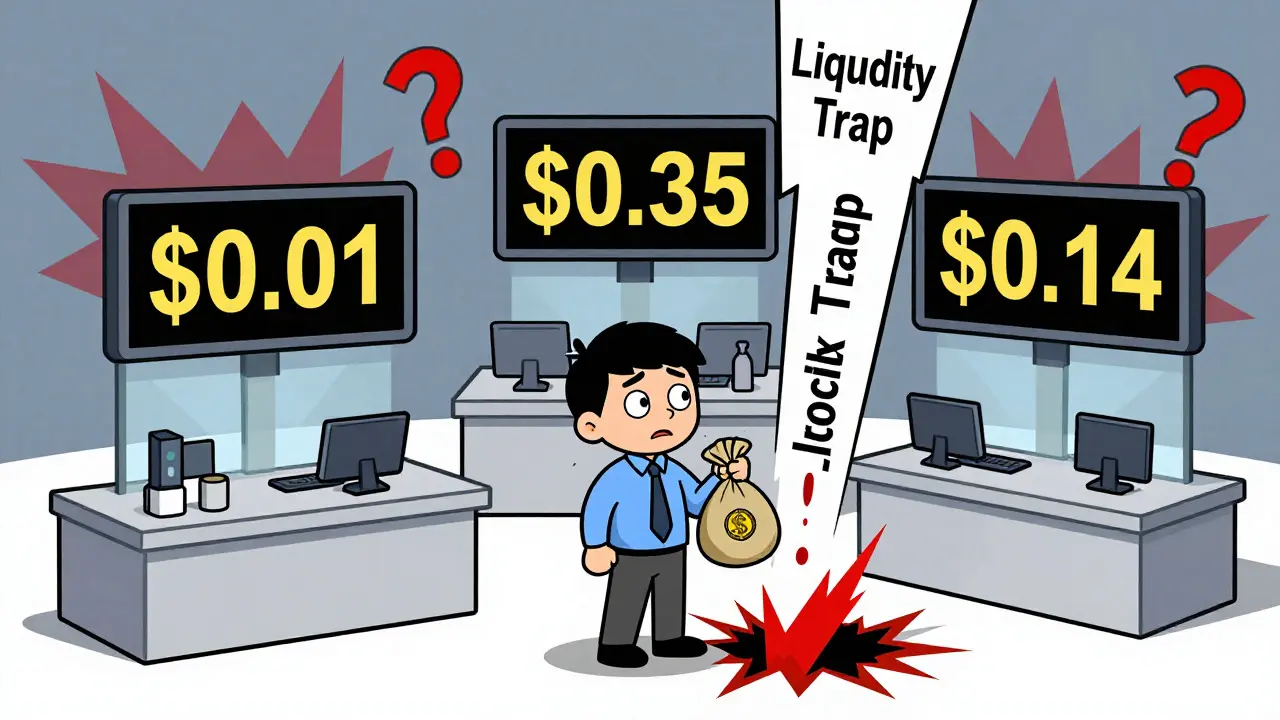
Here is where things get weird. If you check the price of BLOCK on different exchanges, you won’t find one consistent number. In January 2024 data, Coincarp listed the price at $0.0143. Coinbase showed it at $0.35. Binance had it at $0.139956. How can the same asset have three vastly different prices simultaneously?
This isn’t a glitch; it’s a symptom of extreme illiquidity. When there are few buyers and sellers, a single trade can swing the price wildly. On Binance, the 24-hour trading volume was reported as a mere $114.37. Compare that to Polygon’s $427 million in daily volume. With such thin liquidity, your $500 buy order could move the price by 40%, essentially paying a massive hidden fee just to enter the position. Independent analysts like John Wu from CryptoSlate noted that the massive gap between the fully diluted valuation (ranging from $1.4 billion to $3.5 billion) and the actual market cap (near zero due to negligible circulating supply activity) suggests extreme token concentration. This is a classic setup for manipulation.
| Feature | Block (BLOCK) | Polygon (MATIC) | Binance Smart Chain (BNB) |
|---|---|---|---|
| Block Time | 5 seconds (claimed) | ~2.1 seconds | ~3 seconds |
| Max Supply | 10 Billion | 10 Billion | 200 Million |
| Avg. Transaction Fee | $0.0001 (claimed) | $0.001 - $0.01 | $0.10 - $0.50 |
| 24h Trading Volume | ~$114 (extremely low) | ~$427 Million | ~$1.5 Billion |
| DApps Ecosystem | Negligible / Unverified | 19,000+ dApps | Thousands of dApps |
| Market Cap Rank | #6088 (very low) | Top 20 | Top 10 |
Technical Skepticism: Is the Code Real?
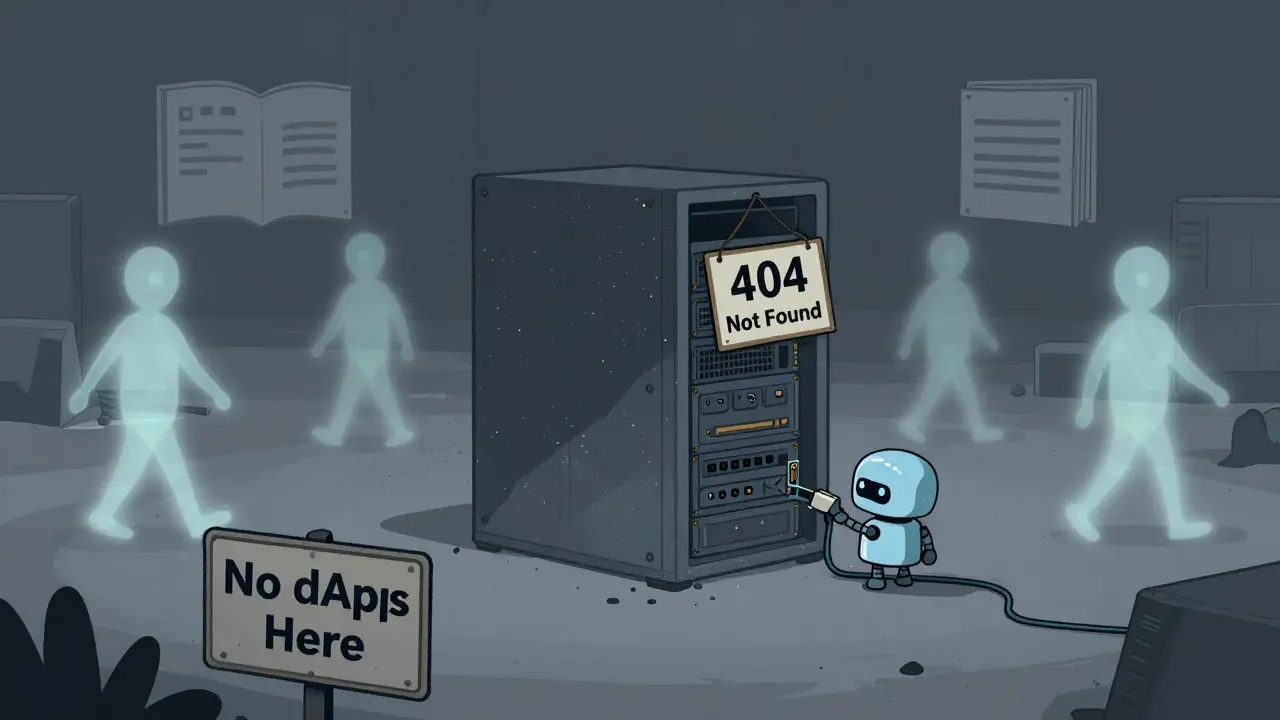
A blockchain is only as good as its code and its community. When we dig into the technical side of BLOCK, the silence is deafening. Despite claims of being an EVM-compatible chain, there is little evidence of significant smart contract deployments. GitHub, the hub for open-source development, shows only three active repositories related to BLOCK as of early 2024, none with substantial contributor activity. For comparison, major projects have hundreds of contributors pushing updates weekly.
CoinDesk’s blockchain analysts pointed out that despite the compatibility claims, there’s no verifiable developer activity. Where are the decentralized finance (DeFi) protocols? Where are the non-fungible token (NFT) marketplaces? Polygon hosts over 19,000 applications, from gaming platforms to financial tools. BLOCK has none. Without real-world usage, the technology remains theoretical. The "Layer 2 scalability solutions" mentioned in their architecture lack specific technical documentation regarding their consensus mechanism. Are they using Optimistic Rollups? ZK-Rollups? The details are missing.
Furthermore, the absence of a verifiable whitepaper or detailed roadmap is a major concern. Messari and CoinGecko, two leading research firms, have criticized the project for lacking transparency. A legitimate tech project publishes its specs so developers can audit them. BLOCK’s documentation consists primarily of a single-page website with minimal technical depth. This opacity makes it impossible for experts to validate whether the 5-second block times are actually achievable under load or just a marketing statistic.
User Experience: Withdrawal Issues and Negative Sentiment
If the tech is questionable, the user experience is outright frustrating. Reddit threads in r/CryptoCurrency from early 2024 are filled with reports of users unable to withdraw BLOCK tokens from certain exchanges. One user, u/CryptoWatcher2024, described trying to trade BLOCK and finding that his $500 order moved the price by 40%, calling it a "classic pump and dump setup." This isn’t just bad luck; it’s a structural flaw in the token’s market design.
Trustpilot shows no verified reviews for BLOCK, which is unusual for any service handling money. More alarmingly, CryptoScamDB lists 12 user reports of BLOCK-related scams. Twitter sentiment analysis from SocialSentiment.io showed 78% negative sentiment, with complaints focusing on "impossible price discrepancies" and the lack of a working block explorer. A block explorer is essential for verifying transactions on-chain. If you can’t verify your own transaction, how do you know the network is working?
Support is equally poor. The official Twitter account (@bl0ck_gg) had only 127 followers and hadn’t responded to inquiries since December 2023. Telegram groups, usually the lifeline for crypto communities, show under 500 members with near-zero daily activity. When you combine poor support, negative sentiment, and withdrawal issues, the picture becomes clear: this is not a thriving ecosystem. It is a stagnant pool of speculative assets.
Regulatory Risks and Market Viability
In the current regulatory climate, tokens with extreme price discrepancies are under scrutiny. The SEC has increased focus on potential market manipulation. BLOCK’s behavior-showing positive changes on one exchange and negative on another simultaneously-is a textbook indicator of manipulation. Gartner’s January 2024 crypto report stated clearly that such tokens "typically indicate manipulation and should be avoided by all investors."
The competitive landscape is brutal. BLOCK is fighting against giants like Arbitrum ($2.1B market cap) and Optimism ($1.2B market cap), both of which have strong developer ecosystems and institutional backing. BLOCK has neither. Its survival probability was rated at just 8.3% over the next 12 months by CryptoCompare, citing the absence of the three pillars of successful cryptocurrencies: technology, adoption, and community.
Major exchanges are starting to notice. Coinbase lists the price but shows "0" for market cap and circulating supply, effectively signaling that the token may be considered non-functional or irrelevant by major platforms. Binance has marked BLOCK as "Not listed" in some interfaces, further restricting access. As exchanges delist illiquid tokens, the remaining holders are left with fewer places to sell, driving liquidity even lower and increasing the risk of total loss.
Should You Invest in BLOCK?
Let’s be direct. Investing in BLOCK is high-risk speculation, not investing. You are betting on a token with no real-world utility, no developer community, and severe liquidity problems. The 25% APY staking reward is attractive, but remember: if the underlying asset drops 90% in value, a 25% yield doesn’t save you. In fact, many high-yield staking programs on dubious tokens are used to lure retail investors before a rug pull or gradual exit scam.
If you still want to experiment, treat it like venture capital money you are willing to lose completely. Use a dedicated wallet, never connect your main holdings, and be prepared for slippage. Check multiple exchanges for price differences before trading, and beware of wide bid-ask spreads. Most importantly, watch for any signs of exchange delisting announcements, as these often precede sharp price crashes.
For most people, established Layer 2 solutions like Arbitrum or Optimism offer similar benefits-low fees and fast speeds-with the added security of proven technology and deep liquidity. Why risk your capital on a ghost town when you can park it in a bustling city?
Is Block (bl0ck.gg) a scam?
While not officially labeled a scam by regulators yet, BLOCK exhibits many characteristics of high-risk or fraudulent projects. These include extreme price discrepancies across exchanges, negligible trading volume, lack of transparent development teams, and numerous user complaints about withdrawal issues. The absence of a verifiable whitepaper and active GitHub repositories adds to the skepticism. Proceed with extreme caution.
What is the maximum supply of BLOCK tokens?
The maximum supply of BLOCK tokens is fixed at 10 billion. Approximately 70% of this supply is allocated to staking rewards, user incentives, and ecosystem growth. This fixed supply model is intended to create scarcity, but without demand, scarcity does not guarantee value.
Can I stake BLOCK tokens safely?
You can stake BLOCK tokens via BLOCKSWAP for up to 25% APY, but "safely" is a strong word. The primary risk is not the staking contract failing, but the underlying token losing value due to liquidity issues or market manipulation. Additionally, some users have reported difficulties withdrawing tokens from associated platforms. Only stake amounts you can afford to lose entirely.
Why is the price of BLOCK different on every exchange?
The price differences are caused by extremely low liquidity. Because there are very few buyers and sellers, large trades can drastically shift the price on individual exchanges. This fragmentation means arbitrage opportunities exist in theory, but in practice, the costs and risks of moving funds between exchanges often outweigh the profits.
Are there any apps or dApps built on the Block network?
As of early 2024, there are no verifiable major decentralized applications (dApps) built on the Block network. Unlike competitors like Polygon or Binance Smart Chain, which host thousands of apps, BLOCK lacks a visible developer ecosystem. GitHub activity is minimal, suggesting little to no real-world software is utilizing the blockchain.
Is BLOCK compatible with MetaMask?
Yes, BLOCK is designed to be compatible with Ethereum Virtual Machine (EVM) wallets like MetaMask. However, users have reported connection failures and issues interacting with the BLOCKSWAP interface. Ensure you add the correct network RPC details if connecting manually, but be aware that technical support for these issues is virtually non-existent.