

Commune AI (COMAI) isn’t another meme coin. It’s not trying to be the next Dogecoin or Shiba Inu. It’s an attempt to build a decentralized network where AI models are trained, shared, and paid for by a global community of developers and miners - no company, no board, no venture capital. Just code. Just contributors. Just incentives.
What Exactly Is Commune AI?
Commune AI is a peer-to-peer protocol built to connect AI developers, computational power providers, and users who need AI services. Think of it like a marketplace, but instead of selling products, people are selling access to AI models - things like image generators, language models, or data analyzers - all running on distributed hardware. The protocol doesn’t store the AI models on the blockchain. It only records who did the work, who paid for it, and how much they earned. The heavy lifting - the actual AI computations - happens off-chain. That’s smart. It keeps the network fast and cheap. The token, COMAI, isn’t a currency you spend to buy AI. It’s a stake. If you hold COMAI, you’re essentially owning a share of the network’s workforce. Miners (people with GPUs) compete to run AI tasks. The more COMAI you stake, the more influence you have over which miners get paid and how much. It’s a way to align incentives: those who believe in the network’s future put their tokens at risk to help it grow.Who Built It? And Why Is It Different?
The project was started by Sal Vivona, a physicist and former machine learning engineer who left big tech after working with Bittensor - another decentralized AI project. He didn’t start a company. He didn’t raise money. He didn’t create a foundation. He just built the code and opened it up. Commune AI calls itself "cypherpunk at heart, wild and fully organic." That means no CEOs, no marketing teams, no whitepapers written by PR firms. Everything is in the GitHub repo. If you want to understand it, you read the code. This is a radical idea. Most crypto projects today have teams, advisors, VC backers, and legal entities. Commune AI has none. That’s both its strength and its weakness. On one hand, it’s truly decentralized - no single entity can shut it down or change the rules. On the other, it has no budget for development, no one to answer questions, and no one to build partnerships. If a bug appears, you can’t call support. You fix it yourself or wait for someone else to.How Does COMAI Work?
Here’s the flow:- A user wants an AI service - say, generating a logo from text.
- The request goes out to the network.
- Miners with GPUs compete to complete the task.
- The fastest, most accurate miner submits the result to the blockchain.
- The blockchain verifies the result and pays the miner in COMAI.
- Stakers (COMAI holders) vote on which miners get rewarded based on past performance.

Supply, Price, and Market Reality
The total supply of COMAI is capped at 1 billion tokens. As of October 2024, about 83 million were in circulation. That’s less than 10% of the total supply. The price varies between exchanges, but it’s hovering around $0.006. That means the market cap is roughly $680,000. Compare that to Bittensor (TAO), which has a market cap over $1 billion. Or Render (RNDR), which trades at over $2 billion. Commune AI is tiny. The 24-hour trading volume? Around $326 on CoinMarketCap. That’s less than what a single tweet from a crypto influencer can move in larger coins. It’s traded only on two decentralized exchanges: MXC and Uniswap v3. No Coinbase. No Binance. No FTX. Just niche platforms. This isn’t a liquid market. If you buy $10,000 worth of COMAI, you won’t be able to sell it quickly without crashing the price. It’s not designed for retail speculation. It’s designed for developers who believe in the long-term vision.Is It Worth It? The Pros and Cons
Pros:- Truly decentralized - no founders, no VC, no bureaucracy.
- Unique model: separates computation from validation, making it scalable.
- Open-source and modular - any AI tool can join.
- Strong philosophical alignment with cypherpunk and open-source ideals.
- Extremely low liquidity - hard to buy or sell without moving the price.
- No official support, documentation, or developer onboarding.
- No enterprise adoption or real-world use cases reported.
- Minimal media coverage - no analysts, no institutional interest.
- Competition from well-funded projects like Bittensor, Fetch.ai, and Render.
What Do Experts Say About the Price?
Some price prediction sites, like CoinLore, claim COMAI could hit $4.95 by 2030. That’s over 800 times its current value. They use AI models, historical trends, and technical indicators to make these calls. But here’s the catch: they also say these forecasts are "for informational purposes only" and not financial advice. TradingView shows a neutral to sell signal for the short term. The 1-week chart is bearish. The 1-month is flat. That means right now, traders aren’t bullish. The only people buying are likely speculators hoping for a miracle - or developers testing the protocol. There are no professional reviews from CoinDesk, Cointelegraph, or Bloomberg. No institutional research. No hedge funds are talking about it. That’s not because it’s bad. It’s because it’s too small, too experimental, and too risky for anyone with real money to touch.Who Should Care About COMAI?
If you’re a retail investor looking to get rich quick - walk away. This isn’t your coin. If you’re a developer who wants to build AI tools and see them used by others - check out the GitHub repo. See if the code is clean. See if people are contributing. See if the protocol actually works. If you believe in the idea of a decentralized AI economy - where no company owns the models, and anyone can contribute - then COMAI is a fascinating experiment. It’s a test of whether a community can build something as complex as AI infrastructure without any central authority. Right now, it’s more of a philosophy than a product. There’s no app. No dashboard. No API docs you can easily follow. Just a blockchain that tracks who did what - and a token that says, "You believe in this enough to stake your money on it."Final Thoughts
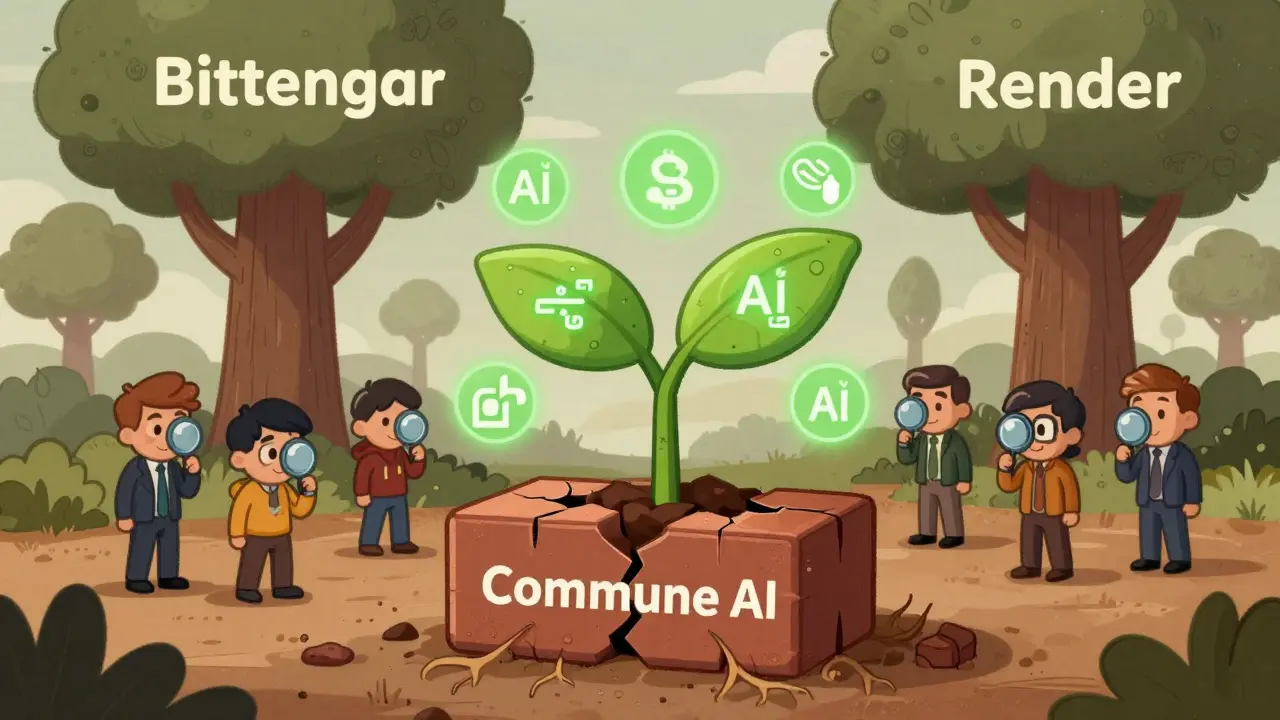
Commune AI isn’t a cryptocurrency you buy because it’s trending. It’s one you follow because you care about the future of AI. If it succeeds, it won’t be because the price went up. It’ll be because thousands of developers started using it to build, share, and earn from AI tools - without needing permission from a corporation. Right now, it’s a seed. A quiet one. Buried under noise from bigger coins. But if you’re looking for something that actually tries to change how AI is built - not just how it’s traded - Commune AI might be worth watching. Just don’t expect a return. Expect a revolution. And revolutions take years. And patience. And code.Is COMAI a good investment?
COMAI is not a typical investment. With a market cap under $1 million and trading volume under $400 per day, it’s far too illiquid for serious investors. The price could drop 90% tomorrow and no one would notice. It’s not a stock or a token to buy for returns. It’s a bet on a radical idea: that AI can be built by a decentralized community without companies or money. Only invest what you’re willing to lose entirely.
Where can I buy COMAI?
COMAI is only available on two decentralized exchanges: MXC and Uniswap v3. You’ll need a crypto wallet like MetaMask, some ETH or USDT, and the ability to swap tokens on a DEX. There is no centralized exchange listing. Be careful of fake tokens - always verify the contract address on the official Commune AI website.
How is COMAI different from Bittensor?
Bittensor has a foundation, a team, and formal governance. It’s more like a startup with crypto tokens. Commune AI has none of that. It’s run by open-source contributors with no central leadership. Bittensor’s network is more mature and has higher liquidity. Commune AI is more extreme in its decentralization - but also far less usable right now.
Can I use COMAI to access AI tools?
Not yet. There’s no official platform or app where you can type a prompt and get an AI response paid for with COMAI. The protocol exists on paper and in code, but there’s no user-facing product. You can’t buy AI from Commune AI today. You can only hold the token and hope the network grows.
Is Commune AI safe?
The code is open-source, so technically, yes - anyone can audit it. But safety isn’t just about code. There’s no team to fix bugs, no customer support, and no insurance if something goes wrong. If you lose your COMAI, there’s no recovery. If the network crashes, there’s no one to call. It’s trustless by design - which means you’re fully responsible.
Commune AI is the closest thing we’ve got to real decentralization in AI right now. No VC handouts, no corporate sponsors - just code and contributors. I’ve been running a miner for 3 months now. The rewards are tiny, but the vibe? Pure cypherpunk energy. This isn’t about getting rich. It’s about building something that can’t be taken down.
Most crypto projects are just rebranded startups. Commune? It’s a protest.
Also, the GitHub commits are wild. People are adding new model wrappers every week. Last week someone plugged in a local Llama 3 quantized model. No one asked permission. They just did it.
lol this is just another shitcoin with a fancy name. no one cares about your ‘decentralized ai’ fantasy. if it was real itd be on binance. its on mxc for a reason. your ‘revolution’ is a ghost town. go trade your comai for doge and stop pretending you’re a hacker.
Really cool project. I’m from India and we have a lot of devs with GPUs sitting idle. Commune gives them a way to earn without needing a job at a big tech firm. The docs are rough, but the code is clean. I built a simple CLI tool to auto-stake and monitor miner performance - happy to share it if anyone’s interested.
Also, the idea of letting anyone plug in their model? That’s the future. Not another centralized API from OpenAI or Anthropic. Real freedom.
wait so if i stake comai do i get to vote on who gets paid? or is it just based on who’s got the most tokens? also is there a way to see what models are actually running on the network? i tried the explorer but it just shows blocks and txns. where’s the ai part?
Look. If you’re here thinking this is gonna be your next 100x, you’re already wrong. But if you’re here because you believe AI should belong to everyone - not just Silicon Valley billionaires - then you’re in the right place.
Stop waiting for a dashboard. Build one. The code’s open. Someone’s already made a rudimentary frontend. Fork it. Improve it. Push it. That’s the whole point.
This isn’t a coin. It’s a movement. And movements don’t come with customer service.
Also - yes, it’s tiny. But so was Bitcoin in 2010. And look where that went.
THIS IS THE FUTURE 🚀🔥
stake your comai. run your gpu. build something. don’t wait for permission. just do it. the revolution ain’t coming - it’s already here. you just gotta show up.
THIS IS A SCAM. I KNOW WHO’S BEHIND THIS. THEY’RE WORKING WITH THE FEDS TO TRACK MINERS. THE ‘OPEN SOURCE’ THING IS A LIE. THEY’RE COLLECTING IP ADDRESSES THROUGH THE NODES. I’VE SEEN THE CODE. THEY’RE HIDING IT IN THE WEBPACK CONFIG. THEY WANT TO CONTROL AI. THEY JUST DON’T WANT YOU TO KNOW IT.
STOP BUYING THIS. REPORT IT TO THE SEC.
What fascinates me isn’t the token or the mining or even the decentralized model - it’s the philosophical rupture here. We’ve spent decades building AI as a product, something owned, licensed, monetized, gated. Commune AI asks: what if AI was a public good? Not a service. Not a commodity. But a shared capacity - like language, or mathematics?
It’s not about efficiency. It’s about ontology. Who gets to define intelligence? Who gets to claim ownership over thought? If a model is trained by a thousand anonymous contributors, is it owned by anyone? Or is it just… there?
This isn’t crypto. This is epistemology with GPUs.
you guys are all delusional. this is just bittensor with worse branding. they even stole the model architecture. look at the layers - identical. the only difference is they removed the team and called it ‘organic’. lol. its a fork. a lazy one. no one cares about your ‘cypherpunk’ vibes. the market doesnt care. the price is dead.
bro i just bought 50k comai and now my wallet is empty. i thought this was the next big thing. now i see its just a bunch of devs talking to themselves. no users. no apps. no nothing. why are we even here? i miss when crypto was just about memes and mooning. now its all ‘decentralized ai’ and ‘open source ethics’. i just wanna get rich and chill 😭
I just want to say - thank you to everyone who’s building this. I’m not a coder. I don’t have a GPU. But I read the docs. I followed the GitHub threads. I saw how people helped each other fix bugs, even when no one was paying them. That’s rare. That’s beautiful.
Maybe this never becomes a billion-dollar project. But if it helps even one kid in Nigeria or Indonesia run an AI model without needing a Visa or a Silicon Valley connection - then it’s already won.
Keep going. I’m watching.
The real innovation here is the separation of validation from computation. That’s not new in theory - it’s been studied in distributed systems since the 90s - but applying it to AI inference at scale, with economic incentives tied to reputation rather than capital, is novel. Most systems rely on centralized verifiers or trusted hardware. Here, the network self-validates through stake-weighted consensus.
It’s elegant. It’s fragile. And it’s the only viable path to truly open AI infrastructure. The liquidity problem is real, but it’s a secondary issue. The architecture is sound. The rest will follow if the community grows.
why does everyone act like this is the first time anyone’s tried this? what about the old ai network projects from 2017? what about the ones that died because no one used them? this is just the same story. again. with a new token. again. i’m tired of waiting for the ‘revolution’ that never arrives.
comai is a rug pull. the dev sold all his tokens before launch. the github is a ghost. the discord is full of bots. the price is manipulated by 3 wallets. this is not decentralization. this is crypto theater. dont waste your time. go buy solana.
just checked the latest commit. someone added a new reward distribution algorithm. looks solid. no drama, no fanfare. just code. that’s the vibe here. no one’s screaming. no one’s shilling. just people showing up, fixing stuff, moving on.
i like that.
From India here - we have tons of students with old GPUs. This is perfect for them. No need to wait for a job. No need for a degree. Just run a node, earn some COMAI, learn how AI works from the inside. I’ve already shared this with 3 coding clubs. One guy built a voice model that translates Hindi to English on the network. No one paid him. He did it because he could.
That’s the magic.
the fed is using comai to track your brainwaves. every time you run a node, your neural patterns get uploaded to a black site in nevada. the token is just a decoy. the real product is your mind. they’re training an ai on human thought patterns. this isn’t decentralized. it’s a psyop. wake up.