
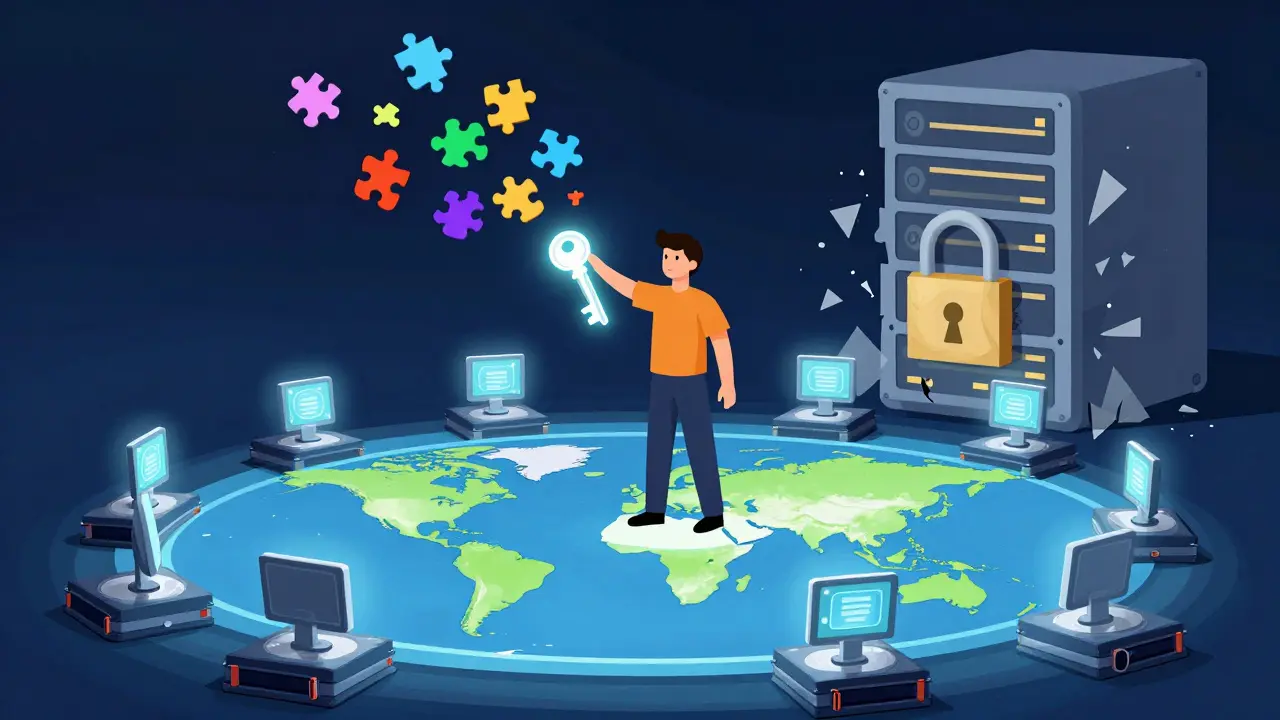
Imagine storing your files not on a server owned by a big tech company, but scattered across thousands of computers around the world - each holding a tiny, encrypted piece of your data. No single company controls it. No hacker can wipe it all out. And you, not a corporation, hold the only key to unlock it. That’s decentralized storage.
How Decentralized Storage Works
Traditional cloud storage like Google Drive or Dropbox keeps your files on a few massive data centers. If one of those servers crashes, goes offline, or gets hacked, your data could vanish or be stolen. Decentralized storage flips that model. Instead of trusting one company, you trust a network. Here’s how it actually works:- Your file is split into 10-20 small pieces called shards.
- Each shard is encrypted with your private key - meaning only you can decrypt it.
- These shards are sent to hundreds of independent computers (called nodes) across the globe.
- No single node has your full file. Even if someone hacks one node, they only see scrambled data.
- To get your file back, the system finds the right shards, pulls them together, and decrypts them - using your key.
Why It’s More Secure Than Cloud Storage
Centralized storage has one fatal flaw: a single point of failure. If Amazon’s S3 servers go down, millions of websites go offline. If a hacker breaks into Dropbox’s database, millions of passwords and documents leak. Decentralized storage removes that risk. Because your data is spread out, encrypted, and duplicated:- Even if 10% of the nodes disappear, your file can still be rebuilt from the remaining 90%.
- There’s no central server to hack - attackers would need to compromise hundreds of machines simultaneously.
- Each file has a unique cryptographic hash (like a digital fingerprint). If even one byte changes, the hash breaks, and you know instantly that someone tampered with it.
Who Runs the Network? And Why Would They Help?
You might wonder: if no company owns this system, who’s keeping the servers running? The answer: everyday people. Anyone with spare hard drive space can join these networks and become a storage provider. In return, they earn cryptocurrency. On Sia, hosts earn Siacoin (SC). On Filecoin, they earn FIL tokens. These aren’t just bonuses - they’re payments for real infrastructure. Think of it like Airbnb for storage. Instead of renting out your spare room, you rent out your unused hard drive space. A freelance developer in Berlin might lease 500GB of their home server and earn $20/month in FIL. A student in Jakarta uses their old laptop’s 2TB drive to help store medical records for clinics in Nairobi. This creates a self-sustaining economy. The more people join, the more storage is available - and the cheaper it gets for everyone.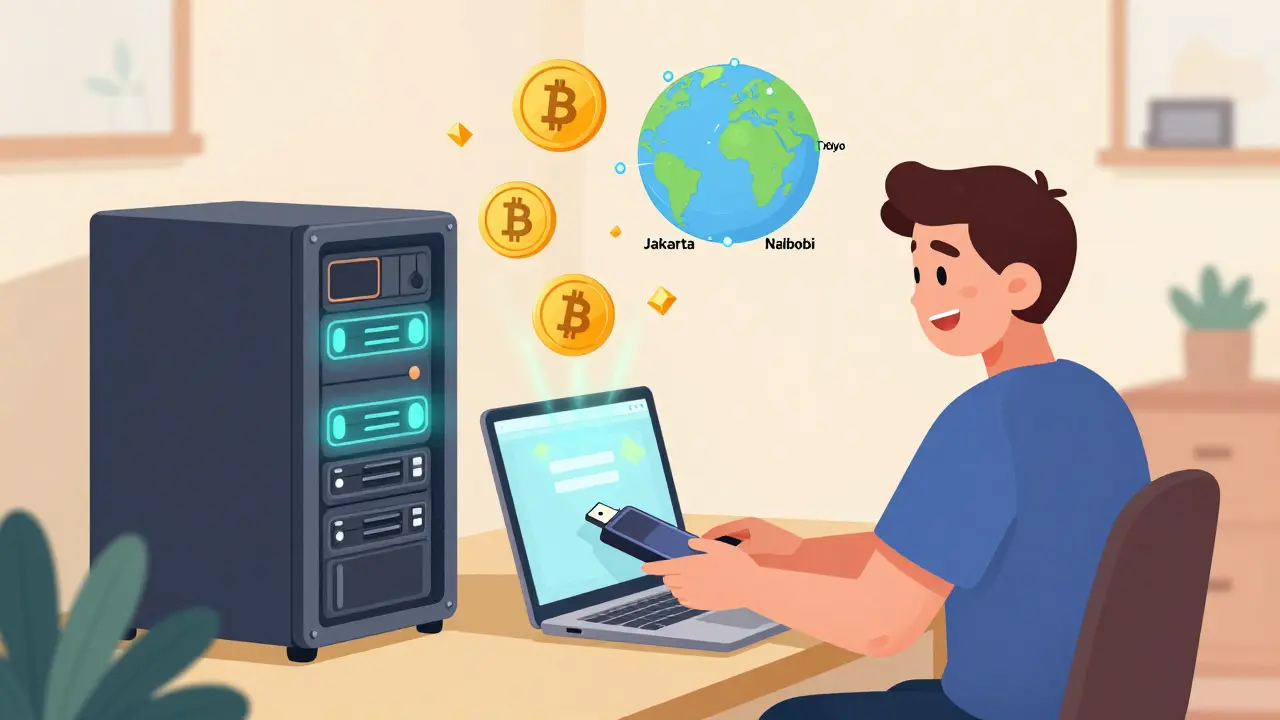
Decentralized vs. Centralized: A Clear Comparison
| Feature | Decentralized Storage | Traditional Cloud Storage |
|---|---|---|
| Control | You hold the encryption key | The company controls access |
| Location | Data spread across global nodes | Data stored in owned data centers |
| Uptime | 99.9%+ due to redundancy | Depends on provider’s infrastructure |
| Cost | Often cheaper due to unused capacity | Premium pricing for reliability |
| Censorship | No single entity can delete your files | Company can remove content on request |
| Security | Shards + encryption = no single point of attack | Single breach = mass data leak |
Real-World Use Cases Today
Decentralized storage isn’t just for tech enthusiasts. It’s already solving real problems:- Journalists and activists store sensitive documents on networks like IPFS - where governments can’t shut down access.
- Medical researchers use it to share encrypted genomic data without risking leaks.
- Game developers host assets on decentralized networks so players don’t lose progress if a company shuts down.
- Archives and museums preserve cultural heritage on blockchain-backed storage, ensuring it survives political upheavals.

Is It Perfect? The Downsides
No system is flawless. Decentralized storage has challenges:- Slower speeds - downloading from 50 random nodes takes longer than pulling from one Amazon server.
- Complexity - most users still need apps or wallets to manage keys and uploads.
- Adoption - it’s growing fast, but most people still use Dropbox because it’s easy.
Why This Matters Now
In 2026, data is more valuable than oil. But right now, you don’t own your data - corporations do. They can sell it, delete it, or hand it over to governments without your consent. Decentralized storage changes that. It gives you back control. It makes censorship harder. It turns idle hardware into public infrastructure. And it does it without needing permission from anyone. This isn’t just about storage. It’s about who owns the future of the internet.Is decentralized storage the same as blockchain?
No. Blockchain is the ledger that tracks where data is stored and who paid for it. Decentralized storage is the actual system that stores the files. Think of blockchain as the receipt and the storage network as the warehouse. Filecoin and Sia use blockchain to manage payments and verify storage - but the files themselves are stored on regular hard drives across the globe.
Can I use decentralized storage for my personal photos?
Yes - and it’s safer than uploading them to Google Photos. Apps like Storj and Filecoin offer simple desktop tools. You drag and drop your files, they’re encrypted and split across nodes. Only you have the key. Even if the app shuts down tomorrow, your data remains accessible as long as the network is live.
What happens if a node storing my data goes offline?
Your file is stored across dozens of nodes. If one goes down, the network automatically pulls the data from the remaining ones. Redundancy is built in - most systems store at least 3-5 copies of each shard. You won’t notice a single node failing. It’s like having 10 backup copies of your file scattered across different cities.
Is decentralized storage cheaper than Dropbox?
Often, yes. On Filecoin, storing 1TB costs around $2-$5 per month - roughly half the price of AWS or Google Cloud. That’s because you’re using unused hard drive space, not paying for corporate data centers. The more people join, the cheaper it gets.
Can governments block decentralized storage?
They can try - but it’s extremely hard. Since data is spread across thousands of computers in different countries, shutting down one ISP or country’s network won’t stop access. Even if a government blocks the Filecoin app, users can still access their data through alternative interfaces or peer-to-peer tools. Censorship resistance is one of its core design goals.
I work with a few devs in Bangalore who use Filecoin to store client backups. Honestly, it’s cheaper than AWS and way less scary. No one can just delete your stuff because they ‘changed their business model’. We’ve had zero downtime in 2 years. 🤘
Oh wow, another blockchain solution that ‘solves everything’ until you try to download a 4K video and it takes 17 hours. I’ll stick with Dropbox thanks. At least when it crashes, I know who to yell at.
There’s a real shift happening here that’s easy to overlook. Decentralized storage isn’t just about security - it’s about resilience. When Hurricane Idalia wiped out a data center in Florida last year, a lot of small businesses using Sia kept their archives intact. No corporate PR statement. No ‘temporary outage’. Just data, alive and accessible. That’s not tech. That’s infrastructure. And it’s growing.
i tried storj last year 😅 uploaded my cat pics and forgot the key. now i have 2000 photos of my cat wearing hats and no way to see them. it’s kinda poetic? like digital art. 🤷♀️
This is the future. Seriously. Stop thinking of it as ‘cloud 2.0’. It’s the internet reclaiming itself. Every time someone uses decentralized storage, they’re voting against corporate control. You don’t need to be a dev. Just start using it. One file at a time. 🚀
Filecoin is just a glorified peer-to-peer rental system with tokenomics layered on top. The real innovation is in the economic incentive layer - not the storage. Most users don’t care about decentralization. They care about uptime. And right now, AWS still wins on that metric. Don’t confuse novelty with superiority.
I’ve been running a Sia node for 18 months now. I have a 10-year-old laptop in my closet that does nothing but store encrypted shards. I earn about $15/month. My kid’s college fund is now 12% funded by spare hard drive space. It’s not glamorous. But it’s real. And it’s working. If you’ve got an old machine collecting dust - give it purpose.
The concept is sound. The execution is still maturing. Speed, usability, and key management remain significant barriers for non-technical users. That said, the long-term implications for data sovereignty are profound. This isn’t a replacement for cloud services - it’s a parallel infrastructure. And that’s valuable.
shard encryption + redundancy = good. but what if 50 nodes go offline at once? how do you rebuild? is there a manual? i need simple answer.
so basically we’re paying people to host our data on their laptops? sounds like a scam waiting to happen. who’s gonna pay for the electricity? the planet? the kids? 🤔
i switched to Storj for my family photos last month and i’m obsessed!! 🥹 it’s like a magic vault no one can break into. even if google shuts down tomorrow, my baby’s first steps are safe. thank you for writing this!!
I love how this empowers everyday people. My neighbor in Ohio is earning crypto just by leaving his NAS on. He didn’t even know what blockchain was six months ago. Now he’s teaching his grandkids about decentralization. That’s the kind of change that sticks.
It’s ironic. We’re told decentralization removes trust, yet we’re expected to trust random strangers on the internet to store our personal data. The assumption that encryption alone solves trust issues is naive. What if a node operator runs a backdoor? What if the client software is compromised? The attack surface is larger, not smaller.
You’re glorifying a system that consumes more energy than a small country and gives users false security. Your ‘encrypted shards’ are still vulnerable to side-channel attacks. And let’s not pretend people aren’t going to lose their keys. It’s not freedom if you can’t recover your data. It’s negligence.
i used to think this was for nerds. then i stored my dad’s cancer records on filecoin. no company owns them. no insurer can demand them. no hospital can lose them. it’s not tech. it’s dignity.
This is just crypto bros pretending they’re saving the world. Most decentralized storage networks are run by bots. The real nodes? They’re in data centers in China or Russia. You think your ‘decentralized’ file is safe? It’s probably stored on a server in a government warehouse.
if the network is global why do most nodes seem to be in usa and europe? what about africa asia south america? where is the equity?
I used to be skeptical. Then my mom, who’s 72 and thinks ‘the cloud’ is where rain comes from, uploaded her recipe book. She cried when she got it back. Said it felt like her memories were finally protected. I didn’t realize this tech could feel so human.
The comparison table is misleading. Decentralized storage doesn’t guarantee 99.9% uptime - it guarantees redundancy. Uptime depends on node availability, which is volatile. Also, ‘cost’ doesn’t account for the time investment required to manage keys, monitor shards, or recover data. For most users, convenience still trumps control.
i just started using siaskynet to host my zines. no domain, no hosting fee, no corporate middleman. if the world ends tomorrow, someone can still read my poetry. that’s worth more than any ‘reliability’ metric. 🌱
so wait… if i lose my key, i lose my stuff forever? like… forever? no password reset? no support? lol i’m out. this sounds like a horror movie
Decentralized storage? More like decentralized chaos. You think your data’s safe? What if the node that holds your 3rd shard gets seized by the FBI? What if the encryption algorithm is backdoored? You’re not owning your data - you’re gambling on it.
The real question isn’t whether decentralized storage is better. It’s whether we’ve stopped asking who gets to decide what ‘better’ means. Who decides which shards get stored where? Who sets the economic rules? The blockchain? The miners? The early adopters? We’ve just replaced one hierarchy with another - and called it freedom.