

Imagine a cryptocurrency that doesn’t rely on government bonds or US dollars for its value. Instead, it’s backed by diamonds. That’s the pitch behind Diment Dollar, a digital asset that aims to bridge the gap between luxury commodities and blockchain technology. If you’ve seen the ticker symbol **DD** pop up on a price tracker and wondered what the fuss is about, you’re not alone. It’s a niche player in a massive market, promising stability through an unconventional reserve.
But does it actually work? Is your money safe if you buy DD? And why do some sites show it at $1.00 while others list it near $0.09? Let’s cut through the marketing hype and look at the hard facts. This isn’t just another meme coin; it’s a commodity-backed stablecoin with a specific mechanism-and some significant risks attached.
What Exactly is Diment Dollar?
Diment Dollar (DD) is a diamond-backed stablecoin launched in October 2023, designed to maintain a 1:1 peg to the USD value of a physical diamond reserve held by the issuer.
To put it simply, DD is a type of stablecoin. Most people know stablecoins like USDT or USDC, which are backed by cash and treasury bills in bank accounts. Diment Dollar takes a different route. Its creators claim that every single token in circulation is matched by the equivalent value of physical diamonds stored in reserve. The goal is to offer "real-value backing" rather than relying on fiat currency fluctuations or algorithmic models that can collapse under pressure.
The project positions itself as unique because it claims to be "pre-audited and pre-backed." This means, according to their whitepaper, the diamonds are verified before the tokens are issued. You aren’t buying a promise that they *will* have diamonds later; you’re buying a token that corresponds to diamonds they supposedly already hold and have appraised. This distinction matters in the crypto world, where trust issues often stem from lack of transparency regarding reserves.
How the Diamond Backing Works
The core mechanic of Diment Dollar is its peg. The issuer maintains a portfolio of diamonds. These gems are appraised in US dollars. If the total value of those diamonds is $1 million, then theoretically, there should be 1 million DD tokens in circulation. This creates a direct link between the digital token and the physical asset.
Here is how the process is described in their documentation:
- Acquisition: The issuer buys physical diamonds.
- Audit: Independent parties verify the quality and value of these stones.
- Minting: New DD tokens are created only after the audit confirms the reserve value.
- Circulation: Users trade DD on exchanges, knowing it represents a slice of that diamond pile.
This model attempts to solve the volatility problem of Bitcoin or Ethereum while avoiding the counterparty risk associated with traditional banks holding fiat reserves. However, diamonds are not as liquid as cash. Selling a bag of gold bars is easier than selling a collection of loose gemstones quickly without affecting the price. This illiquidity is a key factor to keep in mind when evaluating the stability of DD.
The Price Discrepancy: Why Does DD Cost Different Amounts?
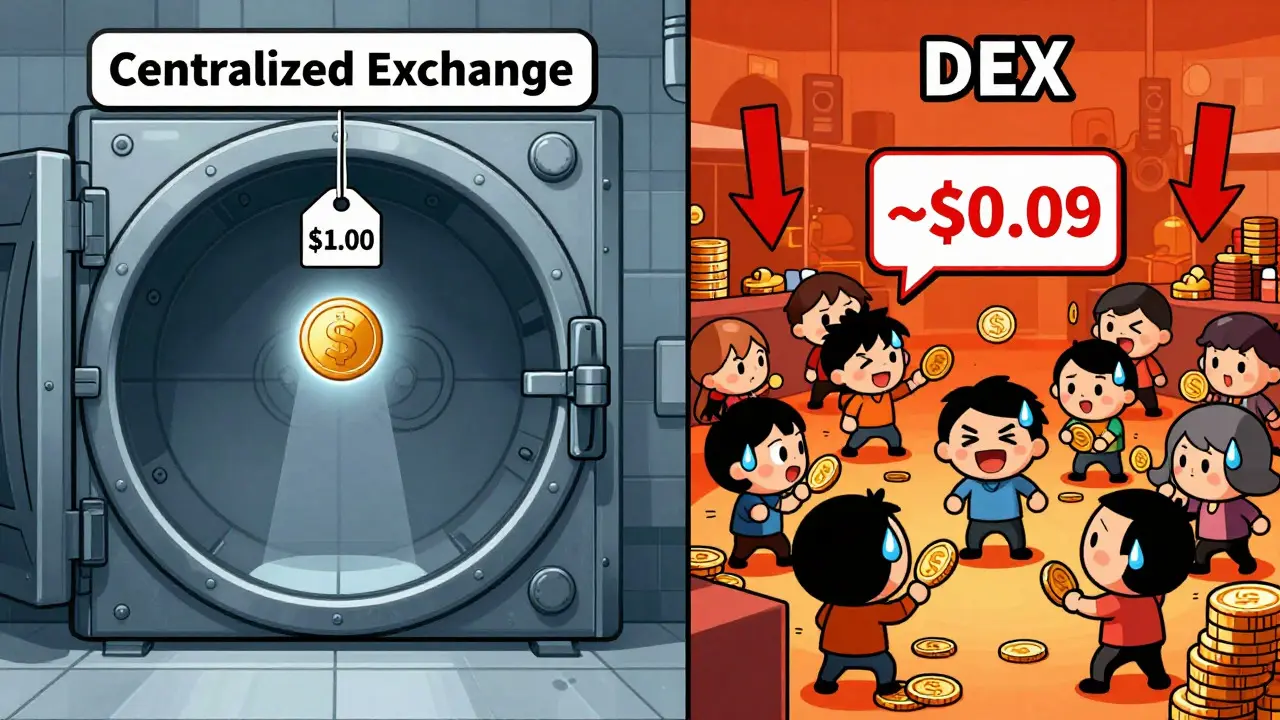
If you check different crypto tracking sites today, you might see confusing data. Some major exchanges list Diment Dollar at exactly $1.00. Others show it trading around $0.09. Which one is right? The answer lies in liquidity and data feeds.
On large centralized exchanges, DD often shows zero trading volume. When there is no active buying or selling, the price chart may default to the theoretical peg of $1.00. It looks stable, but it’s a ghost town. No one is actually trading it there.
In contrast, decentralized exchanges (DEXs) and smaller aggregators often show a price closer to $0.09. This suggests that in the actual secondary market where real users are swapping tokens, the demand is low, or the perceived risk is high enough that traders are discounting the value significantly. A 91% drop from the $1.00 peg indicates either a severe lack of confidence in the redemption process or simply thin liquidity where a few sells can crash the price.
| Source Type | Listed Price | Trading Volume | Liquidity Status |
|---|---|---|---|
| Major Centralized Exchange | $1.00 | $0.00 | Illiquid / Theoretical Peg |
| Decentralized Exchanges (DEX) | ~$0.09 | Low | Active but Thin |
| Price Aggregators | Varies ($0.09 - $1.00) | Inconsistent | Data Fragmentation |
This discrepancy is a red flag for new investors. In a healthy stablecoin market, the price stays within 1% of $1.00 across all platforms due to arbitrage bots correcting any deviations. DD does not behave this way yet.
How to Buy and Trade Diment Dollar
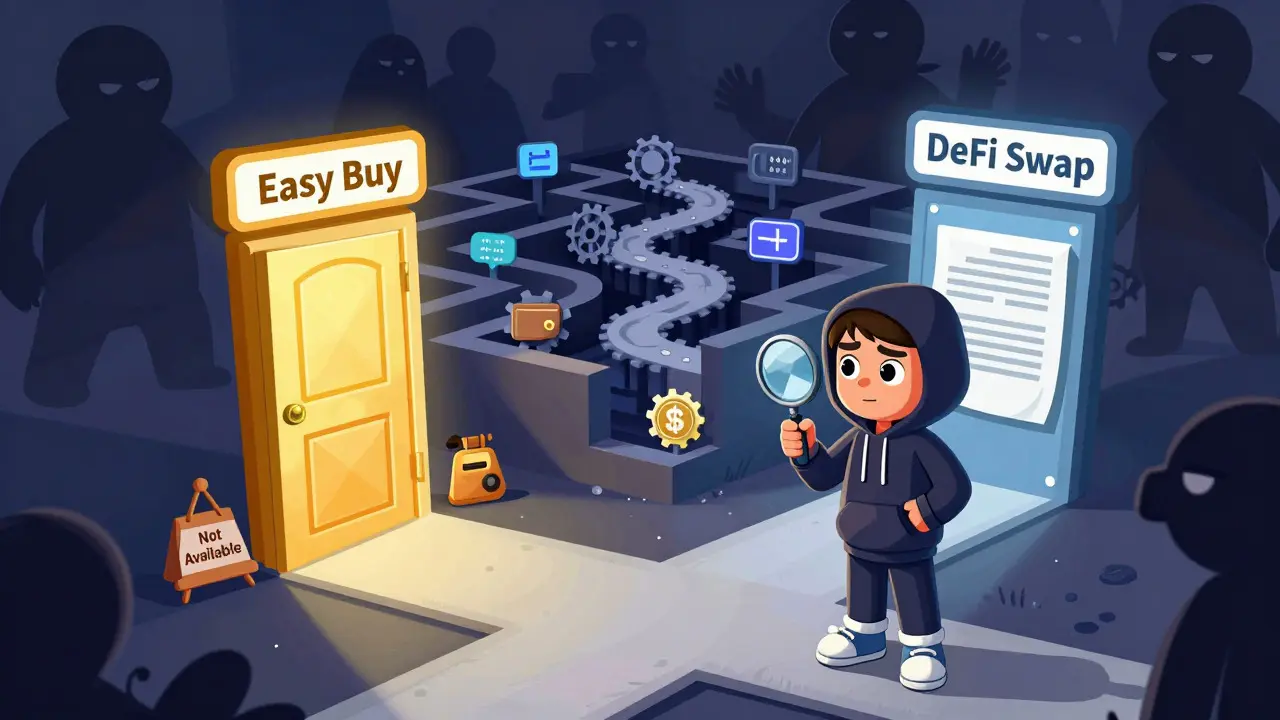
Buying DD is not as simple as clicking "Buy" on Coinbase or Binance. Because it is a micro-cap asset with limited exchange support, you usually need to use decentralized finance (DeFi) tools. Here is the typical path most users take:
- Set Up a Web3 Wallet: You’ll need a wallet like MetaMask or Trust Wallet. Make sure it supports the blockchain network where DD is deployed (often BNB Chain or Ethereum-based networks).
- Fund Your Wallet: Buy a base cryptocurrency like BNB or ETH on a major exchange and transfer it to your Web3 wallet.
- Connect to a DEX: Use a decentralized exchange like PancakeSwap or Uniswap. Connect your wallet to the platform.
- Find the Pair: Search for the DD token contract address. Be careful-there are many fake tokens. Always verify the official contract address from the project’s website.
- Swap: Swap your BNB or ETH for DD. Expect high slippage due to low liquidity. Set your slippage tolerance appropriately to avoid failed transactions.
Some centralized exchanges do list DD, but options are scarce. Always check if the exchange allows withdrawals. Sometimes you can buy a token on an exchange but get stuck trying to move it to your personal wallet.
Risks and Considerations
Before you put money into Diment Dollar, you need to understand the risks. This is not a blue-chip investment. It falls into the category of high-risk, experimental assets.
- Liquidity Risk: As seen in the pricing data, getting out of a position might be hard. If you try to sell a large amount, you could crash the price further.
- Valuation Opacity: Diamonds don’t have a stock ticker. Their value depends on appraisal. Who is doing the auditing? How often? If the auditors are biased or the storage facility has an issue, the backing is compromised.
- Regulatory Uncertainty: Commodity-backed tokens face complex regulations. Governments are still figuring out how to treat digital assets tied to physical goods.
- Market Cap Size: Ranked around #6696 globally, DD has a tiny market cap. This makes it vulnerable to manipulation by whales who hold large portions of the supply.
The "pre-audited" claim is strong, but without seeing the full, public audit reports from reputable firms, it remains a marketing statement. In crypto, "trust us" is rarely enough. Look for transparent, regular attestation reports similar to those provided by USDC or Tether.
Diment Dollar vs. Traditional Stablecoins
Why would anyone choose DD over USDT or USDC? For most people, they wouldn’t. USDT and USDC are highly liquid, widely accepted, and regulated (to varying degrees). They are used for everyday transactions, trading pairs, and savings.
DD is a speculative play on the concept of Real World Assets (RWA). It appeals to investors who believe that diamonds will appreciate in value over time and want exposure to that appreciation via a digital token. It’s more of a hybrid between a stablecoin and a commodity fund. If diamond prices go up, the value of the reserve goes up, potentially allowing for revaluation or profit distribution, depending on the tokenomics. But until that mechanism is clear and proven, it remains a niche product.
Is Diment Dollar Worth It in 2026?
As of mid-2026, Diment Dollar remains an obscure asset. It hasn’t gained the traction needed to become a mainstream medium of exchange. Its primary utility is currently limited to traders speculating on its price movements or believers in the diamond-backing thesis.
If you are curious, treat it like venture capital. Only invest what you can afford to lose. Do not rely on it for storing significant wealth unless you fully understand the custody arrangements of the underlying diamonds. The crypto space is moving toward greater transparency, and projects like DD will need to prove their worth through consistent audits and growing adoption to survive the next cycle.
Is Diment Dollar (DD) a scam?
There is no definitive proof that Diment Dollar is a scam, but it carries high risk. The discrepancy between its theoretical $1.00 peg and its actual trading price (~$0.09) raises questions about liquidity and trust. Always verify the official contract addresses and audit reports before investing.
Where are the diamonds stored?
The project states that diamonds are held in secure reserves, but detailed information about the specific vault locations and insurance coverage is often not publicly disclosed in granular detail. Investors should look for third-party custodial agreements for clarity.
Can I redeem DD for physical diamonds?
Redemption mechanisms vary. While the token is backed by diamonds, the ability for an individual user to swap DD for a physical stone depends on the minimum redemption thresholds set by the issuer. Check the latest whitepaper for current redemption policies.
Which blockchain is Diment Dollar on?
Diment Dollar is described as a multichain token. It has been deployed on various networks including BNB Chain and Ethereum-compatible chains. Always confirm the specific contract address for the network you are using to avoid sending funds to the wrong chain.
Why is the price of DD so volatile?
DD has low liquidity and limited exchange listings. With fewer buyers and sellers, even small trades can cause large price swings. Additionally, market sentiment regarding the validity of its diamond backing can impact its price significantly compared to fiat-backed stablecoins.