
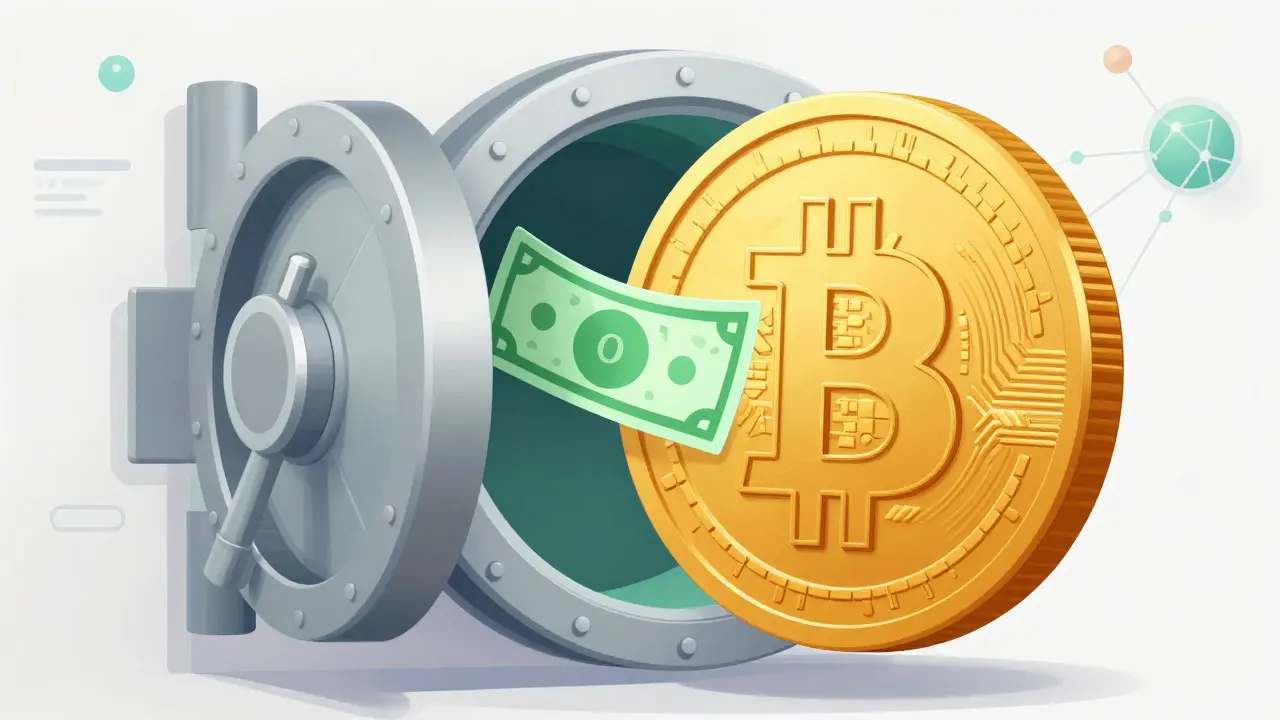
Imagine having the stability of the US dollar but backed entirely by Bitcoin. No bank accounts, no fiat reserves, and no central authority holding your funds hostage. That is exactly what Dollar on Chain (DOC) promises to deliver.
If you are tired of worrying about whether Tether or Circle actually has the cash to back their tokens, DOC offers a different path. It is a stablecoin pegged 1:1 to the US dollar, but instead of sitting in a Swiss bank account, its value is secured by Bitcoin locked in smart contracts. Launched by the Money on Chain team on the Rootstock network, it aims to solve the trust issues that plague traditional stablecoins while keeping everything within the Bitcoin ecosystem.
How Does Dollar on Chain Work?
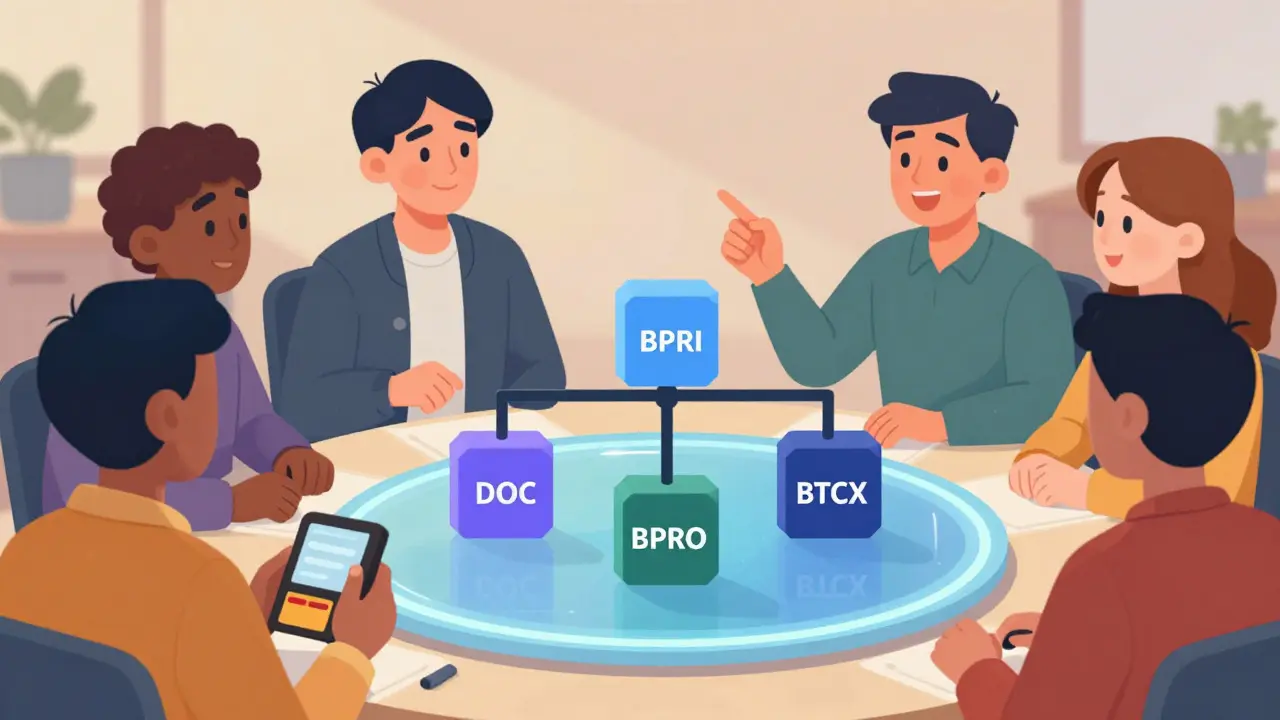
At its core, DOC is not just a token; it is part of a sophisticated three-token system designed to maintain price stability without relying on external assets. To understand DOC, you need to look at how it interacts with two other tokens: BPRO (Bitcoin Pro Token) and BTCX (BitcoinX).
Here is the simple breakdown:
- DOC: The stablecoin itself. You hold this when you want dollar-like stability.
- BPRO: A leveraged token for Bitcoin holders who want exposure to BTC price movements without selling their coins.
- BTCX: A derivative instrument that helps absorb volatility and keeps the DOC peg intact.
When you mint DOC, you deposit rBTC (Bitcoin wrapped on the Rootstock network) as collateral. The protocol requires over-collateralization-typically around 150%-to ensure that even if Bitcoin’s price drops, there is enough backing to redeem every DOC for $1. Unlike some lending platforms that liquidate your position during a crash, DOC uses a non-liquidation mechanism. Instead of forced sell-offs, it adjusts incentives using BPRO and BTCX to stabilize the system automatically.
The Role of Rootstock (RSK)
You cannot talk about DOC without mentioning Rootstock (or RSK). This is the blockchain where DOC lives. Rootstock is a hybrid blockchain that merges the security of Bitcoin with the smart contract capabilities of Ethereum.
Why does this matter? Because most stablecoins live on Ethereum or Solana. If you are a "Bitcoin maximalist"-someone who believes Bitcoin is the only crypto that matters-moving your money to Ethereum feels like leaving the safety of the vault. With DOC on RSK, you stay within the Bitcoin family tree. Transactions on RSK confirm in about 30 seconds, and gas fees are paid in rBTC. This makes it cheaper and faster than moving funds directly on the Bitcoin mainnet, while still benefiting from Bitcoin’s robust proof-of-work security.
DOC vs. Traditional Stablecoins: The Key Differences
Let’s be real. Most people use USDT or USDC because they are everywhere. But they come with baggage. Here is how DOC stacks up against the giants:
| Feature | Dollar on Chain (DOC) | Tether (USDT) | Circle (USDC) | MakerDAO (DAI) |
|---|---|---|---|---|
| Collateral Type | 100% Bitcoin (rBTC) | Fiat reserves & commercial paper | Fiat reserves & treasuries | Mixed (ETH, USDC, etc.) |
| Centralization Risk | Low (Smart Contracts) | High (Central Entity) | Medium-High (Central Entity) | Medium (Governance Council) |
| Network | Rootstock (Bitcoin L2) | Multi-chain (Ethereum, TRON, etc.) | Multi-chain (Ethereum, Solana, etc.) | Ethereum / L2s |
| Liquidity | Low (~$88k daily volume) | Very High ($50B+ daily) | Very High ($10B+ daily) | High ($1B+ daily) |
| Censorship Resistance | High | Low (Can freeze addresses) | Low (Can freeze addresses) | Medium |
The biggest advantage of DOC is transparency. There is no black box of bank statements to audit. You can verify the Bitcoin collateral on-chain at any time. However, the trade-off is liquidity. As of early 2026, DOC trades with a daily volume under $100,000, compared to billions for USDT. This means buying or selling large amounts of DOC might result in slippage unless you use decentralized exchanges carefully.
Who Is Dollar on Chain For?
DOC isn’t trying to replace USDT for paying for coffee at Starbucks. It serves a specific niche. You should consider using DOC if:
- You are a Bitcoin Holder: You want to park your wealth in a stable asset without converting to fiat or leaving the Bitcoin ecosystem.
- You Fear Counterparty Risk: You don’t trust banks or centralized issuers to keep your money safe.
- You Use DeFi on RSK: Protocols like Sovryn allow you to lend DOC and earn yield, making it useful for generating passive income on your Bitcoin collateral.
- You Want Censorship Resistance: Since DOC is algorithmic and backed by Bitcoin, no government or company can easily freeze your balance.
However, if you are a beginner looking for the easiest way to buy crypto, DOC might be too complex. The setup involves connecting a wallet like Defiant, MetaMask, or Nifty Wallet and understanding collateral ratios. It is built for users who value sovereignty over convenience.
How to Get Started with DOC
Getting your hands on DOC involves three main steps. First, you need a compatible wallet. Defiant Wallet is often recommended for RSK interactions because it handles the bridge between Bitcoin and RSK seamlessly. MetaMask works too, but you need to configure it for the Rootstock network.
Second, you need rBTC. You can wrap your Bitcoin into rBTC using the RSK bridge. This process locks your BTC on the Bitcoin mainnet and mints an equivalent amount of rBTC on Rootstock. Keep in mind that this takes time (usually a few hours for confirmations) and costs a small fee.
Third, visit the Money on Chain dApp. Connect your wallet, deposit your rBTC as collateral, and mint DOC. Remember the 150% rule: if you want to mint $100 worth of DOC, you need to lock up roughly $150 worth of rBTC. If Bitcoin crashes significantly, you may need to add more collateral to avoid losing your stake, though the non-liquidation model gives you more breathing room than traditional loans.
Risks and Considerations
No financial tool is perfect. While DOC eliminates bank risk, it introduces others. The primary risk is smart contract vulnerability. If there is a bug in the Money on Chain code or the RSK bridge, funds could be lost. Regular audits help mitigate this, but zero risk is impossible in crypto.
Another risk is market depth. With a market cap of around $4.5 million, DOC is tiny compared to major stablecoins. This makes it vulnerable to price manipulation or sudden de-pegs if large volumes are traded quickly. Additionally, DOC’s success is tied to Bitcoin’s dominance. If Bitcoin loses relevance, the entire RSK ecosystem, including DOC, suffers.
Finally, regulatory uncertainty looms. While DOC avoids being classified as a securities offering in many jurisdictions because it is decentralized, regulators are increasingly scrutinizing all stablecoins. Keep an eye on legal developments in your country.
Future Outlook
The roadmap for DOC looks ambitious. The team plans to integrate with the Lightning Network in mid-2026, which would allow for instant, near-zero fee transactions globally. Cross-chain bridging capabilities are also scheduled for release, potentially allowing DOC to move between networks more easily.
Analysts are divided. Some see DOC as the future of Bitcoin-native finance, predicting it could capture a significant share of the growing Bitcoin DeFi market. Others remain skeptical, pointing out that without massive liquidity improvements, it will remain a niche product for enthusiasts. Only time will tell if DOC can scale beyond its current community of Bitcoin purists.
Is Dollar on Chain (DOC) a good investment?
DOC is not typically held as an investment vehicle like Bitcoin or Ethereum. It is a utility token designed to maintain a $1 peg. Its value lies in its utility for trading, lending, and preserving value within the Bitcoin ecosystem. You profit from DOC by earning yield through lending protocols like Sovryn, not by expecting the token itself to appreciate in price.
Can I lose my money with DOC?
Yes. Risks include smart contract bugs, extreme market volatility leading to under-collateralization (if you don't manage your collateral ratio), and potential de-pegging events. While the non-liquidation mechanism reduces some risks, it is not foolproof. Always do your own research and never invest more than you can afford to lose.
What is the difference between DOC and DAI?
Both are decentralized stablecoins, but their collateral differs. DAI is backed by a mix of assets including Ethereum, USDC, and other tokens. DOC is backed exclusively by Bitcoin (rBTC). This makes DOC more appealing to those who want to stay within the Bitcoin ecosystem and avoid reliance on Ethereum-based assets or fiat-backed stablecoins.
Which wallets support Dollar on Chain?
DOC operates on the Rootstock network, so you need a wallet that supports EVM-compatible chains on RSK. Popular choices include Defiant Wallet, MetaMask (configured for RSK), Nifty Wallet, and Trust Wallet. Ensure your wallet is updated to the latest version to interact with the Money on Chain dApp smoothly.
How does DOC maintain its $1 peg?
DOC uses a combination of over-collateralization (requiring ~150% Bitcoin backing) and a three-token system (DOC, BPRO, BTCX). The BPRO and BTCX tokens absorb volatility and provide leverage mechanisms that incentivize traders to keep the price close to $1. Smart contracts automatically adjust these incentives to prevent de-pegging without needing human intervention.