

HOLY Risk Calculator
Calculate Your HOLY Exposure
Based on article data: 15% slippage, top 10 wallets holding 43.7% of supply, and price swings exceeding 10% daily.
Holy Coin (HOLY) isn't a charity project. It isn't a revolutionary blockchain tool. And it definitely isn't the next Bitcoin. As of late 2025, HOLY is a meme coin on the Solana blockchain - a speculative token with no real utility, a fading community, and a price that swings wildly based on hype, not fundamentals.
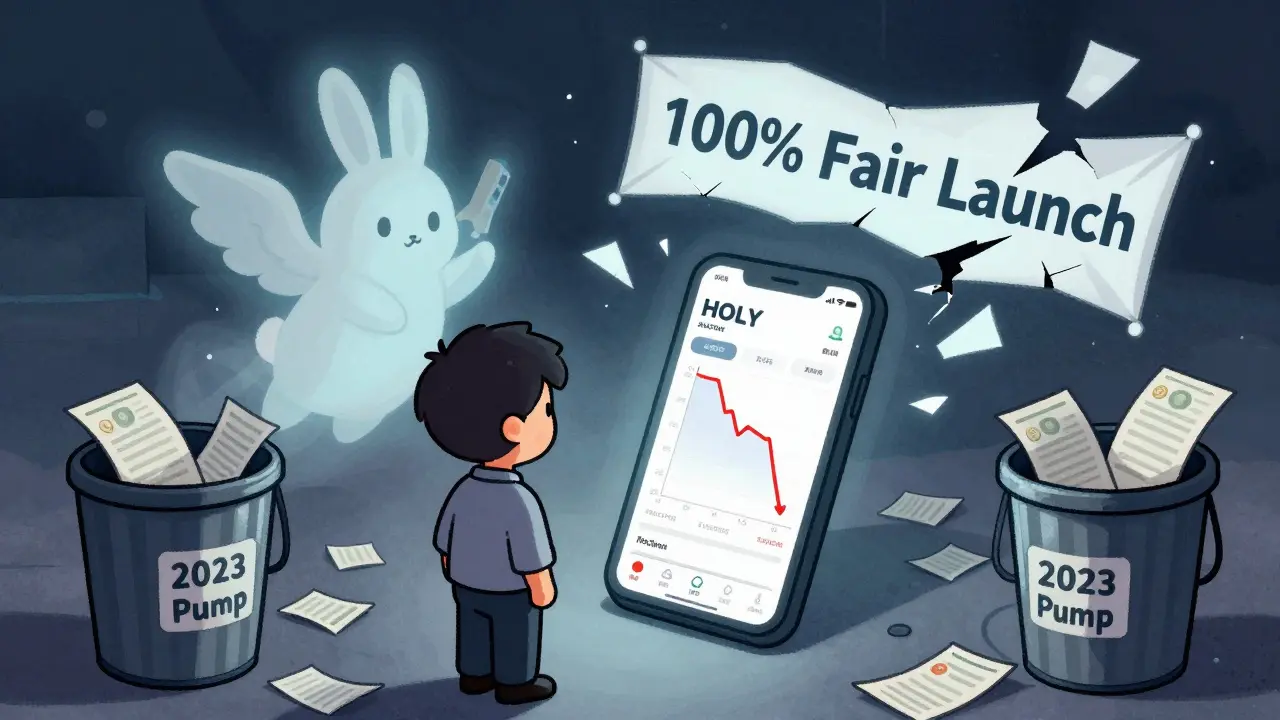
When you first hear about HOLY, you might be told it's designed to help charities. The project’s old website from 2018 even claimed it was an ERC-20 token on Ethereum with a mission to fund social causes. But that version is gone. What exists today is a completely different animal. The current HOLY token launched in October 2023 on Solana through a launchpad called Smart Pocket. It was marketed as a "100% fair-launch" with no team tokens held back. Sounds fair, right? But here’s the catch: it’s all about branding, not impact.
The token’s official site, holycoin.world, now features an angel bunny who loves carrots. Yes, you read that right. An angel bunny. That’s the face of HOLY. No whitepapers. No development team. No roadmap. Just memes, Telegram groups, and promises of quick riches. This isn’t an anomaly - it’s the norm for hundreds of low-cap tokens flooding Solana every month. In Q3 2025 alone, over 12,800 new tokens launched on Solana. HOLY is just one of them.
So what’s the actual value of HOLY? As of November 25, 2025, CoinGecko reports its price at around $0.0003804. That’s less than half a cent. But don’t be fooled by the low number - it’s not a bargain. It’s a red flag. The token’s total supply is fixed at 999,962,177, and all of them are already in circulation. That means no more tokens will be minted. But it also means every single one is out there, traded by retail investors hoping to catch a pump.
Here’s where things get messy. Different platforms show wildly different prices. LiveCoinWatch says HOLY is at $0.000841. CoinMarketCap says $0.00039. Why? Because HOLY trades almost entirely on decentralized exchanges like Raydium, and liquidity is fragmented. There’s no single source of truth. And with trading volumes as low as $2,200 in 24 hours (according to CoinMarketCap), the market is shallow. A single large wallet can move the price up or down in seconds.
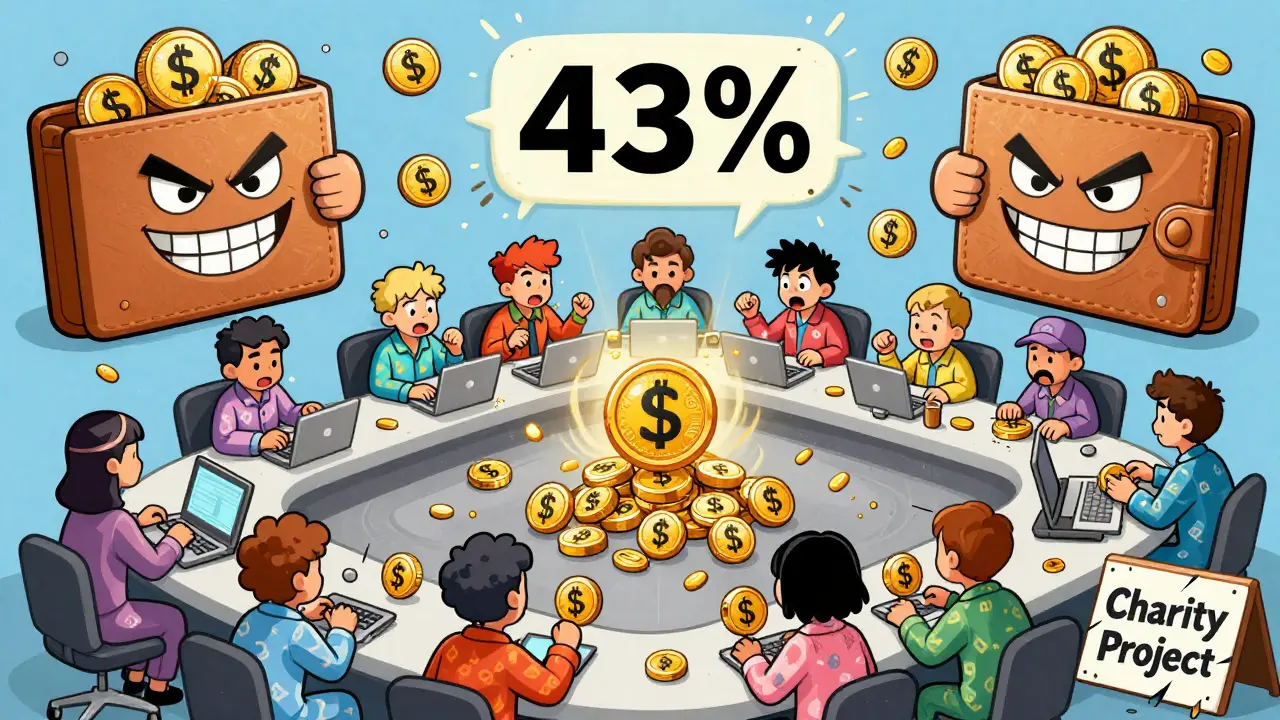
And those large wallets? They’re holding most of the supply. Blockchain data shows the top 10 wallets control about 43.7% of all HOLY tokens. That’s a massive concentration of power. If even one of those wallets dumps its holdings, the price crashes. That’s exactly what happened to users on Reddit’s r/CryptoMoonShots. One trader posted: "Got rekt on HOLY, dumped 30% in 2 minutes after buying." That’s not speculation - it’s a warning.
Even the charity angle is gone. The original promise of funding social projects? No evidence of that happening. No donations recorded on public ledgers. No partnerships with NGOs. Just a logo of a bunny and a vague slogan about "sacred artifacts." Trustpilot reviews for holycoin.world give it a 1.7 out of 5 based on 37 reviews. The most common complaints? "Misleading charity claims" and "rugged token." That’s not a coincidence. It’s the pattern you see in every failed meme coin.
What about trading? It’s easy to buy HOLY if you have a Solana wallet like Phantom. You just go to Raydium, connect your wallet, swap SOL for HOLY, and you’re in. But here’s the reality: slippage is brutal. Because there’s so little liquidity, your buy order might execute at a price 10-15% higher than what you expected. Sell orders? Even worse. You might find your transaction stuck or rejected because no one’s buying. Experienced traders warn that HOLY has a "honeypot risk" - meaning you might not even be able to sell your tokens. So far, no confirmed honeypot code has been found in the contract, but the risk is real.
Compare HOLY to other Solana meme coins. WIF and BONK have market caps over $1 billion. They’re listed on major exchanges like Binance and Coinbase. They have active communities, influencers, and even real-world partnerships. HOLY? It’s not on any centralized exchange. Not even KuCoin or Kraken. Its entire existence depends on decentralized trading with tiny volume. It doesn’t compete - it just floats in the noise.
And the numbers don’t lie. CoinGecko ranks HOLY as the #7163 cryptocurrency by market cap. That’s not just low - it’s near the bottom. The market cap hovers around $100,000 to $400,000 depending on the source. For context, a single tweet from a big influencer can move a $100 million coin. HOLY doesn’t have that kind of weight. It’s a digital lottery ticket.
What’s the future? Bleak. Trading volume has dropped 45% from its 30-day average. No new code has been pushed to GitHub in over 18 months. No team updates. No exchange listings. Messari, a top crypto analytics firm, estimates there’s a 78% chance HOLY gets delisted from tracking platforms within a year. CoinGecko’s own survival model gives it only a 12% chance of still being tradable by 2026.
So who’s buying it? Retail investors. 98.7% of trading activity comes from individuals, not institutions. No hedge funds, no venture capitalists, no serious players. Just people chasing a 10x on a token with no business model, no team, and no future.
If you’re thinking about buying HOLY, here’s what you need to know: it’s not an investment. It’s gambling. And like any casino game, the house always wins. The only people who profit are the early holders who dumped their tokens when the price spiked in late 2023. Everyone else? They’re left holding a digital asset that’s slowly fading into oblivion.
There’s no reason to believe HOLY will ever become more than what it is today: a meme with a bunny logo, a broken promise, and a fading price chart. If you want to support charities, donate directly. If you want to trade crypto, pick something with real volume, real development, and real transparency. HOLY has none of that.
Is Holy Coin (HOLY) a scam?
It’s not technically a scam in the legal sense - there’s no proof of fraud or stolen funds. But it’s a classic case of misleading marketing. The project started with a charitable narrative and then quietly pivoted to pure meme speculation. That’s not illegal, but it’s deceptive. The angel bunny, the "sacred artifact" language, and the lack of any charity activity all point to a token designed to attract buyers, not build value.
Can I buy HOLY on Coinbase or Binance?
No. HOLY is not listed on any major centralized exchange. You can only buy it on decentralized exchanges like Raydium using a Solana wallet like Phantom or Solflare.
What’s the current price of HOLY?
As of late November 2025, HOLY trades between $0.00038 and $0.00084 depending on the platform. The most reliable data comes from CoinGecko, which reports around $0.0003804. Prices vary because of low liquidity and fragmented trading across DEXs.
Is HOLY a good investment?
No. HOLY has no utility, no development team, no roadmap, and almost no trading volume. Its price is driven entirely by speculation. The risk of losing your entire investment is extremely high. Even experienced traders recommend allocating no more than 0.5% of your portfolio to tokens like this - if you trade it at all.
Why does HOLY have such different prices on different sites?
Because it trades only on decentralized exchanges with very low liquidity. Each platform pulls price data from different trading pairs, and with so few buyers and sellers, even small trades can distort the price. This is common with low-cap tokens, but HOLY’s discrepancies are extreme - a sign of weak market structure.
How many people own HOLY?
As of November 2025, CoinMarketCap reports about 15,280 token holders. That’s a tiny community. For comparison, BONK has over 1.5 million holders. The small number of holders makes HOLY vulnerable to manipulation by just a few large wallets.
What happened to the charity promise?
It disappeared. The original 2018 version of HOLY claimed to support charities, but that project was abandoned. The current Solana token has no connection to those claims. No donations have been recorded. No partnerships announced. The charity angle is now just marketing fluff.
holy (the coin, not the word) is just a digital rabbit with a halo and zero substance. i bought 50k of it last year thinking it was a joke that might pump. it did. then it crashed harder than my ex’s car after a night out. now i use it as wallpaper on my phone. at least the bunny’s cute.
The bunny is oddly soothing. 🐰✨ Like a digital zen garden made of pure speculation. I don’t trade it-I just stare at the logo when I’m stressed. It’s the only crypto that feels like a lullaby.
I think we’re all just chasing meaning in a system designed to extract it. HOLY doesn’t fund charities, but maybe it funds something else-our collective delusion that anything can be valuable if enough people pretend it is. The bunny isn’t the mascot. It’s the mirror.
The absence of a whitepaper, development team, or verifiable charitable activity constitutes a failure of fiduciary transparency. The token’s price discovery mechanism is fundamentally broken due to liquidity fragmentation and concentrated ownership. This is not investing; it is statistical gambling masquerading as community.
Americans love memes. Indians love money. This token is a perfect export: useless, flashy, and doomed. The bunny? Cute. The project? A joke. The traders? Delusional.
I cried when I realized I’d lost $1,200 on HOLY. Not because of the money-because I believed in the bunny. I thought maybe, just maybe, this was the one that would actually do good. Turns out the only thing sacred here is the exit liquidity of the early whales. I still keep the screenshot of the angel bunny on my fridge. It reminds me: hope is expensive, and sometimes, it’s just a logo.
The entire ecosystem is a grotesque parody of decentralized finance. The 43.7% concentration in top wallets is not a feature-it’s a predatory design. The 1.7 Trustpilot rating? That’s the polite version. The real reviews say ‘scam’ in all caps. The fact that this still trades at all speaks to the cognitive dissonance of retail crypto traders. You don’t need a PhD to see this is a dumpster fire. You just need eyes.
This is why America’s crypto scene is trash. We don’t build. We meme. We don’t innovate. We gamble. And we call it ‘decentralized finance’ while a bunny in a halo steals our life savings. Meanwhile, China’s building quantum blockchain ledgers and we’re here arguing if the bunny’s ears are too long.
I used to think crypto was about freedom. Now I see it’s about loneliness. People buy HOLY not because they believe in it-but because they want to believe in something. I get it. I’ve been there. But please… don’t throw away your rent money for a cartoon rabbit.
India has better meme coins. Real ones. With actual memes. Not this soft, overpriced bunny nonsense. You think this is crypto? It’s a TikTok trend with a smart contract. We laugh here. You cry there.
The liquidity fragmentation is textbook market inefficiency-each DEX has its own order book, slippage multipliers, and varying depth. The price discrepancies aren’t anomalies-they’re symptoms of a token that lacks a central price anchor. The 12% survival probability isn’t a forecast-it’s a statistical inevitability. This isn’t a coin. It’s a tombstone with a QR code.
I know it sounds crazy, but I still hold a little HOLY-not to make money, but to remember what not to do. If you’re reading this and thinking of buying, pause. Take a walk. Call a friend. Ask yourself: would I give this to my little sister as an investment? If the answer’s no… then don’t do it. You’re better than this.
The bunny’s kinda cute tho? Like, if we all just accepted that this is art and not finance, maybe we’d all feel better. I don’t trade it. I just admire it. Like a weird sculpture in a museum called ‘Capitalism: The Meme Edition’.
I bought HOLY with my last $200 because I was lonely and thought maybe the community would be nice. It wasn’t. But I still smile when I see the bunny. Sometimes, you don’t need returns-you just need a little joy. Even if it’s fake. 💛🐰
You’re all pathetic. You think you’re so clever, trading a token with no utility and calling it ‘fun.’ You’re not a trader. You’re a sucker. And you’re not even good at being a sucker-you’re the kind of person who buys lottery tickets and then cries when you lose. You deserve to lose everything.
The structural deficiencies of HOLY are emblematic of a broader failure in retail crypto education. The absence of a development roadmap, the reliance on speculative hype, and the lack of institutional oversight create a perfect storm for capital erosion. One must question the ethical implications of marketing a non-functional asset under the guise of social good.
The 999M supply is a masterstroke of psychological manipulation-makes the price look ‘cheap’ while ensuring infinite dilution of value. The ‘fair launch’ narrative? A red herring. The top 10 wallets hold more than 40%. That’s not fair. That’s a cartel with a bunny logo. And the charity angle? Pure performative virtue signaling. This is crypto’s most elegant Ponzi in a pastel hoodie.
I know it’s dumb. I know it’s risky. But sometimes… you just need to believe in something silly. The bunny reminds me of my grandma’s garden. I don’t trade it hard. I just hold it. Like a good luck charm. Maybe that’s all it ever was meant to be.
I’m from a small town where people still believe in miracles. HOLY is our miracle. Not because it works-but because it gives us something to talk about. We don’t care about the price. We care about the story. And honestly? That’s more valuable than any whitepaper.
This is the future of decentralized finance: no team, no code, no future-just a meme and a crowd. We’ve turned finance into performance art. And the bunny? She’s the star. The only thing more powerful than blockchain is belief. Even when it’s misplaced.