
Imagine holding a Visa debit card that lets you spend Bitcoin or Ethereum at your local coffee shop, yet you never hand over your private keys to a bank. That was the core promise of Monolith, a project that tried to bridge the gap between decentralized finance (DeFi) and everyday spending. Formerly known as TokenCard, this platform wasn't just another speculative asset; it was a functional tool for 35,000 European users who wanted to use their crypto without selling it first. But here’s the twist: despite facilitating over $113 million in transactions, the project has announced its shutdown. So, what exactly was Monolith, how did its native token TKN work, and why did such a promising service fail to survive?
The Origin Story: From TokenCard to Monolith
The journey began with a rebranding effort that signaled a shift in focus. Originally launched as TokenCard, the project renamed itself to Monolith in 2018. The name wasn’t chosen randomly. It draws inspiration from Arthur C. Clarke’s novel 2001: A Space Odyssey. In the book, the monolith represents a leap in human evolution. The team viewed Ethereum similarly-as the technological monolith enabling a transcendence in the global economy through DeFi.
This philosophical backing hinted at their ambitious goal: to make cryptocurrency invisible in daily life. You wouldn't think about blockchain when buying groceries; you’d just swipe your card. To achieve this, they built a non-custodial contract wallet on the Ethereum blockchain. Unlike exchanges where you trust them with your money, Monolith kept control in your hands while connecting to traditional payment rails via Visa.
How the Non-Custodial Wallet Worked
At the heart of the system was a smart contract wallet. This isn't your typical hardware wallet or mobile app. Because it ran on Ethereum, every action-like topping up your balance or setting limits-required gas fees. To manage this complexity, Monolith introduced a "Gas tank." Think of it as a prepaid fuel reservoir for your car. You had to keep ETH in this tank to pay for network operations. If it ran empty, your card stopped working until you refilled it.
Security was a major selling point. The wallet was open-source and triple-audited by external security firms. This meant independent experts checked the code for vulnerabilities multiple times. Users could whitelist specific addresses, allowing trusted contacts to send funds without triggering daily limits. Plus, access required a PIN or Face ID, adding a layer of biometric protection. However, this non-custodial nature came with responsibility. Lose your seed phrase, and your funds were gone forever. There was no customer support hotline to reset your password.
The Visa Debit Card Experience
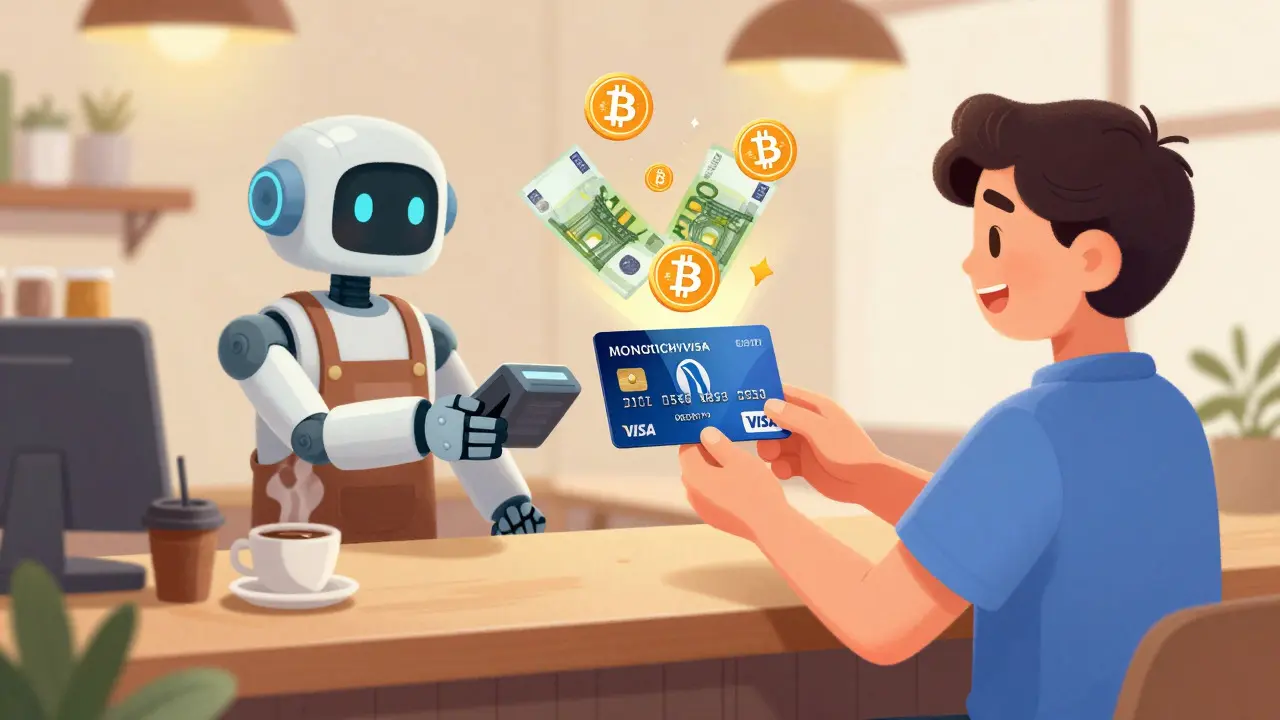
The real magic happened at the point of sale. Monolith issued physical and virtual Visa debit cards accepted globally across 31 EEA countries. When you swiped the card, the backend automatically converted your crypto holdings into fiat currency (EUR, GBP, etc.) in real-time. This conversion process supported several tokens, including ETH, DAI, MKR, DGX, and TKN.
Fees played a crucial role in the user experience. Converting most cryptocurrencies to fiat cost a 2% fee. However, if you used the native TKN token for conversions, the fee dropped significantly, incentivizing token holders to keep and use TKN. ATM withdrawals followed standard banking rules: two free withdrawals per month, then a small fee per transaction thereafter. International transactions also incurred standard Visa fees. For many users, this convenience outweighed the costs, especially compared to the hassle of selling crypto on an exchange, waiting for a bank transfer, and then spending cash.
Understanding the TKN Tokenomics
TKN served as the utility token for the entire ecosystem. Its primary functions included paying for lower conversion fees and participating in governance decisions. With a total supply capped at roughly 30 million tokens, scarcity was designed to drive value as adoption grew.
Let's look at the numbers. TKN reached its all-time high of $4.39 in January 2018, riding the wave of the general crypto bull market. By June 2020, it hit an all-time low of $0.000058. As of August 2026, following the project's shutdown announcement, trading volume is negligible, hovering around $44 per day on decentralized exchanges like Uniswap V2. The market cap reflects this reality, sitting near zero for circulating supply, though fully diluted valuations remain technically higher due to locked or burned tokens.
| Metric | Value / Status |
|---|---|
| Platform Status | Shutdown Announced |
| Total Transactions Facilitated | >$113 Million |
| User Base | 35,000+ (EEA Region) |
| All-Time High Price | $4.39 (Jan 2018) |
| Current Trading Venue | Uniswap V2 (Low Liquidity) |
| Primary Use Case | Crypto-to-Fiat Conversion Fee Discount |
Why Did Monolith Shut Down?
If the product worked and users liked it, why did it end? The answer lies in the brutal economics of fintech. Running a non-custodial wallet connected to traditional banking rails is expensive. Every transaction involves Ethereum gas fees, Visa interchange fees, and operational costs for compliance and customer support. While Monolith charged fees, margins remained thin, especially during periods of low crypto usage or high network congestion.
Competition also intensified. Newer players entered the space with better funding, broader geographic reach, or more seamless user experiences. Some competitors offered bidirectional flows (fiat-to-crypto), whereas Monolith primarily focused on crypto-to-fiat spending. Regulatory pressures in Europe added another layer of complexity, requiring constant adaptation to changing financial laws. Ultimately, the project couldn't sustain the operational burn rate needed to compete against well-funded rivals and traditional banks launching their own crypto cards.
Lessons from the Monolith Experiment
Monolith proved that people want to spend crypto, not just hold it. The $113 million processed demonstrates genuine demand for real-world utility. However, it also highlighted the technical friction inherent in early DeFi integrations. Managing gas tanks and understanding smart contract interactions created a barrier for casual users. Future projects must simplify these mechanics to achieve mass adoption.
For current TKN holders, the situation is tricky. The token still trades on decentralized exchanges, but liquidity is dry. Without an active platform providing utility, the token’s value relies purely on speculation or potential buybacks/burns, which are uncertain given the shutdown status. Investors should treat TKN as a legacy asset rather than a growth investment.
Is Monolith still operating?
No, Monolith has announced its shutdown. While the TKN token continues to trade on decentralized exchanges like Uniswap V2, the core services, including the Visa debit card and wallet infrastructure, are no longer actively maintained or expanding.
What happened to my Monolith Visa card?
With the platform shutting down, existing cards are likely being phased out. Users should withdraw any remaining balances immediately. The ability to spend crypto via the card depends on the final wind-down procedures communicated by the team to registered users.
Can I still buy TKN tokens?
Yes, but with caution. TKN is available on decentralized exchanges, primarily Uniswap V2. However, trading volume is extremely low, meaning large orders may suffer from significant slippage, and exit liquidity can be scarce.
Was Monolith custodial or non-custodial?
Monolith was strictly non-custodial. Users held their own private keys and controlled their funds directly within the smart contract wallet. The platform did not have access to user funds unless explicitly authorized for transactions.
Which countries supported Monolith?
The service was primarily targeted at residents of the European Economic Area (EEA). It was available in 31 European countries, aligning with EU regulatory frameworks for electronic money institutions.