

Imagine getting paid just for sharing your spare internet connection. That’s the core promise of Packet, a cryptocurrency designed to turn everyday users into nodes in a global network. Unlike Bitcoin, which relies on heavy computer processing power, PKT uses your actual data transfer speed to secure the blockchain. This makes it one of the few coins you can mine from a home router or even a smartphone.
If you’ve stumbled upon PKT in a portfolio or a news feed and wondered what it actually does, you’re not alone. It sits at the intersection of crypto technology and physical infrastructure. The goal isn’t just to create a digital asset; it’s to build a decentralized internet service provider (ISP) where people pay each other for connectivity using crypto.
The Core Concept: Bandwidth-Hard Proof-of-Work
To understand Packet, you first have to look at how it secures its ledger. Traditional proof-of-work (PoW) systems like Bitcoin require miners to solve complex mathematical puzzles. This consumes massive amounts of electricity and requires specialized hardware like ASICs. PKT changes this equation by introducing PacketCrypt.
PacketCrypt is a consensus mechanism that validates transactions based on both computational effort and real-world bandwidth usage. In simple terms, when you run the PKT software, your device doesn't just crunch numbers; it sends small data packets across the network. These packets prove that you are connected to the internet and willing to share that connection. This process is called "bandwidth-hard" mining because the difficulty of securing the block depends on the amount of data transmitted, not just CPU cycles.
This distinction matters because it lowers the barrier to entry. You don’t need a warehouse full of GPUs. You need a stable internet connection and a basic computer. This design choice aims to distribute control over internet infrastructure away from big tech companies and back to individual users.
How the PKT Network Works
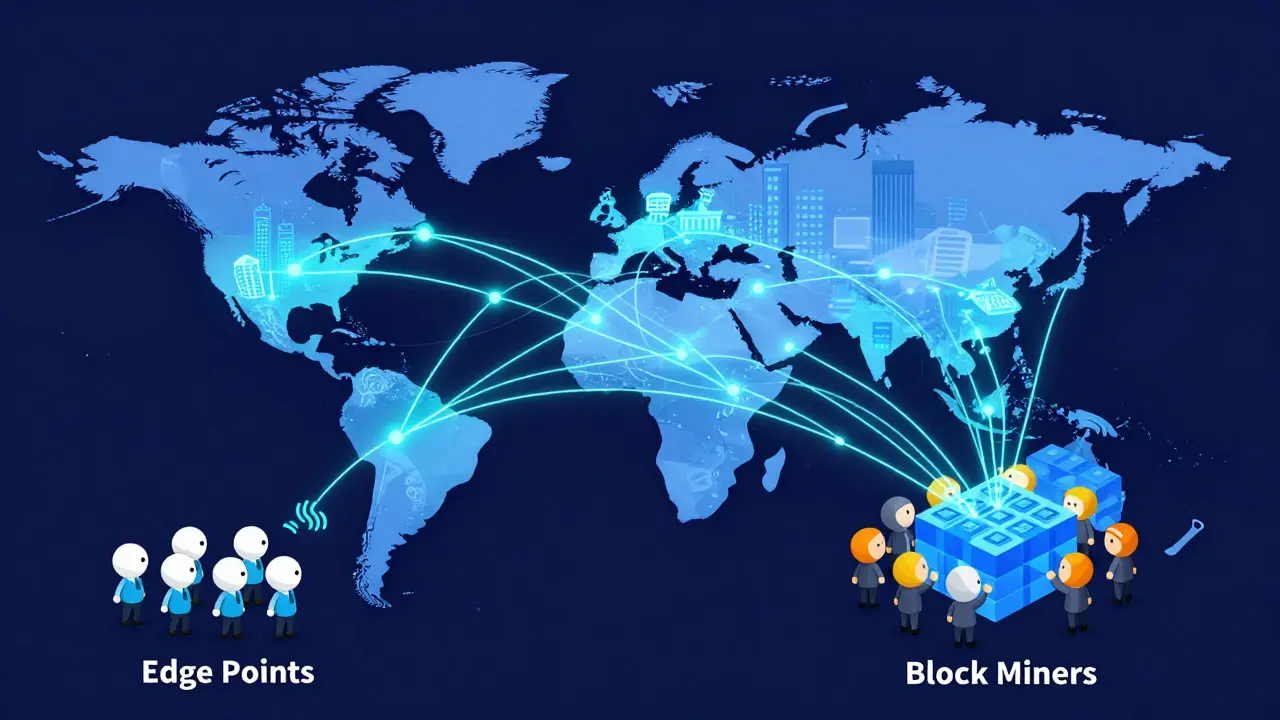
The ecosystem operates through two main roles: Edge Points and Block Miners. Understanding these roles helps clarify who earns money and how.
- Edge Points: These are regular users-like you or me-who install open-source software on their devices. Their job is to broadcast small messages called "announcements" every second. These announcements act as pings to the network, proving they are online and available to share bandwidth. For doing this, Edge Points earn PKT Cash.
- Block Miners: These are larger operators with significant bandwidth capacity. They collect billions of announcements from Edge Points every 60 seconds. To win the right to add a new block to the chain, they must execute a memory-hard algorithm. When they win, they receive a block reward in PKT.
The flow is continuous. Every 60 seconds, the network resets. Edge Points send their data, Block Miners validate it, and rewards are distributed. This cycle ensures that the network remains active and that those contributing to its stability are compensated fairly.
Tokenomics and Supply Mechanics
Let’s talk numbers, because that’s usually what investors care about most. The maximum supply of PKT Cash is capped at 6 billion coins. There is no premine, meaning no coins were created before the network launched. Everything has been mined by participants since day one.
Here is how the distribution works:
- Total Supply: 6 billion PKT.
- Circulating Supply: Approximately 4.25 billion PKT as of recent data.
- Mining Schedule: The remaining coins will be mined over the next 63 years.
- Reward Split: 20% of every block reward goes to the "Network Steward," a democratic wallet address. The rest goes to the winning mining pool.
The Network Steward plays a crucial role. It’s not a corporate treasury. Instead, it’s a community-governed fund. Every 90 days, the steward distributes collected coins to fund infrastructure growth. If there’s money left over, it gets burned (removed from circulation). This deflationary pressure helps maintain value as the network expands.
| Feature | Packet (PKT) | Bitcoin (BTC) |
|---|---|---|
| Consensus Mechanism | Bandwidth-Hard PoW (PacketCrypt) | Standard PoW (SHA-256) |
| Hardware Requirement | CPU + Internet Bandwidth | ASIC Miners |
| Block Time | 60 Seconds | ~10 Minutes |
| Primary Utility | Decentralized Bandwidth Trading | Store of Value / Settlement |
| Premined Supply | No | No |
Real-World Use Cases: More Than Just Speculation
Many altcoins struggle to find practical use beyond trading. PKT tries to solve this by targeting the $2 trillion global bandwidth market. Currently, if you want faster internet, you call your ISP. With PKT, the vision is to allow peer-to-peer bandwidth leasing.
Think of it like Uber for internet speed. If you have fiber-optic internet but only use 10% of its capacity, you can lease the unused portion to neighbors or businesses via the PKT Network. They pay you in PKT Cash. This creates a secondary market for internet access that bypasses traditional telecom monopolies.
Another key feature is the integration of Lightning Network functionality. This allows for near-instantaneous microtransactions with negligible fees. Why does this matter? Because buying and selling small amounts of bandwidth requires fast, cheap payments. If it costs more to process the payment than the bandwidth itself, the model fails. Lightning-style settlement solves this.
Additionally, the project supports Virtual Private Networks (VPNs). As the network matures, Edge Points can offer encrypted VPN services to others, earning PKT for providing privacy and security. This adds another layer of utility beyond raw data transfer.
Technical Architecture and Security
Under the hood, PKT is built on a modified version of the Bitcoin codebase. This gives it the proven reliability of Bitcoin’s structure while allowing for custom features. The 60-second block time is significantly faster than Bitcoin’s 10-minute average, enabling quicker finality for transactions.
Security is maintained through the dual requirement of CPU and bandwidth. A hacker trying to attack the network would need to control not just computing power, but also a vast amount of global internet bandwidth. This makes a 51% attack exponentially more expensive and difficult than on standard PoW chains.
The open-source nature of the project means anyone can audit the code. There is no central company controlling the roadmap. Decisions are made by the community, specifically through the election of the Network Steward. This governance model reduces the risk of corporate mismanagement or insider deals.

Market Position and Current Status
As of mid-2026, PKT remains a niche but interesting player in the crypto space. Its market cap hovers around $1.34 million USD, placing it firmly in the micro-cap category. The price per coin is approximately $0.000316. While these numbers seem low, they reflect the early-stage adoption of a utility token focused on infrastructure rather than hype.
The low trading volume (around $1,282 daily) indicates that PKT is primarily held by long-term believers in the decentralized internet concept rather than short-term traders. This suggests high volatility potential if mainstream adoption of bandwidth trading ever takes off, but also higher risk due to lower liquidity.
Projects like Routie have already begun using PKT technology to offer guest WiFi services, proving that the underlying tech works in real-world scenarios. However, widespread consumer adoption still requires user-friendly interfaces and clear incentives for non-crypto natives.
Who Should Care About PKT?
Not everyone needs to hold PKT, but certain groups might find it particularly relevant:
- Tech Enthusiasts: Those interested in mesh networking and decentralized protocols will appreciate the innovative consensus mechanism.
- Developers: Building apps on top of TokenStrike (the PKT token standard) could open up new dApps for bandwidth trading.
- Infrastructure Investors: People looking for projects that solve real-world problems (internet access) rather than just creating new financial instruments.
- Privacy Advocates: The push for decentralized ISPs aligns with goals of reducing surveillance by large telecom providers.
If you’re looking for a quick flip, PKT might not be the best fit due to its low liquidity. But if you believe in the long-term vision of a user-owned internet, it’s worth keeping an eye on.
Frequently Asked Questions
Can I mine PKT on my phone?
Yes, technically. Since PKT uses bandwidth-hard mining, any device with an internet connection and sufficient CPU can participate as an Edge Point. However, profitability on a single phone may be minimal unless you have very cheap electricity and high-speed data plans. Most serious mining is done on dedicated servers or powerful home computers.
What is the difference between PKT and Ethereum?
Ethereum is a general-purpose smart contract platform focused on decentralized applications (dApps) and DeFi. PKT is a Layer-1 blockchain specifically designed for incentivizing bandwidth sharing. While PKT can support tokens (via TokenStrike), its primary utility is tied to physical internet infrastructure, whereas Ethereum’s value is derived from its ecosystem of developers and users.
Is PKT a good investment in 2026?
That depends on your risk tolerance. PKT is a micro-cap coin with low liquidity, meaning prices can swing wildly. It’s a speculative bet on the success of decentralized ISPs. If you believe peer-to-peer bandwidth trading will become common, PKT could see significant growth. If you prefer stability, major assets like Bitcoin or Ethereum might be safer choices.
Where can I buy PKT?
PKT is listed on several smaller exchanges and decentralized platforms. Due to its lower trading volume, you should check multiple sources for the best price and liquidity. Always verify the exchange's reputation before depositing funds, especially for micro-cap assets.
What happens to unused Network Steward funds?
Any funds collected by the Network Steward that are not used for infrastructure grants within a 90-day period are burned. This removes them from circulation permanently, creating a deflationary effect that can support the token's value over time.