
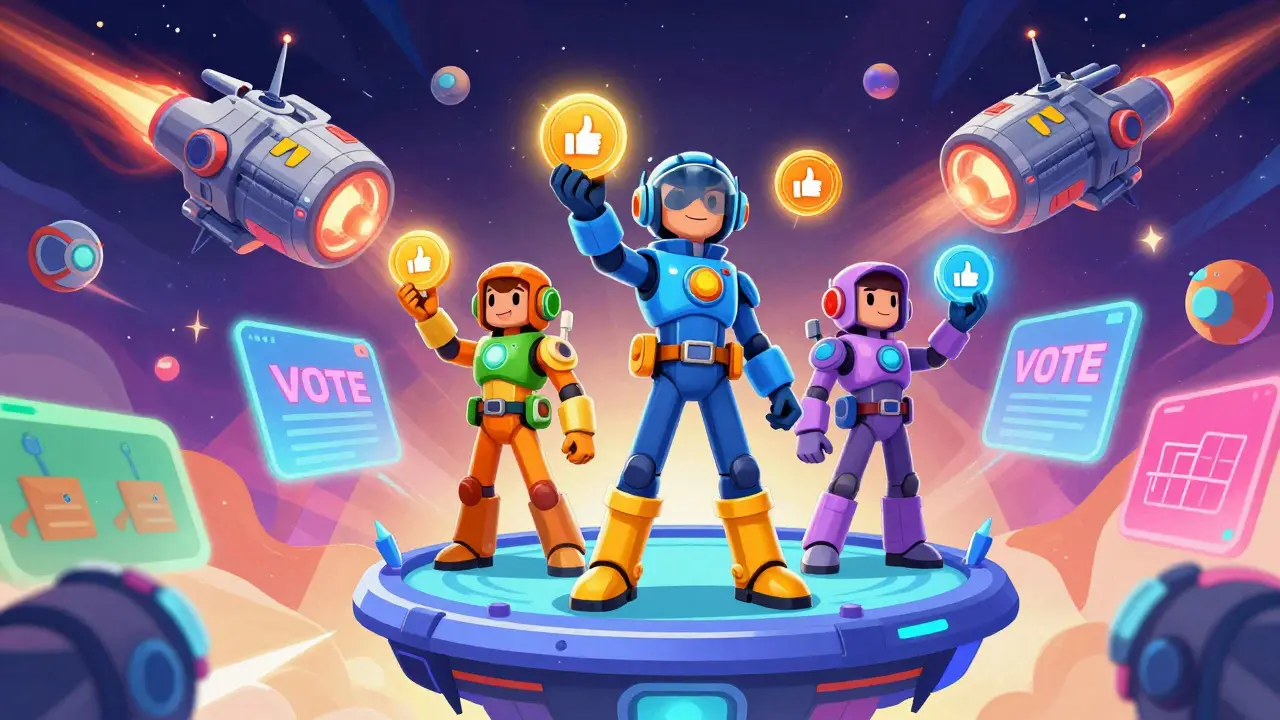
Star Atlas DAO isn’t just another crypto coin. It’s a full-blown space empire built on blockchain, where players don’t just hold tokens-they command fleets, fight for territory, and vote on the future of an entire universe. The token behind it all? POLIS. And if you’ve heard whispers about it rising from the ashes after crashing from $14 to under $0.10, you’re not imagining things. This isn’t a get-rich-quick scheme. It’s a living, breathing metaverse with real gameplay, real economics, and real stakes.
What POLIS Actually Does
POLIS isn’t meant to be spent on in-game items. That’s what ATLAS is for. POLIS is the voting card. Think of it like a share in a corporation, but instead of a boardroom, you’re voting on the rules of a space war. Want to change how mining taxes work? Need to adjust the reward structure for player-vs-player battles? Hold POLIS, and you get a say. Every decision that shapes the Star Atlas universe-from economic policies to new ship designs-goes through a DAO vote. No central company pulls the strings. Players do.
This isn’t theoretical. Since its launch, over 300 million POLIS tokens have been minted, with 84% already in circulation. That means nearly every token is in someone’s wallet, actively participating in governance. It’s not just speculation-it’s participation.
How Star Atlas Works as a Game
Star Atlas is built on Solana, which means transactions are fast and cheap. No more waiting 10 minutes for a ship to move. In-game actions happen in real time. The game uses Unreal Engine 5’s Nanite tech, so ships look like they came out of a sci-fi movie. You don’t just see a 3D model-you see a massive battleship with glowing engines, damage scars, and crew members moving inside the hull.
Players take on roles:
- Explorers scout uncharted sectors for rare minerals and ancient tech.
- Traders move goods between star systems, haggling over prices and avoiding pirates.
- Combatants build fleets, claim territories, and fight for control of resource-rich zones.
- Stakers lock up their assets in safe zones to earn passive rewards.
Every ship, weapon, and piece of land is an NFT. You own it. You can sell it. You can rent it. You can lose it in battle. That’s the core idea: real ownership in a virtual world.
POLIS Price History: From $14 to $0.09
Let’s be blunt: POLIS has been through hell. It peaked at $14.57 in September 2021. That was during the last crypto bull run, when everyone thought metaverse tokens were the future. By early 2023, it had fallen below $0.10. Many wrote it off.
But here’s what’s happening now. As of March 10, 2026, POLIS is trading around $0.0958 on Coinbase. That’s up from $0.0491 just a month ago-a 93% jump. The past week alone saw a 45% surge. That’s not a fluke. It’s driven by renewed interest in the game’s latest updates: new ship classes, expanded territory claims, and a fresh wave of player activity.
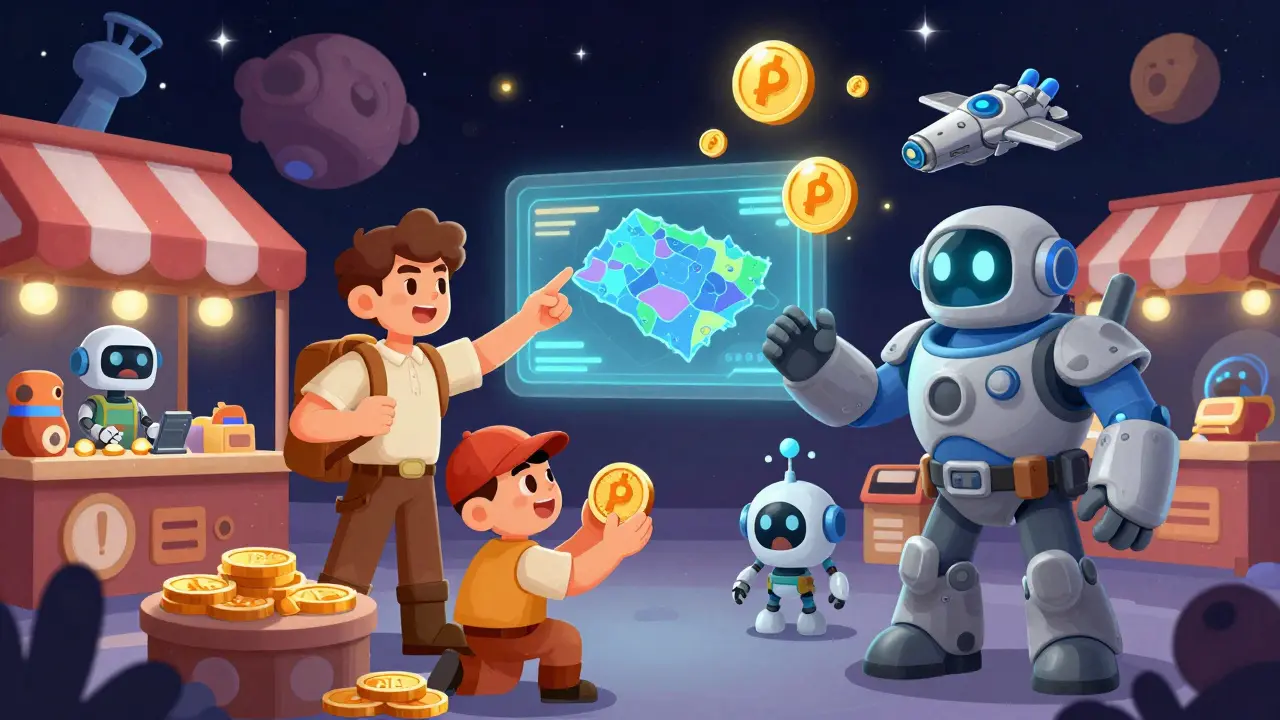
Why the price differences across exchanges? MEXC lists it at $0.036, CoinMarketCap at $0.014. Why? Liquidity. Most trading happens on smaller exchanges with thin order books. Coinbase has deeper volume, so its price is more reliable. The 24-hour trading volume on Coinbase is over $460K-enough to show real demand.
Market cap? Coinbase says $28.7M. CoinMarketCap says $4.4M. The discrepancy comes from how each site calculates supply. But the fully diluted valuation-what it’d be if all 360M tokens were in circulation-is $34.16M. That’s the real ceiling.
Why the Volatility?
POLIS has a 55% volatility rating. That’s wild. One week it’s up 45%, the next it’s down 15%. That’s normal for a project this young and tied to gaming adoption. Unlike Bitcoin, which moves slowly because it’s seen as digital gold, POLIS moves with every patch note, every new player signup, every battle won or lost in the game.
It’s not just crypto speculation-it’s game sentiment. If Star Atlas releases a new faction or a major event, POLIS spikes. If players leave because the game feels grindy, it drops. That’s why long-term holders watch the game’s player count, not just price charts.
Where to Buy POLIS and How
You can buy POLIS on several exchanges:
- COINBASE - Most trusted, supports USD deposits, best for beginners.
- MEXC - Offers spot and futures trading, lower fees, but less regulation.
- Uniswap - If you already hold SOL or USDC, you can swap directly.
On MEXC, you can buy POLIS with a credit card, bank transfer, or even PayPal. On Coinbase, you can use fiat directly. No need to buy Bitcoin first. Just log in, deposit USD, and swap for POLIS.
Pro tip: Don’t buy just because the price is low. Ask yourself: Are you buying because you want to play the game? Or because you think it’ll go back to $14? The latter is gambling. The former is investing in a play-to-earn ecosystem.
Is POLIS Worth It in 2026?
Here’s the truth: POLIS isn’t a currency. It’s a key. Without it, you can’t shape the future of Star Atlas. If you’re a player who wants control over how the game evolves-if you care about who gets taxed, who controls trade routes, who gets to build new outposts-then holding POLIS makes sense.
But if you’re just hoping for a 10x return? You’re probably going to be disappointed. The game has to keep growing. Player numbers have to climb. New features have to land. And they have to be good.
Right now, the signs are promising. The game’s player base is growing. The UI is improving. The visuals are unmatched in blockchain gaming. And the DAO is active. That’s rare.
Price predictions for 2027? Some models say $0.047. That’s a 50% drop from today. Others say it could hit $0.30 if adoption surges. Neither is guaranteed. But if Star Atlas becomes the first blockchain game that actually feels like a real MMO-where you forget you’re playing on a blockchain-then POLIS could become more valuable than any price chart suggests.
Final Thought: It’s Not About the Price
POLIS isn’t a stock. It’s a membership card to a digital civilization. You’re not buying a coin. You’re buying a vote. And in a world where most games are controlled by corporations, that’s worth something.
Play the game. Join the DAO. See how the decisions get made. If you like what you see, hold POLIS. If not, walk away. That’s the whole point.
What is the difference between POLIS and ATLAS in Star Atlas?
ATLAS is the in-game currency used to buy ships, land, weapons, and crew. POLIS is the governance token used to vote on game rules, economic policies, and system upgrades. You spend ATLAS to play. You hold POLIS to lead.
Can I earn POLIS by playing Star Atlas?
No, you cannot earn POLIS directly through gameplay. POLIS is not mined or rewarded like ATLAS. You can only acquire it by purchasing it on exchanges like Coinbase or MEXC. Some players earn ATLAS through missions and trade, then use it to buy POLIS.
Why is POLIS price so different on different exchanges?
POLIS has low overall trading volume compared to major coins. On smaller exchanges like MEXC or CoinMarketCap-listed pairs, there’s less liquidity, so prices swing more. Coinbase has deeper buyers and sellers, so its price is more stable and reliable. Always check multiple sources, but trust the one with the highest trading volume.
Is Star Atlas still active in 2026?
Yes. Star Atlas is actively developing new ship classes, expanding territory mechanics, and rolling out improved UI features. Player activity has increased in early 2026, with over 120,000 active users per month. The game is no longer in beta-it’s a fully operational metaverse with real economic systems.
Do I need to own NFTs to use POLIS?
No. You only need to hold POLIS tokens in a wallet to vote. You don’t need to own a ship or land. But if you want to influence decisions that affect your gameplay-like tax rates on mining-you’ll likely want to own assets too. POLIS gives you power. Assets give you stakes.
POLIS is a trap. 🤡 They're not giving you democracy - they're giving you a front-row seat to a crypto Ponzi. Remember when the devs said 'decentralized governance'? Yeah, turns out 3 wallets hold 60% of the voting power. They just made it look like you have a voice. I saw the DAO meeting transcripts. It's all staged. Don't be the sucker voting for 'fair mining taxes' while they quietly mint more tokens. 💸
I appreciate the depth of this breakdown. As someone who has spent over 400 hours in Star Atlas, I can confirm that POLIS isn't just a token - it's a civic responsibility. The DAO has passed 17 major proposals since January 2026, including the elimination of the 15% transaction tax on player-to-player trades. This is not speculation. This is governance. If you're holding POLIS, you're not gambling. You're participating in the creation of a new digital society. I encourage everyone to attend a live DAO session. You'll be surprised how much care goes into each vote. It's not perfect - but it's real.
I came in when POLIS was at $0.03 and just held. Didn't sell. Didn't panic. Just kept playing. The game got better. Ships got prettier. Battles got more strategic. And guess what? The price crept up. Not because of hype - because people kept showing up. If you're in it for the money, you'll burn out. But if you're in it to build something - to fight, trade, explore - then POLIS just becomes part of the story. It's not a coin. It's a badge.
The entire premise is a metaphysical illusion. You believe you're 'voting' on a universe, but you're merely optimizing your exposure to a speculative asset wrapped in theatrical worldbuilding. The DAO is a performance art piece designed to mask the underlying reality: that this is a liquidity grab disguised as utopia. The NFTs? They're digital serfdom. The 'ownership'? A ledger entry. The 'empire'? A server cluster in Virginia. You're not shaping a future. You're feeding a machine that harvests your attention and converts it into exchangeable tokens. Wake up.
I live in India, and I’ve watched this project evolve - and honestly? I’ve never seen anything like it. The way players from Lagos, Jakarta, and Des Moines all come together to vote on tax policy for a fictional asteroid belt… it’s beautiful. POLIS isn’t about price. It’s about connection. When the community voted to allow non-English proposals last month? That was the moment I knew this wasn’t just a game. It was a movement. I cried. I’m not even kidding. We’re building something that doesn’t exist anywhere else. And yes - I bought more POLIS today.
For anyone confused about why prices vary across exchanges - it's simple. Coinbase has real volume because real players are buying. MEXC? That’s where bots and pump groups dump. Check the order book depth, not the price. If you're trading on MEXC, you're playing Russian roulette with slippage. Also - don't buy POLIS if you don't understand how DAO voting works. It's not like buying ETH. You have to read the proposals. You have to understand the implications. It's work. But if you do it right? You get real power.
I used to think crypto was just gambling. Then I found Star Atlas. Now I have a fleet. I have a trade route. I have a voice. I voted to lower the fuel tax for explorers last week - and it passed. I didn’t just buy a token. I became part of a community that actually listens. I’ve never felt this connected to a digital space. The ships? Unreal Engine 5. The lore? Richer than most AAA games. The politics? More real than Twitter. I’m not saying it’s safe. I’m saying it’s meaningful. And that’s rare.
The 55% volatility is a red flag. In institutional terms, that’s equivalent to a startup with no revenue and a beta product. The fact that liquidity is concentrated on Coinbase suggests centralization of influence - which contradicts the DAO narrative. Furthermore, the fully diluted valuation is misleading. If 84% is in circulation, and the remaining 16% is locked in dev wallets with a 2-year vesting schedule, then the actual float is even lower. This isn’t a decentralized economy - it’s a thinly veiled equity offering with NFTs as collateral.
They’re lying. They’re all lying. I’ve seen the behind-the-scenes footage. The ‘player votes’? They’re pre-written. The ‘DAO meetings’? Scripted. The ‘real economy’? A bot farm running 24/7. They’re not trying to build a metaverse - they’re trying to pump and dump. I know because I used to work for them. I quit after they told me to fake player engagement logs. I’m not paranoid. I’m informed. POLIS is a ghost ship. Sail away.
If you’re buying POLIS because you think it’ll hit $14 again, you’re delusional. That price was a bubble fueled by hype, not utility. The game is good - I’ll give you that. But utility doesn’t fix bad tokenomics. The supply is too high. The demand is too thin. You’re not an investor. You’re a gambler. And gambling on a game that’s not even 3 years old? That’s not smart. That’s reckless.
America built the internet. Now we’re letting Indians and Filipinos vote on how our space empire runs? I’m sorry, but I don’t think a guy in Mumbai should be deciding my mining tax rates. This isn’t democracy. It’s cultural colonization. If I want to play a game, I want American values - not global consensus. POLIS is just another way for the world to dilute our sovereignty. I’m not voting. I’m leaving.
The fact that you can rent out your NFT ships and earn passive income in ATLAS is huge. I’ve had my cruiser out for 3 weeks and made more in ATLAS than I did in my full-time job last month. I used that ATLAS to buy POLIS. Now I vote on whether to expand the trade lanes. It’s surreal. I didn’t think a blockchain game could make me feel this empowered. I’m not rich. But I’m involved. And that’s worth more than any price chart.
What’s fascinating isn’t the token - it’s the emergence of a new kind of civic identity. People who’ve never voted in their own country are now debating fiscal policy for a fictional galaxy. That’s not tech. That’s anthropology. We’re witnessing the birth of a digital polis - literally. The name isn’t accidental. The governance isn’t a gimmick. It’s a prototype. And if this works - if real people can self-organize without a CEO or a board - then this could be the most important social experiment of the 21st century. I’m not holding for profit. I’m holding for history.
You say 'real ownership'... but your NFTs are locked in a Solana wallet. Who’s to say the devs won’t hard-fork the chain tomorrow? You think you own it? You own a pointer to a file on a server. That’s not ownership. That’s a lease. And you’re paying rent in your attention. The real asset here? The community. The rest? Illusion.
The price on CoinMarketCap is $0.014? That’s laughable. That’s not even the real market. It’s a bot-driven snapshot. You’re not getting accurate data from a site that doesn’t even verify liquidity. If you’re making decisions based on CoinMarketCap, you’re not an investor - you’re a data fool. Use Coinbase. Use DEX Screener. Or don’t trade at all. But stop pretending you’re informed.
I’m not a crypto guy. I’m a gamer. I’ve played WoW, EVE, Skyrim. This is the first time I’ve ever felt like my actions actually mattered. I lost my ship in a battle. I didn’t rage quit. I joined the DAO meeting. We changed the respawn timer. I didn’t just play a game. I helped fix it. That’s not tech. That’s magic.
I’ve been in this since the alpha. Saw it crash. Saw it rebuild. Saw players leave. Saw them come back. The game isn’t perfect. But it’s alive. And that’s more than I can say for 99% of crypto projects. POLIS isn’t about returns. It’s about legacy. I’m not waiting for it to hit $0.30. I’m waiting to see what happens when 100,000 people vote on whether to colonize a black hole. That’s not a coin. That’s a revolution.
If you’re not holding POLIS, you’re not playing the game - you’re watching it. And in Star Atlas? Watching is losing. I’ve been in 17 fleet battles. I’ve claimed 3 systems. I’ve voted to ban bots. I’ve helped design a new ship class. This isn’t a token. It’s a passport. Get yours. Or get out.
Just joined. Bought 10k POLIS. No regrets. The community is chill. The devs listen. The game is stunning. I didn’t expect to care about asteroid tax policy - but I do. 🚀
i just bought my first ship and now i have to vote on fuel tax? wow. this is wild. i didnt even know i was a citizen of space lol 🤯
I don’t understand crypto. But I love this game. I fly my ship. I trade. I fight. I vote. I don’t know what POLIS is worth. But I know it’s mine. And that’s enough.
You call this innovation? This is just Web3 theater. A bunch of tech bros pretending they’re building the future while wearing VR headsets and sipping matcha lattes. The real future is in silicon - not in pixels. And you’re all just dancing in the glow of a dying star.
I’ve never been this excited about a crypto project. Not because of the price. But because of the people. We’re not just players. We’re pioneers. And this? This is the frontier. Let’s go.
The price doesn’t matter. The vote does. I voted yesterday. It was the first time I ever felt like I mattered in a digital space. That’s worth more than any coin.
I’ve been skeptical, but I’ve watched the DAO meetings. The transparency is real. The debates are heated. The outcomes are binding. This isn’t a game. It’s a living system. And I’m proud to be part of it.