
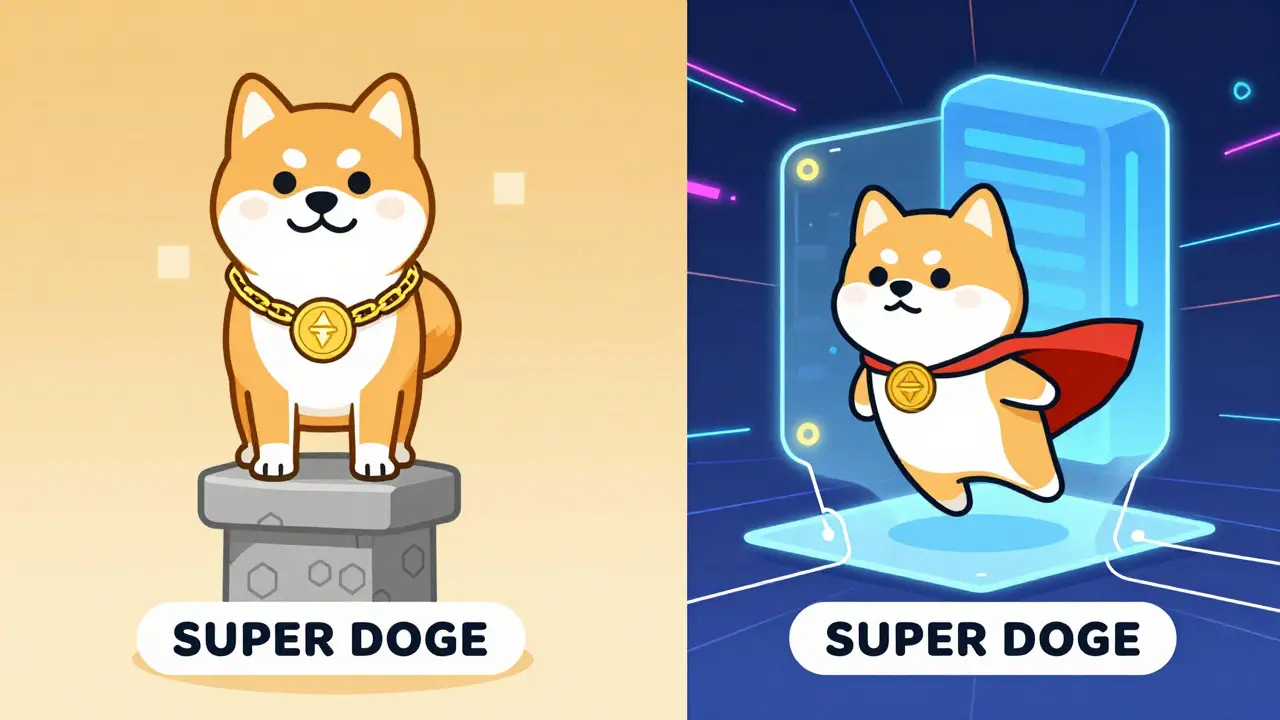
You’ve seen the ticker DOGE. You know it as the Shiba Inu that made millions. But when you search for "SUPER DOGE," are you looking at the same asset? The short answer is no. This distinction matters because confusing a derivative token on a side chain with a major layer-1 blockchain can lead to costly mistakes in your portfolio.
SUPER DOGE is not the original Dogecoin. It is a separate cryptocurrency token operating on the Binance Smart Chain (a blockchain network compatible with Ethereum smart contracts). While it borrows the branding and ticker symbol of the famous meme coin, its technology, supply mechanics, and market status are entirely different. Understanding these differences is critical before you buy or hold either asset.
The Core Difference: Layer-1 Blockchain vs. BSC Token
To understand what SUPER DOGE is, we first need to look at what it is not. The original Dogecoin (a peer-to-peer digital currency created in 2013 by Billy Markus and Jackson Palmer) is a standalone blockchain. It has its own miners, its own consensus mechanism (Proof-of-Work), and its own network security. It operates independently, much like Bitcoin or Litecoin.
In contrast, SUPER DOGE is a token built on top of an existing infrastructure. Specifically, it exists on the Binance Smart Chain (often referred to as BNB Chain). This means SUPER DOGE relies on the BSC network for transaction validation and security. It does not have its own miners or independent ledger. Instead, it functions as a smart contract-a piece of code that defines how the token behaves within the broader BSC ecosystem.
This technical difference changes everything about how you interact with the asset. When you send original Dogecoin, you are sending it across the Dogecoin network. When you send SUPER DOGE, you are interacting with a contract on the BSC network, which requires you to have BNB (the native token of BSC) to pay for gas fees.
Origins and Identity Crisis
The confusion between these two assets stems from their shared identity markers. Both use the ticker "DOGE" (though exchanges often list them differently to avoid errors) and both leverage the Shiba Inu meme culture. However, their origins diverge sharply.
Dogecoin was launched on December 6, 2013, by software engineers Billy Markus and Jackson Palmer. They created it as a joke to poke fun at the speculative nature of cryptocurrencies at the time. Despite its humorous beginnings, it evolved into a serious payment network with a massive global community.
SUPER DOGE, however, lacks this documented history. Major data aggregators and exchange listings describe it as an "emerging cryptocurrency" but rarely name specific founders, release dates, or founding organizations. It appears to be a community-driven project that capitalized on the popularity of the Doge brand. Without a whitepaper or clear team attribution, SUPER DOGE falls into the category of anonymous or semi-anonymous meme tokens, where the community’s belief in the project is the primary driver of value rather than technological innovation or institutional backing.
Market Reality: Liquidity and Price Volatility
If you check the price of SUPER DOGE on platforms like Crypto.com or Bitget, you will see it trading at fractions of a cent-often around $0.001 USD. At first glance, a low price might seem attractive, suggesting room for growth. However, price alone tells only half the story. The other half is liquidity.
Data snapshots often show SUPER DOGE with a 24-hour trading volume listed as "N/A" or negligible. This indicates that while the token has a price, there may not be enough buyers and sellers actively trading it at any given moment. Low liquidity creates high slippage risk. If you try to sell a large amount of SUPER DOGE, you could drive the price down significantly just by executing the trade.
Compare this to the original Dogecoin. CoinGecko data shows Dogecoin regularly processing billions of dollars in daily volume. It is traded on virtually every major exchange worldwide. The disparity in market capitalization is stark: Dogecoin has historically ranked among the top ten cryptocurrencies globally, with a market cap exceeding $70 billion at its peaks. SUPER DOGE, by comparison, occupies a micro-cap niche with unverified supply metrics and thin trading depth.
| Feature | SUPER DOGE (BSC Token) | Dogecoin (Original) |
|---|---|---|
| Network | Binance Smart Chain (BSC) | Dogecoin Blockchain (Layer-1) |
| Type | Smart Contract Token (BEP-20) | Native Cryptocurrency |
| Consensus | Relies on BSC Proof-of-Staked-Authority | Proof-of-Work (Scrypt) |
| Liquidity | Low / Often Unreported | Very High (Billions daily) |
| Use Case | Speculation / Community Meme | Payments / Tipping / Charity |
| Risk Level | High (Micro-cap, Illiquid) | Medium-High (Established but Volatile) |

Utility and Use Cases
Why would someone buy SUPER DOGE? Currently, the utility is largely speculative. Listings describe it as having "innovative technology" and "unique use cases," but these claims lack concrete examples. There is no evidence of widespread adoption for payments, integration into decentralized finance (DeFi) protocols, or governance rights.
The primary value proposition cited by sources like Blockspot.io is community. SUPER DOGE markets itself on fostering collaboration and mutual support among holders. In the world of meme coins, community strength can sometimes sustain a token’s price even without technical utility. However, this makes the asset highly dependent on social media sentiment and influencer hype.
Original Dogecoin, while also a meme coin, has developed real-world utility. It is widely accepted for tipping content creators on Reddit and Twitter. Businesses occasionally accept it for donations and small purchases. Furthermore, the Dogecoin ecosystem is expanding; projects like DogeOS are attempting to add smart contract capabilities to the main chain, potentially bridging the gap between simple payments and complex applications.
How to Buy and Store SUPER DOGE
If you decide to proceed with buying SUPER DOGE, the process differs from buying standard cryptocurrencies like Bitcoin or Ethereum. Because it lives on the Binance Smart Chain, you cannot store it in a basic Bitcoin wallet.
- Choose a Compatible Exchange: Platforms like Bitget or Crypto.com list the token. Ensure you are selecting the correct pair (usually DOGE/BUSD or DOGE/BNB) to avoid accidentally buying the original Dogecoin.
- Set Up a Wallet: You need a wallet that supports BSC tokens. Trust Wallet or MetaMask are popular choices. Make sure your wallet is configured to connect to the Binance Smart Chain network.
- Acquire BNB: To transfer SUPER DOGE off the exchange or to interact with it on-chain, you will need BNB to pay for transaction fees (gas).
- Verify the Contract Address: Always double-check the smart contract address from official sources. Fake tokens with similar names are common on BSC. Sending funds to the wrong address is irreversible.
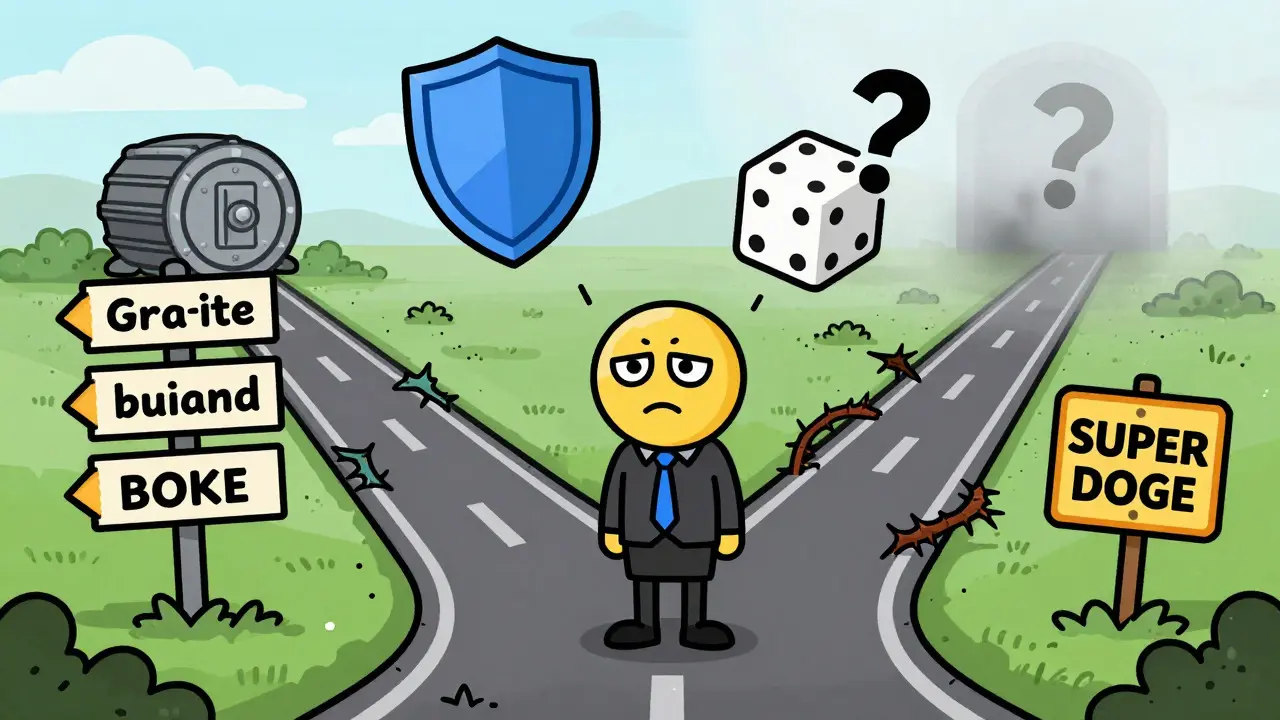
Risks You Should Know
Investing in tokens like SUPER DOGE carries significant risks that go beyond normal market volatility.
- Illiquidity Risk: With low trading volume, you may find it difficult to sell your tokens quickly without accepting a lower price.
- Smart Contract Risk: As a token on BSC, its security depends on the quality of its underlying code. If the contract has bugs or vulnerabilities, funds could be at risk. Unlike major blockchains, smaller tokens rarely undergo rigorous third-party audits.
- Brand Confusion: The similarity to Dogecoin can lead to accidental purchases or misinformed investment decisions based on the performance of the original coin.
- Lack of Transparency: Without a known development team or detailed roadmap, there is no accountability if the project stalls or abandons development.
Final Thoughts on SUPER DOGE
SUPER DOGE is a distinct asset from the original Dogecoin. It is a speculative token on the Binance Smart Chain that leverages meme culture for community building. While it offers exposure to the BSC ecosystem and potential high-risk/high-reward dynamics, it lacks the liquidity, established utility, and transparent governance of its namesake.
Before allocating funds, treat SUPER DOGE as a high-risk speculative play rather than a foundational holding. Verify all contract addresses, ensure you understand the gas fee requirements on BSC, and never invest more than you can afford to lose. For those seeking stability within the meme coin sector, the original Dogecoin remains the more liquid and widely recognized option.
Is SUPER DOGE the same as Dogecoin?
No. SUPER DOGE is a token on the Binance Smart Chain (BSC), while Dogecoin is its own independent blockchain (Layer-1). They have different technologies, supplies, and market caps, despite sharing similar branding and ticker symbols.
Where can I buy SUPER DOGE?
You can purchase SUPER DOGE on centralized exchanges that list it, such as Bitget or Crypto.com. Always verify the trading pair to ensure you are buying the BSC token and not the original Dogecoin.
What wallet do I need for SUPER DOGE?
Since SUPER DOGE is a BEP-20 token on Binance Smart Chain, you need a wallet that supports BSC, such as Trust Wallet or MetaMask. You will also need BNB in your wallet to pay for transaction fees.
Who created SUPER DOGE?
Unlike the original Dogecoin, which was created by Billy Markus and Jackson Palmer, the specific founders or development team behind SUPER DOGE are not clearly identified in public listings. It is primarily described as a community-focused project.
Is SUPER DOGE a safe investment?
SUPER DOGE is considered a high-risk investment due to its low liquidity, micro-cap status, and lack of transparent development details. It should be treated as speculative, and investors should only allocate funds they can afford to lose.
It is absolutely fascinating how the digital landscape allows for such blatant identity theft without immediate legal recourse. The distinction between a Layer-1 blockchain and a mere smart contract token on BSC is not just technical jargon; it is the difference between owning a house and renting a room in someone else's mansion. When you look at the liquidity charts, the disparity is stark. Dogecoin has deep oceans of volume, while Super Doge looks like a stagnant puddle that dries up under the slightest heat. I always tell people to check the contract address because one wrong click can send your funds into the void forever. It is a wild west out there.
This is so true! 🐕💎 Always double check that contract address folks. It’s scary how easy it is to get scammed if you aren’t paying attention. The gas fees on BSC are cheap but still annoying when you’re just trying to move tokens around. 😅
boring read. another meme coin dump.
i think its funny how ppl get confused abt this stuff. in india we have so many fake schemes too. u just need to be careful. super doge seems risky but maybe community will save it? who knows. :)
the whole concept of value in crypto is a social construct anyway. super doge might be illiquid now but perception is reality. if enough people believe in the meme, the liquidity will follow. its all about collective consciousness manifesting financial gain. dont let the skeptics dim ur light.
Oh, darling, you speak of 'collective consciousness' as if it were a shield against market mechanics. How quaint. The truth is far more brutal and elegant. These derivative tokens are merely parasites feeding on the carcass of genuine innovation. To hold Super Doge is to admit you lack the intellectual fortitude to distinguish between a sovereign protocol and a script kiddie's vanity project. It is tragic, really, watching the masses dance to the tune of anonymous developers who could vanish tomorrow. Do try to keep up with the nuances of blockchain sovereignty, would you?
Let us remember that every great journey begins with a single step, even if that step is onto a shaky platform. While the risks are undeniable, the opportunity for growth exists where others see only chaos. Stay positive and do your due diligence. You have got this!
stop being so naive. most of these coins are rugs waiting to happen. why buy super doge when you can just hodl btc or eth. it’s pure speculation based on nothing but hype. typical reddit crowd falling for the same tricks over and over.
Hey Candice, take it easy. Not everyone is looking for the next Bitcoin. Some folks just want to have fun with small amounts. :) Just make sure you know what you're getting into. Happy trading!
it doesnt matter if its layer 1 or token. money is money. if it goes up you win. if it goes down you lose. simple as that. stop overthinking it.
I have been following the development of various meme coins for quite some time now, and it is interesting to observe how the community dynamics shift from one project to another. While Super Doge may lack the technological backbone of its predecessor, the human element of support and shared enthusiasm cannot be entirely dismissed as irrelevant. There is a certain charm in participating in a movement, however fleeting it may be, provided one keeps their expectations grounded in reality and does not invest beyond their means.
Indeed! It is crucial to maintain a balanced perspective. The volatility is high, yes. But the lessons learned are invaluable. Proceed with caution, my friends. Caution is key.
We must ask ourselves: what is the nature of value in a digital realm where scarcity is artificial and utility is often illusory? Is Super Doge merely a mirror reflecting our own desires for quick wealth, or is it a testament to the chaotic beauty of decentralized experimentation? Perhaps both. The line between fraud and freedom is thin, drawn in code and consensus.