
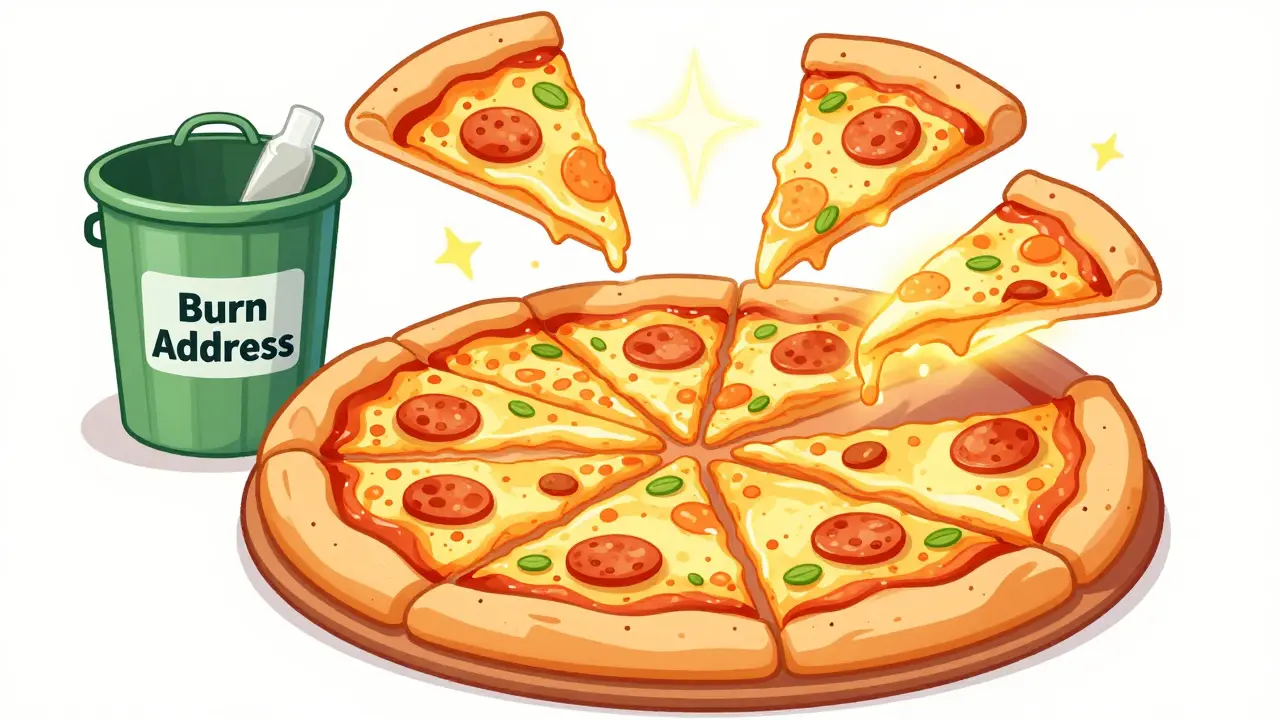
Imagine you have a pizza cut into eight slices. If you throw two slices into the trash, the remaining six slices don't magically get bigger. But if everyone wants a slice and there are fewer available, each slice becomes more valuable to hold. That is the basic idea behind token burning in cryptocurrency. It sounds dramatic-like destroying money-but it is actually a precise accounting trick used by blockchain projects to manage supply.
Token burning means permanently removing tokens from circulation. Once burned, these digital assets are gone forever. They cannot be spent, traded, or recovered. Projects do this to create scarcity. The theory is simple: if demand stays the same or grows, but supply shrinks, the price of the remaining tokens should rise. This concept has moved from a niche experiment to a standard feature in major crypto ecosystems, influencing how billions of dollars in value are managed on-chain.
How Token Burning Actually Works
To understand the mechanics, you need to know what a "burn address" is. In traditional banking, if you want to destroy cash, you shred it. In crypto, you send it to a place where no one can ever access it again. This destination is called a burn address.
A private key is like a password that proves you own the funds in a wallet. Without it, you cannot move the money. A burn address is a valid public address (so the blockchain accepts the transaction), but because no one has the private key, the tokens are locked away for eternity. Think of it as throwing your keys down a bottomless well. The car is still there, but you can never drive it again.
The process usually follows four clear steps:
- Decision: The project team or protocol decides to burn tokens. This might be based on a schedule, a percentage of profits, or a specific trigger event.
- Identification: They determine exactly how many tokens to remove. This could be a fixed number, like 1,000 tokens, or a variable amount, like 5% of the current circulating supply.
- Execution: The tokens are sent via a transaction to the designated burn address. This costs gas fees (network transaction costs) just like any other transfer.
- Verification: The transaction is recorded on the blockchain. Anyone can check the explorer to see the tokens arrive at the burn address and stay there.
This transparency is crucial. Because blockchains are public ledgers, you don't have to trust the company's word. You can verify the burn yourself. This builds confidence among investors that the supply reduction is real.
Manual vs. Automatic Burns: Which Is Better?
Not all burns happen the same way. There are two main methods: manual and automatic. Each has pros and cons that affect how reliable the mechanism feels to investors.
| Feature | Manual Burning | Automatic Burning |
|---|---|---|
| Control | Project team or developers decide when and how much to burn. | Smart contracts execute burns automatically based on code rules. |
| Flexibility | High. Teams can pause burns during bear markets or accelerate them during bull runs. | Low. The code runs regardless of market conditions unless updated via governance. |
| Trust Required | High. Users must trust the team to act honestly and transparently. | Low. The code is immutable; anyone can audit the smart contract logic. |
| Example | BNB (Binance Coin) quarterly burns. | Ethereum EIP-1559 base fee burns. |
| Volatility Impact | Higher short-term volatility due to uncertainty about timing. | Lower volatility; predictable supply reduction helps stabilize expectations. |
Manual burning gives teams control. For example, Binance, the world’s largest crypto exchange, uses a manual approach for its native token, BNB. Since 2017, they have conducted quarterly burns, removing millions of tokens worth billions of dollars. This allows them to time burns strategically, such as increasing frequency when the market is hot. However, this requires users to trust Binance’s announcements. If they stopped burning without notice, confidence would drop.
Automatic burning removes human discretion. Ethereum’s upgrade known as EIP-1559 changed how transaction fees work. Instead of paying miners entirely, a portion of every transaction fee is now burned. This happens automatically with every block. No CEO needs to approve it. A study by Crypto.com found that tokens with automatic burns experienced less price volatility after burn events compared to manual ones. Why? Because the market knows exactly how the supply will shrink. Predictability reduces panic selling and speculative spikes.
Does Burning Actually Increase Price?
This is the million-dollar question. Everyone burns tokens hoping their coin goes up. But does it work? The answer is: sometimes, but not always.
Economic theory says yes. Supply down + Demand steady = Price up. But crypto markets are driven by sentiment, utility, and macro trends, not just supply numbers. A 2022 study published in the Journal of Digital Finance analyzed over 200 token burns. They found that small burns-less than 0.5% of total supply-had almost zero impact on price. Investors barely noticed.
However, large burns mattered. When burns exceeded 2% of the total supply, prices tended to rise by an average of 8.7% over the following month. The size of the burn relative to the total supply is critical. Burning 1,000 tokens out of a million is significant. Burning 1,000 tokens out of a trillion is invisible.
Consider the case of Shiba Inu (SHIB). In May 2021, the community collectively burned 410 trillion SHIB tokens. At the time, this was about 4% of the total supply. The news generated massive hype, and the price surged 230% in a month. Was it the burn itself? Or was it the attention the burn created? Likely both. Marketing plays a huge role in crypto.
On the flip side, Dr. Christine Lagarde, former head of the IMF, has criticized token burning as addressing symptoms rather than root causes. She argues that artificial scarcity doesn’t fix underlying issues like lack of utility or poor technology. If a project has no real use case, burning tokens won’t save it. The TerraUSD (UST) collapse in 2022 proved this. UST had a burning mechanism to maintain its peg, but when confidence broke, the burns couldn’t stop the crash. Supply management fails without genuine demand.
Real-World Examples of Token Burning
Let’s look at how major projects implement this strategy differently.
Binance Coin (BNB)
Binance pioneered the quarterly burn model. Their goal is to reduce the total supply of BNB to 100 million tokens (from an initial 200 million). As of late 2023, they had burned over 48.5 million BNB. This consistent reduction has helped BNB maintain high value despite market downturns. The burn is tied to Binance’s revenue, meaning successful business operations directly benefit token holders through supply reduction.
Ethereum (ETH)
Ethereum’s approach is unique. It doesn’t burn ETH to boost price intentionally. Instead, it burns ETH as part of network security and efficiency. With EIP-1559, the base fee for transactions is burned. During busy periods, more ETH is burned. This makes Ethereum potentially deflationary during high usage. Over 4.2 million ETH have been burned since the upgrade. This links the health of the network (high activity) to token scarcity, aligning user interests with holder interests.
Paxos Gold (PAXG)
PAXG represents physical gold held in vaults. When someone redeems their PAXG tokens for actual gold bars, those tokens are burned. This ensures the digital supply matches the physical inventory. It’s not about speculation; it’s about accuracy. This model shows that burning isn’t always about price manipulation-it can be about maintaining integrity in asset-backed tokens.
Risks and Pitfalls of Token Burning
While burning sounds great, it carries risks. First, there’s the risk of greenwashing. Some projects announce massive burns to pump their price, then quietly issue new tokens later. Always check the total supply cap. If a project has no hard cap, they can mint infinite new tokens, rendering previous burns meaningless.
Second, regulatory scrutiny is increasing. The U.S. Securities and Exchange Commission (SEC) has hinted that structured burns designed to manipulate price could be seen as securities violations. While no major enforcement actions have occurred yet, founders should be cautious. Burns should be part of a transparent, documented economic model, not a covert scheme to inflate value.
Third, technical errors happen. In 2020, the Waves platform accidentally burned the wrong amount of tokens due to a calculation error. It required a complex community vote to reverse. While rare, bugs in smart contracts or manual execution can lead to permanent loss of value or trust.
Future Trends in Token Economics
Token burning is evolving. We are moving beyond simple "send to void" models. New trends include:
- Dynamic Burn Rates: Protocols like Kadena adjust burn rates based on market conditions. If the price drops too low, burns increase to support value. If it spikes, burns decrease to prevent overheating.
- Conditional Burns: VeChainThor implemented burns that only trigger when specific volume thresholds are met. This ties scarcity directly to real-world usage.
- Integration with Real-World Assets: More projects are linking burns to physical redemption or service delivery, ensuring that every burned token corresponds to tangible value destruction or consumption.
Analysts predict that by 2025, nearly all new crypto projects will include some form of burn mechanism. However, the marginal impact is diminishing. As burning becomes common, investors are becoming smarter. They look past the burn announcement to examine utility, adoption, and team competence. Burning is no longer a silver bullet; it’s one tool in a broader toolkit.
Can I recover tokens I accidentally sent to a burn address?
No. By definition, a burn address has no private key. Once tokens are sent there, they are permanently lost. Double-check addresses before sending any funds. Many wallets now warn you if you attempt to send to known burn addresses.
Is token burning legal?
Yes, generally. However, regulators like the SEC monitor whether burns are used to artificially manipulate prices. If a burn is part of a deceptive scheme to inflate value without disclosure, it could face legal challenges. Transparent, documented burns are widely accepted.
Why do projects burn their own tokens instead of buying back stock?
In traditional finance, companies buy back shares to reduce supply. In crypto, buying back tokens keeps them in a corporate wallet, which raises centralization concerns. Burning removes them entirely, decentralizing ownership and proving the supply reduction is irreversible. It’s a more trustless method.
Does burning tokens make a cryptocurrency safer?
Not directly. Security depends on the blockchain’s code and consensus mechanism. However, burning can improve economic security by increasing the cost of attacks. If fewer tokens exist, an attacker needs to acquire a larger percentage of the remaining supply to gain control, which may be more expensive.
How do I verify if a token burn actually happened?
Use a blockchain explorer like Etherscan or BscScan. Find the transaction hash provided by the project. Check the recipient address. If it matches the known burn address for that network and the balance of that address increases while the sender’s decreases, the burn is verified. Never rely solely on social media announcements.