

Buying a cryptocurrency because it sounds like a "smart" automated fund can be a trap. That’s exactly where Venus UNI (vUNI) fits into the picture. On paper, it promises to take the stress out of trading by using bots and smart contracts to manage your money for you. But if you’ve looked at the price charts recently, you might have noticed something unsettling: the numbers don’t add up.
In May 2026, Venus UNI is struggling to find its footing. The token is listed on major aggregators, yet trading volume is effectively zero on many platforms. Prices vary wildly between exchanges, and some major players have quietly stopped listing it entirely. Before you put even a dollar into this, you need to understand what vUNI actually is, why the market has largely abandoned it, and whether there’s any life left in this project.
What Exactly Is Venus UNI?
To understand the risk, you first have to understand the product. Venus UNI is a decentralized investment fund token that automates trading strategies on the Uniswap exchange.
Here is how the mechanism works in theory:
- The Goal: It acts as a passive income vehicle. You buy vUNI, and instead of holding a static asset, you are funding a pool that actively trades.
- The Engine: It relies on Uniswap, one of the largest decentralized exchanges (DEX) in the world, to execute these trades.
- The Brain: It uses alerts from TradingView, a popular charting platform, to trigger buy and sell orders automatically.
The idea is appealing. You don’t want to stare at charts all day, so you let a bot do it for you. However, this isn’t a new concept. The DeFi space is crowded with automated yield protocols. What makes vUNI different-or rather, what makes it suspicious-is the lack of transparency around its performance and the recent collapse in its market presence.
The Red Flags: Price and Liquidity Crisis
If you check the price of vUNI today, you’ll see a mess of conflicting data. This is not normal for a healthy cryptocurrency. Here is what the data looks like across different platforms in mid-2026:
| Platform | Reported Price | Status / Note |
|---|---|---|
| CoinMarketCap | $3.79 USD | Zero 24-hour trading volume reported. |
| Binance | $3.39 USD | Shows slight gains (+2.03%), but liquidity is thin. |
| Crypto.com | $3.95 - $6.00 USD | Explicitly states: "vUNI is not tradable yet." |
Notice the discrepancy? Crypto.com shows two different prices simultaneously and tells you you can’t trade it. CoinMarketCap shows a price but reports zero dollars in trading volume. In the crypto world, zero volume means no one is buying or selling. If you tried to sell your vUNI tokens right now, you might find yourself unable to offload them without crashing the price further.
A History of Volatility
This didn’t happen overnight. Venus UNI had a moment of glory, but it was short-lived. Let’s look at the historical context to understand why confidence has evaporated.
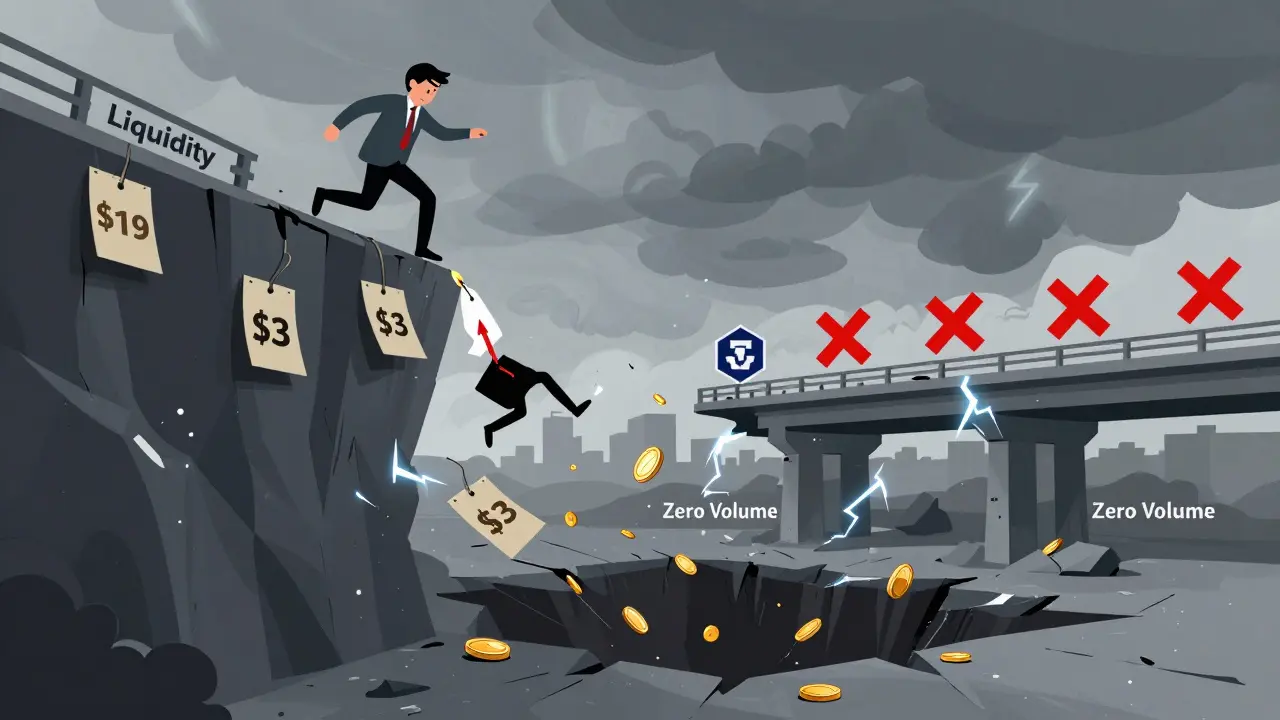
- All-Time High: On December 8, 2024, vUNI hit a peak of $19.43 USD. At this point, investors were optimistic about the automated trading model.
- The Crash: Over the next four months, the token lost massive value. By April 9, 2025, it hit an all-time low of $4.60 USD.
- The False Recovery: From that low point, it managed to climb back up roughly 100% to reach the ~$3.80 range we see in May 2026. However, this is still a 52.7% loss from its peak.
This pattern-a sharp rise followed by a steep decline and a weak recovery-is typical of speculative projects that fail to deliver on their core promise. When a token drops by more than half its value and stays down, it usually signals that the underlying technology or team is no longer viable.
Why Is the Market Cap Zero?
One of the most concerning metrics for vUNI is its ranking. On CoinMarketCap, it sits at rank #7698. For context, Bitcoin is #1, Ethereum is #2, and even small meme coins often rank in the top 500. Being ranked nearly 8,000 places down puts vUNI in the "dust" category-tokens that are virtually irrelevant to the broader market.
More alarmingly, CoinMarketCap lists the market capitalization as zero. Market cap is calculated by multiplying the current price by the total circulating supply. A zero market cap implies one of two things:
- Data Error: The aggregators have failed to scrape the correct supply data from the blockchain.
- Abandonment: The token has been delisted from major liquidity pools, meaning there is no active market to determine its true value.
Given that Crypto.com has also flagged it as untradable, the second scenario feels increasingly likely. Without active development updates, community engagement, or clear documentation on its smart contract audits, investors are left guessing.
The Technical Gap: Where Is the Code?
In legitimate DeFi projects, transparency is king. You should be able to go to a block explorer like Etherscan or BscScan and verify the smart contract code. You should know which network the token lives on (Ethereum, Binance Smart Chain, Arbitrum, etc.).
For Venus UNI, this information is conspicuously missing from public documentation. The World.org ecosystem page describes the function of the bot, but it does not provide:
- The specific smart contract address for verification.
- Audits from reputable security firms (like CertiK or OpenZeppelin).
- Details on who controls the admin keys (the people who can pause or drain the fund).
Without this data, you are trusting a black box with your money. If the TradingView alerts stop working, or if the Uniswap integration breaks, who fixes it? Who pays for the gas fees? These questions remain unanswered.

Should You Buy Venus UNI in 2026?
I’m going to be direct: **No.**
Unless you are looking for a high-stakes gamble where the odds are heavily stacked against you, there is no logical reason to invest in vUNI right now. Here is why:
- Liquidity Risk: With zero volume on major trackers, you may not be able to sell when you want to.
- Exchange Delisting: Major platforms like Crypto.com are already blocking trades. This trend will likely spread.
- Opportunity Cost: There are dozens of other DeFi protocols offering automated yield farming with better track records, higher liquidity, and transparent teams.
- No Catalyst: There is no news, no roadmap update, and no community buzz driving the price up. It is simply drifting downward.
If you already hold vUNI, consider this a lesson in due diligence. Check if you can still withdraw your assets. If the token is stuck on a DEX with no liquidity, you may need to accept the loss as a tuition fee for learning how to vet crypto projects.
Alternatives to Consider
If you like the idea of automated trading or decentralized finance, don’t throw your money into a sinking ship. Look at established alternatives that offer similar benefits with actual liquidity:
- Uniswap (UNI): Instead of betting on a third-party wrapper, you can use the Uniswap protocol directly. It powers the liquidity for thousands of tokens.
- Yearn Finance: A leading DeFi aggregator that automates yield farming strategies across multiple protocols with a proven track record.
- Aave: A lending protocol that allows you to earn interest on deposits or borrow against collateral, all through smart contracts.
These platforms have millions of users, regular audits, and active development teams. They aren’t immune to risk, but they are real businesses, not ghost towns.
Is Venus UNI (vUNI) a scam?
While we cannot legally label it a "scam" without proof of intent to defraud, vUNI exhibits many characteristics of failed or abandoned projects. The lack of trading volume, zero market cap data, and delisting from major exchanges like Crypto.com suggest it is no longer a viable investment. Proceed with extreme caution.
Where can I buy Venus UNI?
As of May 2026, availability is extremely limited. Binance still lists it, but liquidity is very low. Crypto.com explicitly states it is not tradable. Buying on decentralized exchanges (DEXs) may be possible but carries high slippage and risk due to the lack of buyers.
What happened to the price of vUNI?
The price peaked at $19.43 in December 2024 before crashing to $4.60 in April 2025. It has since recovered slightly to the $3.39-$3.95 range but remains significantly below its all-time high. The crash was likely driven by a loss of investor confidence and lack of liquidity.
Does Venus UNI really automate trading?
According to its documentation, yes. It claims to use TradingView alerts to trigger trades on Uniswap via smart contracts. However, without access to verified audit reports or live performance data, this claim cannot be independently confirmed.
Why is the market cap of vUNI zero?
A zero market cap on aggregators like CoinMarketCap usually indicates a failure to track the circulating supply or a complete halt in trading activity. It suggests the token is either delisted from major pools or has negligible economic value.