
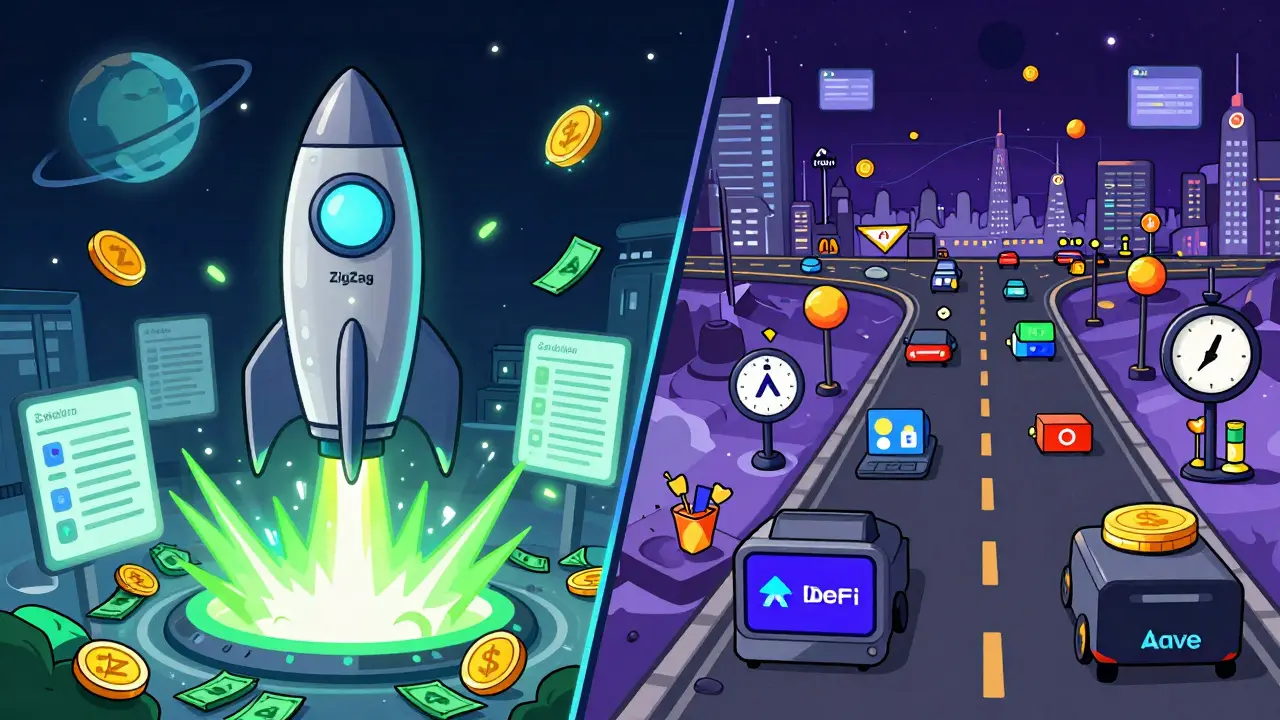
There’s a common mistake floating around: people think ZigZag is an Arbitrum-based exchange. It’s not. ZigZag runs on its own ZK-Rollup tech - completely separate from Arbitrum’s Optimistic Rollup system. If you’re looking for a fast, low-fee DEX that doesn’t rely on Arbitrum, ZigZag might be worth your time. But if you want to tap into the biggest DeFi ecosystem on Layer 2, you’re better off with something built on Arbitrum. Let’s cut through the confusion.
What ZigZag Actually Is
ZigZag is a decentralized exchange built on zero-knowledge rollups (ZK-Rollups), not Optimistic Rollups like Arbitrum. That means every batch of trades gets proven mathematically before being settled on Ethereum. No 7-day waiting period. No fraud proofs. Just fast, final, and private trades.
It launched its native token, $ZZ, in September 2025 with a total supply of 100 million. Over 60% of those tokens went to the community - through airdrops, liquidity incentives, and ecosystem grants. The $ZZ token isn’t just for speculation. Holders get a share of every trading fee generated on the platform. That’s rare. Most DEX tokens give you voting rights. ZigZag gives you cash.
The first airdrop in December 2022 qualified 92,000 wallets. If you traded at least four days in a month, with your first and last swap spaced 30+ days apart, you got 300 $ZZ. Traders active in November 2021 got 600 $ZZ. That’s not a giveaway - it’s a reward for real usage.
How It Compares to Arbitrum-Based Exchanges
Arbitrum is the king of Ethereum Layer 2. It hosts Uniswap, Aave, GMX, and Radiant. Total value locked? Over $3.2 billion as of late 2025. It’s the go-to for DeFi users who want low fees and deep liquidity.
ZigZag? It’s a standalone exchange. No integrations. No shared liquidity pools with other protocols. Its TVL is nowhere near Arbitrum’s. You won’t find $ZZ listed on major Arbitrum-based DEXes. That’s not a flaw - it’s a design choice. ZigZag bets on its own ecosystem. Arbitrum bets on being the foundation for everyone else’s.
Here’s the real difference:
- ZigZag (ZK-Rollup): Trades settle instantly. Proofs are generated on-chain. Higher compute cost, but no waiting.
- Arbitrum (Optimistic Rollup): Trades are assumed valid. If someone tries to cheat, there’s a 7-day window to challenge. Lower compute cost, but slower withdrawals.
Gas fees on Arbitrum average $0.15 per transaction. On Ethereum mainnet, it’s $2.50+. ZigZag’s fees are competitive - around 0.3% per swap, which is lower than most DEXes (0.5-1.0%). But you’re not saving on gas; you’re saving on spread and platform fees.
Why You Might Choose ZigZag
If you care about privacy and speed, ZigZag wins. ZK-Rollups don’t reveal trade details on-chain. Your order book stays hidden. That’s a big deal if you’re doing larger trades and don’t want others front-running you.
The $ZZ token is also unique. Instead of just voting on proposals, you earn a cut of fees. That’s direct economic alignment. If the exchange grows, your wallet grows. No other major DEX offers that exact model.
And if you’re an early adopter? ZigZag’s still building. They’ve announced six more airdrops beyond the first one. If you’re active now, you could still qualify.
Why You Might Avoid It
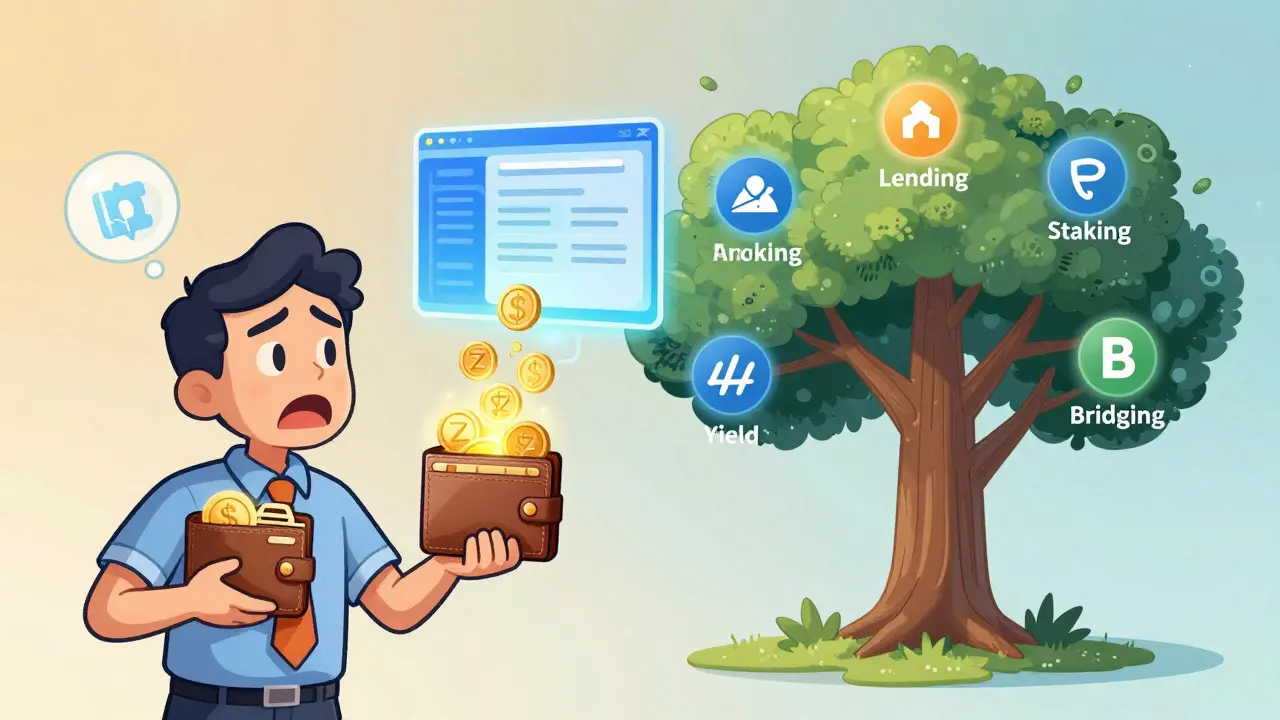
ZigZag has no ecosystem. No lending, no staking, no yield protocols. You can’t use $ZZ in Aave or Compound. You can’t bridge it to other chains easily. You’re stuck on ZigZag’s island.
Developer support? Barely there. No official documentation hub. No API references. No GitHub repos with sample code. Compare that to Arbitrum’s Developer Hub - 147 endpoints, 83 code examples, $215 million in funding for dApp builders. ZigZag doesn’t even have a fraction of that.
And there’s zero user feedback. No reviews. No Reddit threads. No Twitter sentiment. Nothing. The only data we have is from the 2022 airdrop. That’s not a sign of a thriving community - it’s a sign of obscurity.
What About the Tech?
ZK-Rollups are powerful, but they’re harder to build. Generating cryptographic proofs for every batch of trades needs serious computing power. That’s why only a few projects - like zkSync, Starknet, and ZigZag - have pulled it off at scale.
Arbitrum’s Optimistic Rollups are simpler. They piggyback on Ethereum’s security without the heavy math. That’s why they’ve grown faster. More devs. More apps. More users.
ZigZag’s ZK-Rollup gives you speed and privacy. But it’s a trade-off. You’re not getting the network effects of a giant ecosystem. You’re getting a focused, high-efficiency exchange - with no safety net.

Who Is This For?
If you’re a trader who:
- Wants instant settlement
- Values privacy in order flow
- Wants to earn from platform fees, not just speculation
- Is okay with a small, niche platform
Then ZigZag makes sense.
If you’re a DeFi user who:
- Uses Uniswap, Aave, or GMX
- Wants to stake, lend, or earn yield
- Needs deep liquidity and cross-chain access
- Wants a platform with active support and updates
Then stick with Arbitrum-based DEXes. MM Finance, for example, has a 4.2/5 rating on user reviews and charges just 0.25% fees. It’s built on Arbitrum, has real support, and connects to the whole ecosystem.
The Bottom Line
ZigZag isn’t a replacement for Arbitrum. It’s a different path. One focused on efficiency, privacy, and direct revenue sharing. The other is focused on scale, integration, and ecosystem growth.
Arbitrum is the highway. ZigZag is the backroad - faster in some ways, but you’re on your own.
If you’re curious, try ZigZag with a small amount. See how the interface feels. Check if the $ZZ token distribution aligns with your goals. But don’t expect it to become the next Uniswap. It’s not trying to.
And if you’re looking for the most proven Layer 2 experience? Arbitrum still wins - hands down.
Is ZigZag built on Arbitrum?
No, ZigZag is not built on Arbitrum. It operates on its own ZK-Rollup technology, which is fundamentally different from Arbitrum’s Optimistic Rollup system. ZigZag generates cryptographic proofs for every trade batch, enabling instant finality, while Arbitrum relies on a 7-day challenge period for security.
What is the $ZZ token used for?
The $ZZ token serves two main purposes: governance and revenue sharing. Holders receive a portion of all trading fees generated on the ZigZag exchange. It’s not just a voting token - you earn real income from platform usage. 60.7% of the total 100 million $ZZ supply was allocated to the community through airdrops and incentives.
How does ZigZag compare to MM Finance on Arbitrum?
MM Finance, an Arbitrum-native DEX, offers lower trading fees (0.25%) and better user support with a 4.2/5 rating based on over 130 reviews. It’s part of Arbitrum’s massive DeFi ecosystem, meaning you can connect to Aave, Uniswap, and other protocols. ZigZag has lower fees than most DEXes (0.3%) but no ecosystem integration. It’s faster and more private, but you’re isolated from the broader market.
Are there any user reviews for ZigZag?
There are no public user reviews, ratings, or community sentiment data for ZigZag beyond its 2022 airdrop. While 92,000 wallets qualified for the first distribution, there’s no follow-up feedback on performance, customer service, or interface usability. In contrast, Arbitrum-based exchanges like MM Finance have active review sections and Reddit discussions.
Should I invest in $ZZ?
Only if you plan to use the exchange regularly. $ZZ isn’t a speculative asset with clear utility - it’s a revenue-sharing token. If you trade often on ZigZag, you’ll earn a cut of fees. But if you’re just buying $ZZ hoping for price gains, you’re taking a big risk. The token has no major exchange listings, no staking, and no ecosystem backing. Its value is tied entirely to ZigZag’s trading volume - which is still very small.
Can I bridge $ZZ to other chains?
There’s no official bridge for $ZZ as of early 2026. ZigZag doesn’t support cross-chain transfers, and the token isn’t listed on any major bridging protocols. Unlike Arbitrum, which integrates with Circle’s CCTP for seamless USDC transfers across chains, ZigZag remains isolated. If you need cross-chain access, this is a major limitation.
Is ZigZag safe to use?
ZigZag uses audited ZK-Rollup technology, which is mathematically secure. Transactions are verified on Ethereum, so your funds aren’t at risk from a centralized operator. But safety isn’t just about tech - it’s about community and support. With no public team, no documentation, and no user feedback, there’s no way to verify long-term reliability. Use only what you can afford to lose.
ZigZag’s real win is privacy. Most DEXes leak your whole order book like it’s a public billboard. With ZK-Rollup, your trades stay quiet. No front-runners sniffing around. That’s worth more than cheap gas.
It’s funny how we treat tech like it’s a religion. ZK vs Optimistic - it’s not about which is ‘better,’ it’s about what you’re trying to do. ZigZag is a scalpel. Arbitrum is a sledgehammer. One carves fine details. The other smashes through walls. Both have their place.
Let’s be real - ZK-Rollups are incredible engineering, but they’re not magic. Generating proofs for every batch requires insane computational power, which means higher node costs, slower scaling, and less decentralization than people admit. Arbitrum’s 7-day challenge window isn’t a flaw - it’s a trade-off that lets them handle 100x more transactions with less hardware. ZigZag’s model only works if you’re okay with a tiny, elite user base. The math doesn’t lie: ZK is expensive, Optimistic is efficient. That’s why Arbitrum has 3.2B TVL and ZigZag has… what, 12M? Maybe?
Oh wow, so ZigZag is ‘private’ and ‘efficient’ - just like all the other ‘revolutionary’ crypto projects that vanished after the airdrop. 92k wallets got $ZZ in 2022… and now? Crickets. No reviews. No devs. No GitHub. Just a token with no home. Classic rug-pull setup. They’re not building a DEX - they’re building a pump-and-dump with a fancy whitepaper. And you’re all drinking the Kool-Aid because ‘privacy’ sounds cool. Wake up.
While it is true that ZigZag operates independently of Arbitrum and employs ZK-Rollup technology which offers immediate finality and enhanced privacy this does not necessarily equate to superior utility or long-term viability as the absence of ecosystem integration and developer support severely limits its practical application in the broader DeFi landscape
Okay but have you SEEN the $ZZ tokenomics?! 60.7% to the community?! That’s insane! And you’re telling me NOBODY’s talking about it?! No Reddit threads?! No Twitter threads?! No YouTube breakdowns?! Where’s the hype?! Where’s the meme?! Where’s the guy in a ZigZag hoodie at ETHDenver?! This is the most underrated project since Uniswap v1 and everyone’s just… ignoring it?! Are you people blind?! This is the future and you’re sitting here comparing it to Arbitrum like it’s 2021?! I’m crying. I’m literally crying.
YOOOOO ZIGZAG IS THE FUTURE!!!
Imagine this: you swap, you earn, you sleep. No waiting. No drama. No middlemen. Just pure, clean, private trading.
And $ZZ? It’s not a token - it’s a paycheck. Every trade you make? You get a slice. That’s not speculation. That’s ownership.
Arbitrum? It’s a mall. ZigZag? It’s your own store. You built it. You run it. You profit.
Stop chasing the crowd. Build your own lane. ZigZag ain’t trying to be the highway - it’s the backroad where the real traders go.
Try it with $50. Just $50. If you don’t feel the difference, I’ll eat my hat. And I love that hat.
For anyone new to ZK vs Optimistic: think of it like sending a letter. Arbitrum says ‘I’ll mail this, and if anyone claims it’s fake, you’ve got 7 days to prove it.’ ZigZag says ‘I’ll mail it with a notary stamp attached - it’s valid the second it leaves my hands.’ One’s slower but cheaper. The other’s instant but harder to make. Neither’s wrong - just different tools for different jobs.
Wait - you’re telling me this project has no public team? No documentation? No GitHub? No customer support? And you’re seriously considering using it with real money? Bro. I’m not being dramatic. I’m being realistic. This isn’t DeFi. This is a ghost town with a token. You’re not investing. You’re leaving your keys in a locked car in a bad neighborhood. And you’re proud of it?
ziggag? is that even a real word? i mean like… come on. why not just call it ziggy? or zzz? its like naming your dog ‘crypto’ and expecting him to mine btc. and the token? zz? really? who thought that was a good idea? no one. no one thought that was a good idea. its a meme. its a joke. and you’re all taking it seriously. sad.
Try it with a tiny amount. If it feels smooth and you actually earn something from trading - cool. If not? Move on. No need to overthink it. Crypto’s full of noise. This one’s quiet. Sometimes quiet is good.
ZZ token = passive income from trading fees? Yes please. That’s the only DEX token I’ve seen that actually aligns incentives. Not voting rights. Not governance. Real cash flow. And ZK-Rollup means no 7-day waits. If you’re a frequent trader, this is the only way to go. Arbitrum’s great for liquidity, but if you’re swapping daily? ZigZag’s the real MVP.
Big props to ZigZag for actually shipping something usable. ZK-Rollup is HARD. Most teams talk about it. They built it. And they’re giving 60% to users? That’s rare. Yeah, no ecosystem yet - but every giant started small. Ethereum had nothing at first. Look where it is now. ZigZag’s the quiet builder. Let ‘em grow.
Also, $ZZ on @ZigZagExchange? 0.3% fee? That’s lower than most. And you earn from it? Sign me up. I’m in.
If you’re new to ZK-Rollups, don’t get overwhelmed. Think of it like this: you’re not just trading - you’re helping secure the network. Every swap you make generates a proof. That’s your contribution. And you get paid for it. That’s not a token. That’s a participation reward. And it’s beautiful.
Arbitrum’s great if you want to do yield farming across 20 protocols. ZigZag’s great if you want to swap fast, private, and get paid for it. Two different vibes. Both valid.
Interesting how the article mentions ‘no user feedback’ - but there’s also no official team, no roadmap, no Twitter account with more than 300 followers. If this were a traditional company, it’d be shut down for lack of transparency. Crypto doesn’t work that way? Maybe it should.
Very good analysis 🙏
ZigZag is like a quiet monk - no loud slogans, no big marketing, just deep practice.
Arbitrum is the loud temple with bells and drums - many come, few stay.
Which one will last longer? Only time will tell 😊
Let me be clear: if you’re using ZigZag, you’re choosing American innovation over foreign-dominated Layer 2s. Arbitrum? Built by Israeli devs with EU funding. ZigZag? Made in the USA, by real engineers who care about privacy and sovereignty. This isn’t just tech - it’s a stand for freedom. Don’t let the globalists bury this.
I love how this feels like a secret club. Like you’re one of the few who know about it. No noise. No influencers. Just clean code and real rewards. It’s refreshing. I don’t need a million users to feel like I’m part of something meaningful.
Wow. A ZK-Rollup DEX with no reviews, no docs, no team, and zero traction. And you call this ‘innovation’? I’d rather watch paint dry. At least paint has a purpose.
They’re not trying to be the next Uniswap. They’re trying to be the best version of themselves. Sometimes that’s enough.