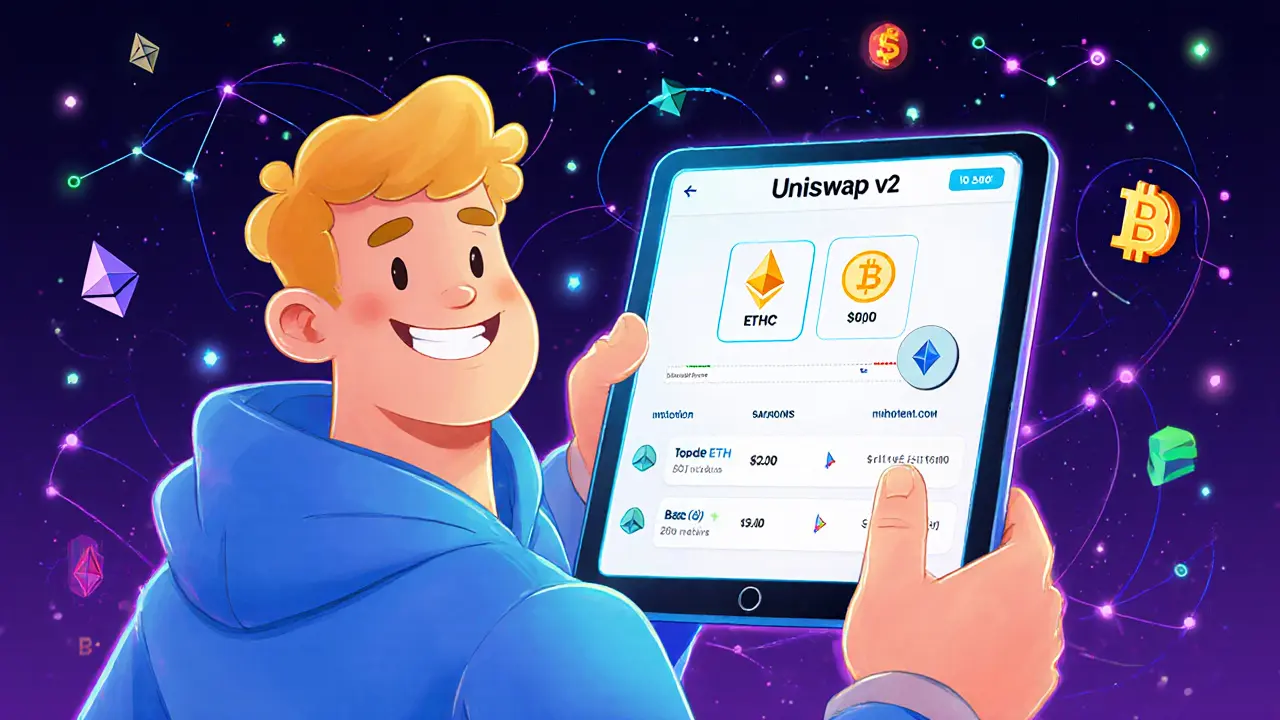
Uniswap Review: What You Need to Know About the Leading Decentralized Exchange
When you want to swap crypto without a middleman, Uniswap, a decentralized exchange built on Ethereum that lets users trade tokens directly from their wallets. Also known as Uniswap V3, it’s the most used decentralized exchange in crypto—handling billions in daily trades without a central company running it. Unlike traditional platforms like Coinbase or Binance, Uniswap doesn’t hold your money. You connect your wallet—MetaMask, Trust Wallet, or others—and trade peer-to-peer using smart contracts. No sign-up. No KYC. No customer support line. If something goes wrong, it’s on you. That’s the trade-off for control.
Uniswap works through liquidity pools, collections of token pairs funded by users who earn fees when others trade against them. Instead of matching buyers and sellers, it uses a math formula (x * y = k) to set prices automatically. The more people add to a pool, the tighter the spread. The less liquidity, the wilder the price swings. That’s why some small tokens on Uniswap can drop 50% in minutes—there’s not enough money in the pool to absorb big trades. And while Uniswap itself is secure, the tokens you trade? Not all of them are. You’ll find legit projects like ETH and USDC next to ghost tokens with zero trading volume, like CherrySwap or Isabelle (BELLE), which appear in our data as dead projects with no users.
Uniswap’s fees are low—0.05% to 1% depending on the pool—but you also pay Ethereum gas fees. During busy times, those can hit $20 or more per swap. That’s why many traders use layer-2 networks like Arbitrum or Polygon to access Uniswap clones with cheaper costs. If you’re new, stick to major pairs: ETH/USDC or ETH/DAI. Avoid random tokens with names you’ve never heard of. Check trading volume. Look for audits. If a token has no volume and no website, it’s probably a rug pull.
Uniswap isn’t the only option. Platforms like PartySwap, a multi-chain DEX that lets you swap across Ethereum, Avalanche, and Polygon without bridging. offer similar tools but with more network choices. Others, like SushiSwap or Curve, focus on stablecoin swaps or yield farming. But Uniswap remains the default—because it’s simple, open, and has been around since 2018. It’s not perfect. It’s not safe for everyone. But if you understand how it works, it’s one of the most powerful tools in DeFi.
Below, you’ll find real reviews of exchanges and tokens—some alive, some dead. You’ll see what works, what doesn’t, and what to avoid. No fluff. No hype. Just what the data shows.
Uniswap v2 on Base is a simple, reliable decentralized exchange for swapping crypto tokens without intermediaries. With low fees and broad token support, it’s still the best choice for beginners and experienced traders alike in 2025.