Advantages and Disadvantages of Public Blockchains Explained
Public blockchains offer transparency and decentralization but struggle with speed, cost, and privacy. Bitcoin and Ethereum show both the power and limits of permissionless ledgers.

When you hear Bitcoin blockchain, a public, immutable digital ledger that records every Bitcoin transaction since 2009. Also known as the original blockchain, it’s not just a tech novelty—it’s the first working example of trust without banks. Every time someone sends Bitcoin, that transaction gets bundled with others into a block, verified by miners, and added to the chain. Once there, it can’t be changed. No central authority controls it. No single company owns it. It runs on thousands of computers around the world—mostly in places like the U.S., Kazakhstan, and Russia—keeping the network alive even if half of them go offline.
This system doesn’t just handle Bitcoin. It set the blueprint for every other cryptocurrency that came after. The blockchain technology, a distributed system where data is stored across many nodes and secured with cryptography behind Bitcoin is now used in supply chains, voting systems, and even land registries. But Bitcoin’s version is still the most battle-tested. It’s been running nonstop since 2009, surviving hacks, bans, crashes, and hype cycles. Its security comes from proof-of-work: miners compete to solve complex math puzzles using powerful hardware, and the winner gets rewarded in new Bitcoin. That’s also why energy use is a big debate—countries like Norway now block new mining centers because they’d rather use their clean power for factories than digital gambling.
People often confuse the Bitcoin blockchain, the underlying network that records transactions. Also known as the Bitcoin network with Bitcoin the coin. The coin is just one thing you can move on the chain. The chain itself is the real innovation. It’s what lets you send value across borders without PayPal, banks, or wire transfers. That’s why it’s used in places like Egypt and Iran, where people turn to crypto to escape inflation or government control—even when it’s illegal. The blockchain doesn’t care about borders or laws. It just records what happens.
What you’ll find below isn’t just a list of articles. It’s a real-world look at how this technology plays out in practice. From mining bans in Norway to shady memecoins built on Solana, from dead exchanges with $94 in daily volume to tax traps for U.S. citizens holding crypto overseas—every post here ties back to the same core idea: the Bitcoin blockchain didn’t just create a new currency. It created a new way to organize trust. And now, everyone’s trying to use it, abuse it, or shut it down.
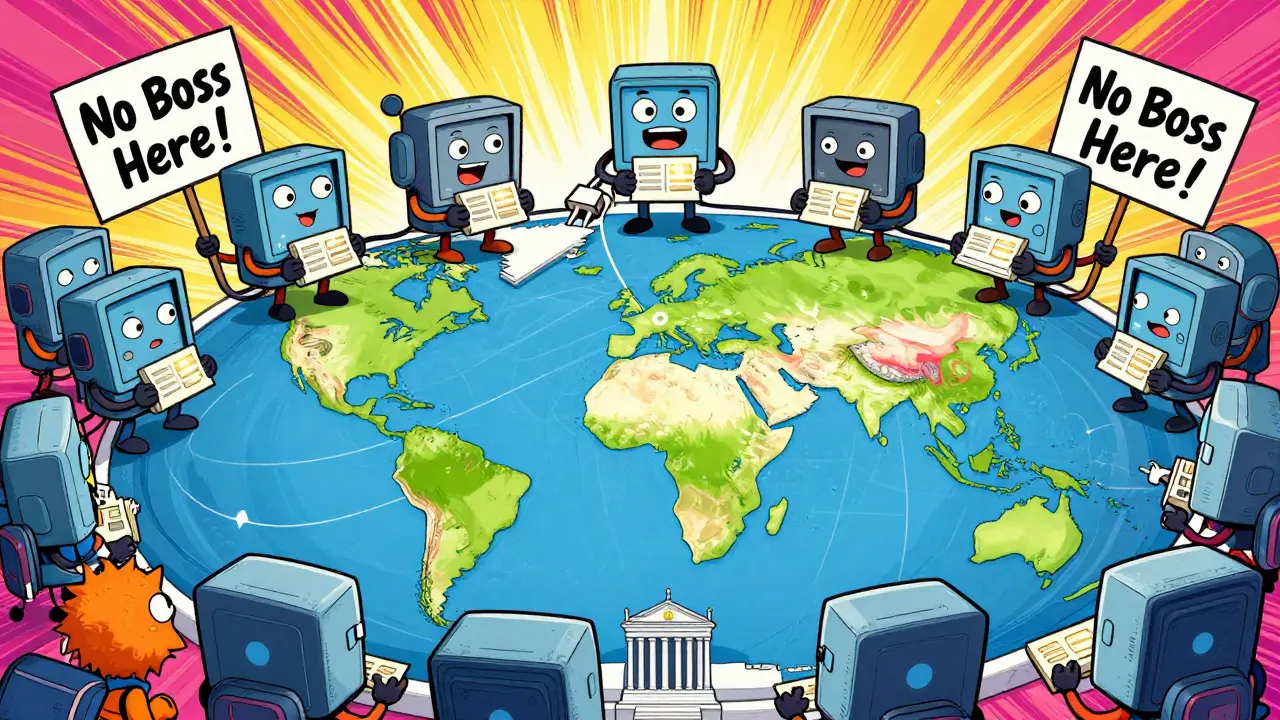
Public blockchains offer transparency and decentralization but struggle with speed, cost, and privacy. Bitcoin and Ethereum show both the power and limits of permissionless ledgers.